
Let’s try to understand what the real story is.
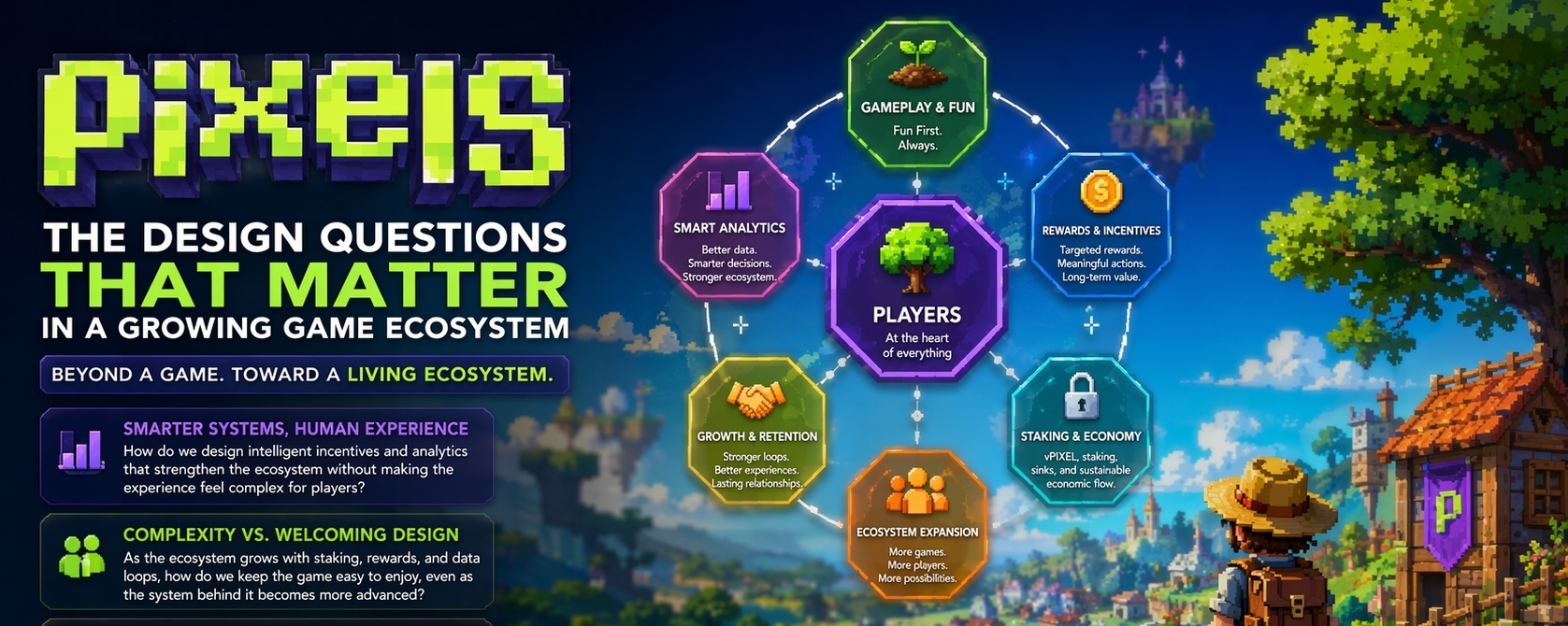
Whenever I look at a project that is trying to improve incentives, I feel like the real challenge is always bigger than it first appears. That is how Pixels feels to me. On the surface, it is easy to describe it as a social farming game. But the more I look at how the project explains itself, the more it feels like Pixels is trying to build something wider than a single game loop. It is trying to bring together fun, rewards, growth, staking, and player behavior in a way that can keep expanding over time. And when a project reaches for something that broad, I think it naturally invites more thoughtful questions.
Not negative questions. Just real ones.
One of the first things I think about is what happens when a game moves beyond a simple reward system and starts building something more intelligent underneath. Pixels talks about using better analytics and smarter reward design to guide incentives toward players and actions that support stronger long-term value. In many ways, that feels more thoughtful than broad, untargeted rewards. It suggests the team understands that not every action inside a game supports the ecosystem in the same way. But once a system becomes more precise, another question appears almost immediately: how do you keep that precision easy for regular players to live with? The more advanced a system becomes behind the scenes, the more important it becomes for the player experience to still feel clear and natural.
I also keep thinking about complexity.
Pixels is not only describing a small in-game economy. It is describing something much larger: staking, user acquisition credits, reward distribution, player behavior, revenue, and data that feeds back into future growth. That is a big idea. It is also part of what makes the project interesting. But big systems always have to solve the same quiet problem: how do you stay welcoming while becoming more layered? Most players may enjoy farming, progression, and social play without wanting to think too much about the machinery underneath. So to me, one of the most important design questions for Pixels is not simply whether the system is smart. It is whether that smartness can stay in the background enough for the game to still feel light and approachable.
Another thing I find myself noticing is the balance between measurement and genuine experience.
Pixels puts “Fun First” at the center of its direction, and I think that matters a lot. It suggests the team understands that incentives alone cannot carry a game. At the same time, the project is also building a data loop designed to improve rewards, retention, and user acquisition. That makes sense from a systems point of view. But it also creates a very human question: when a project gets better at measuring behavior, how does it make sure players still feel like people inside a world rather than users inside a framework? I do not ask that because I think the project is doing something wrong. I ask it because the strongest systems usually know that design is not only about better targeting. It is also about protecting the emotional side of the experience.
I think a similar kind of thoughtful question applies to sustainability.
Pixels has already shown that it is willing to revisit and improve its earlier designs. Its materials talk openly about refining reward structures, improving economic loops, and building stronger connections between gameplay, retention, and participation. It has introduced ideas like smarter reward flows, vPIXEL as a spend-focused token, stronger sinks, and a broader staking model that connects games more closely to the ecosystem itself. To me, that shows movement, not stagnation. But it also means the project is still in the process of shaping something ambitious. And whenever a system wants to become more durable over time, the natural question is how those designs continue to feel as the ecosystem grows larger, adds more players, and becomes more active.
That is probably why Pixels feels more interesting to me as an evolving framework than as a finished answer.
There is clearly a farming game on the surface. That part is real. But underneath it, there is a bigger effort taking shape around growth, retention, incentives, and ecosystem coordination. And when I look at projects like that, I do not think the right response is easy praise or easy dismissal. I think the better response is attention. Careful attention. Because the most interesting systems are often the ones that become clearer through better questions, not louder opinions.
That is how Pixels feels to me.
It feels like a project that is trying to build something larger than a single game, and for that reason, it deserves to be looked at with patience. Serious designs usually do. The more thoughtful the system becomes, the more valuable thoughtful questions become too.