

I keep coming back to the same question: what does staking really mean in a game ecosystem if it does not force anyone to make a real judgment?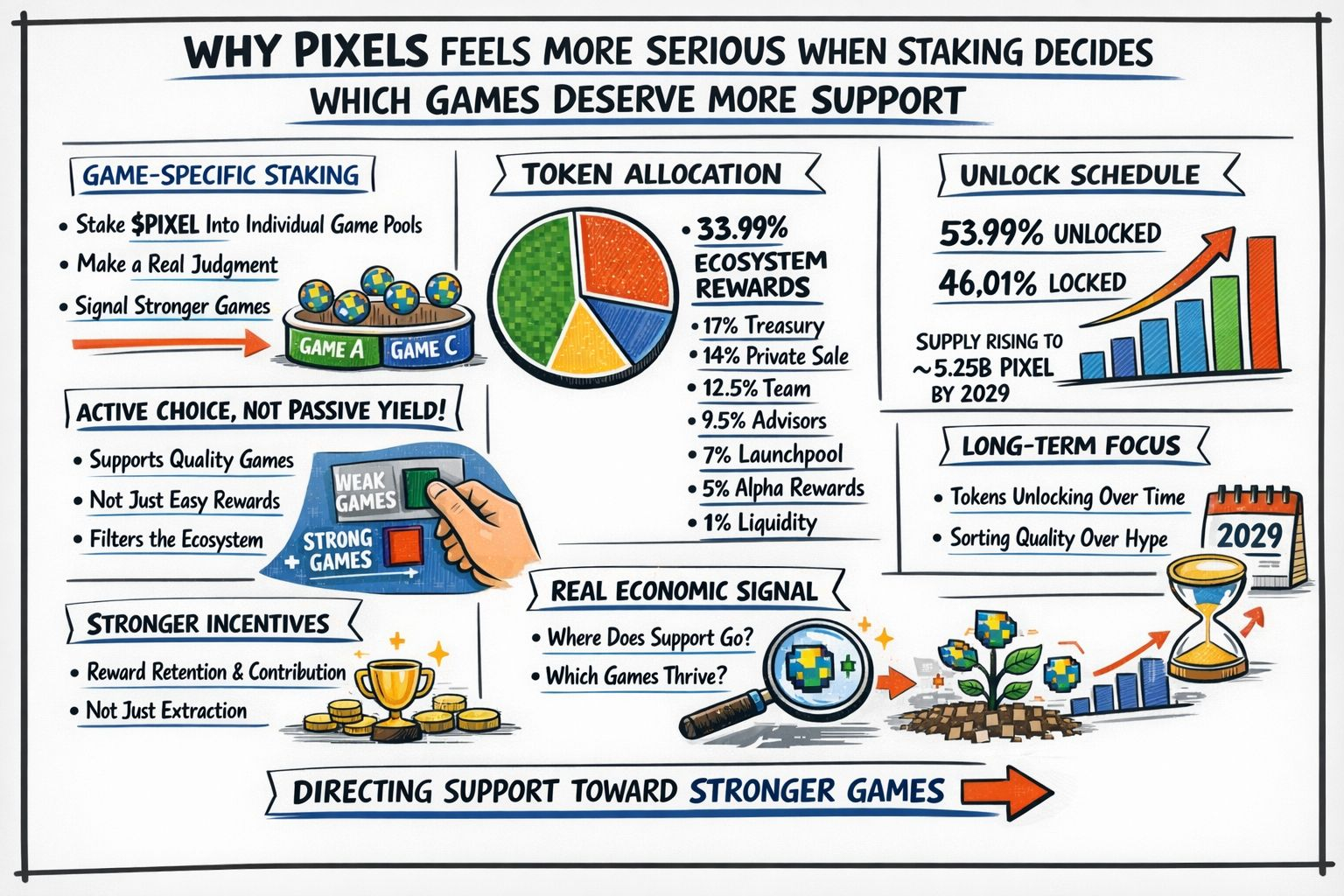
That is usually where my interest starts fading. In a lot of projects, staking feels like passive yield with better branding. Tokens get locked, rewards get distributed, dashboards stay busy, and the whole system looks active without really proving much. It does not clearly tell me which games are actually strong. It does not tell me whether users believe in the ecosystem or are just following emissions. Most of the time, it only shows that capital goes where participation is easiest.
That is why Pixels made me stop a little longer here.
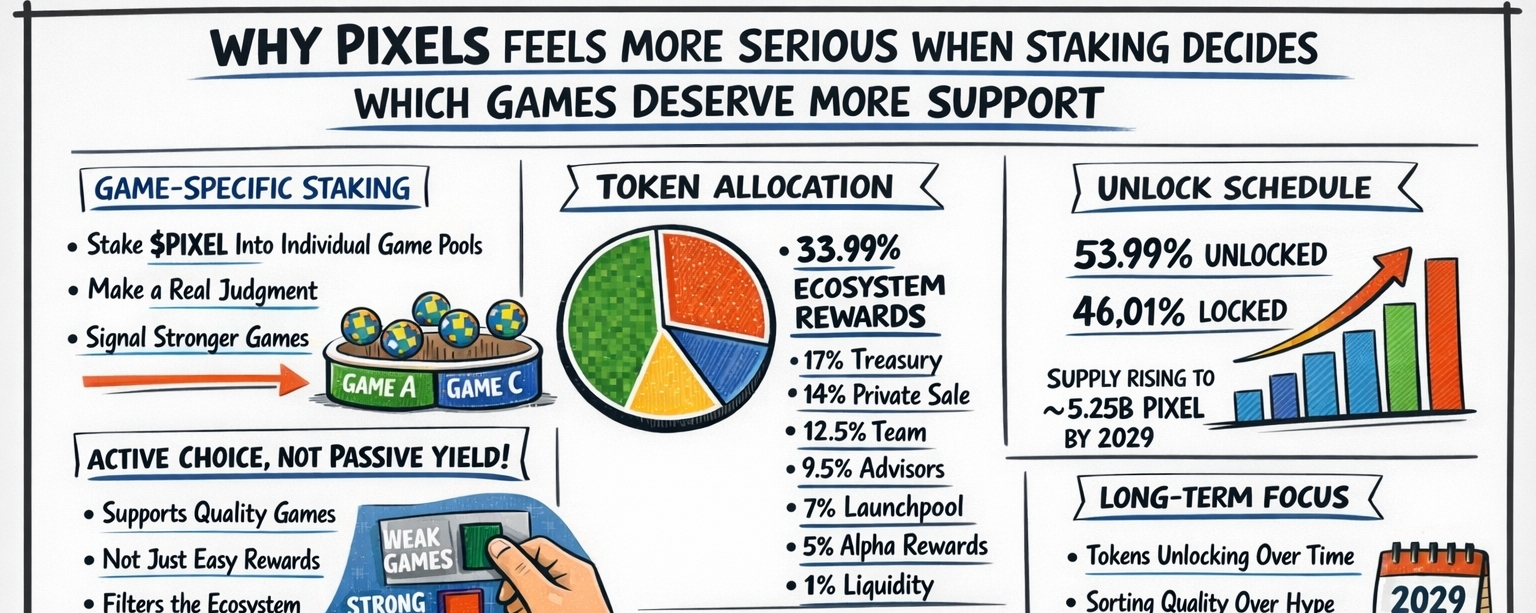
What genuinely caught my attention is that staking is tied to individual game pools instead of one generic bucket. So when someone stakes $PIXEL, they are not only asking where yield comes from. They are also making a choice about which game deserves support. That changes the meaning of staking for me. The action starts carrying judgment. Not loud governance theater, just a quiet economic signal about which part of the ecosystem is actually worth backing.
I think that matters more than it first sounds.
A lot of game economies do not fail because they lacked users, tokens, or incentives. They fail because they stayed too neutral about weak behavior. They rewarded activity without asking whether that activity was healthy, durable, or useful. A system can look alive while still training people to extract value and leave. I have seen that pattern too many times to get excited by raw activity alone.
From my perspective, Pixels becomes more interesting because staking is being used as a filter.
If the amount of $PIXEL staked into each game pool helps shape future ecosystem incentives, then support is no longer fully automatic. Games have to attract conviction. Stronger games and weaker games should not keep receiving the same attention forever. At some point, the system has to separate what is actually retaining players and generating better behavior from what is simply present.
That is where the token structure becomes important.
The allocation is not random. The biggest share, 33.99%, goes to Ecosystem Rewards. Treasury holds 17%. Private Sale takes 14%. Team has 12.50%. Advisors hold 9.50%. Binance Launchpool has 7%. Alpha Rewards gets 5%, and Liquidity is only 1%. To me, that already says the quality of incentive routing matters a lot. When the largest bucket is ecosystem rewards, the real question is not just how much gets emitted, but whether emissions are reaching the right places.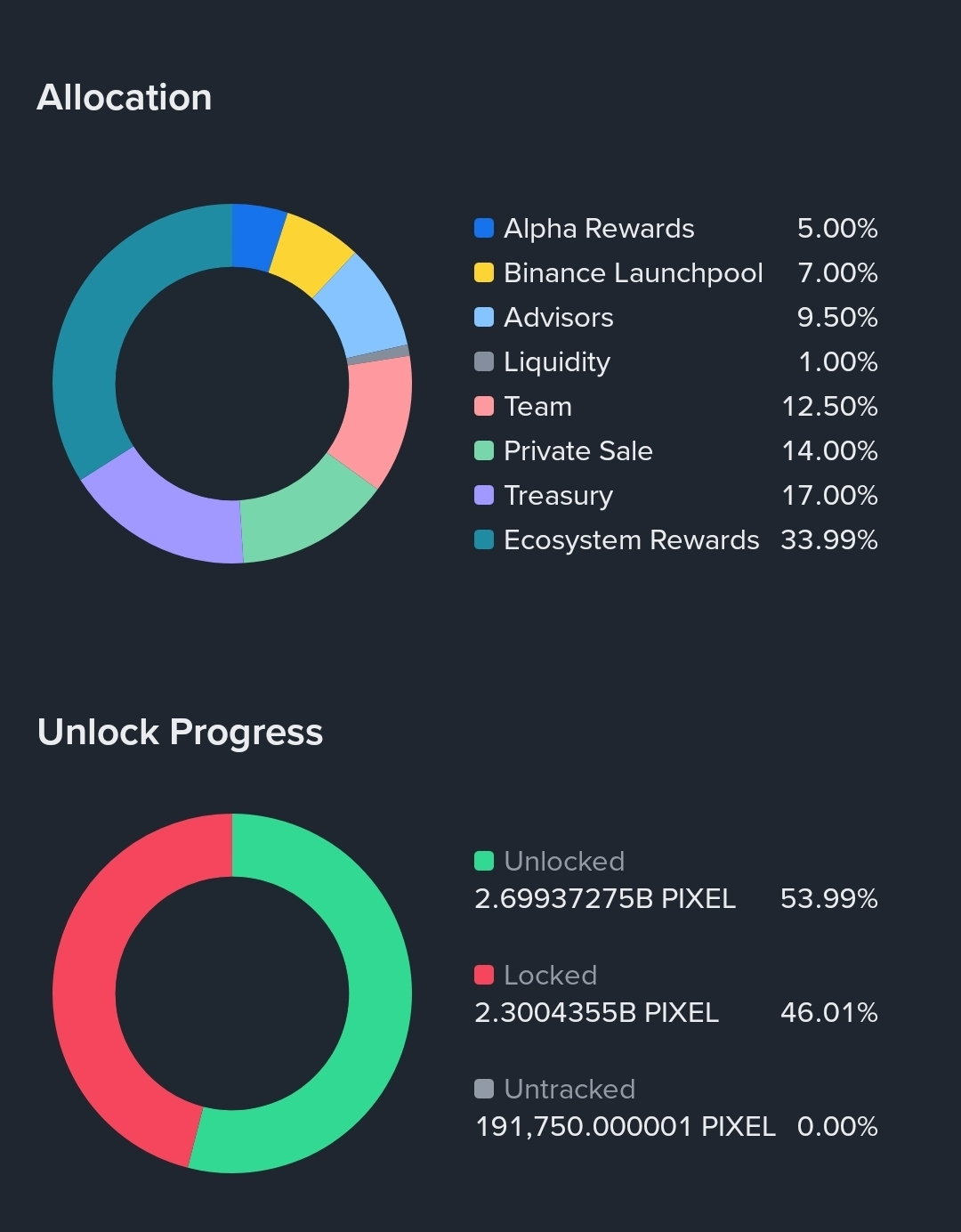
That is exactly why the staking design matters.
If almost a third of supply is reserved for ecosystem rewards, then Pixels cannot afford to distribute support blindly. A large rewards bucket only becomes constructive when the system has some way to distinguish between games that deepen the network and games that simply absorb rewards. So when staking works through game-specific pools, I do not see that as a side feature. I see it as an attempt to make a large rewards allocation more selective.
The unlock picture adds another layer. Around 2.699B PIXEL, or 53.99% of supply, is already unlocked, while about 2.300B PIXEL, or 46.01%, remains locked. That tells me the token is no longer in the early mystery phase, but it is also not fully settled. It is in the middle stage where enough supply is already circulating to shape real behavior, while a large amount is still scheduled to come out over time. That is usually the phase where mechanism quality matters more, because weak systems become harder to hide once unlock pressure keeps moving.
And this schedule keeps moving for years.
The chart extends toward 2029, with supply rising toward roughly 5.25B PIXEL. By 2025-04-19, several buckets had already reached meaningful size: 417.945M PIXEL for Ecosystem Rewards, 350M for Binance Launchpool, 260.2275M for Treasury, 250M for Alpha Rewards, 191.349M for Advisors, 56.763M for Private Sale, 50.68125M for Team, and 50M for Liquidity. Even just looking at those figures, my takeaway is simple: distribution quality matters more here than narrative quality.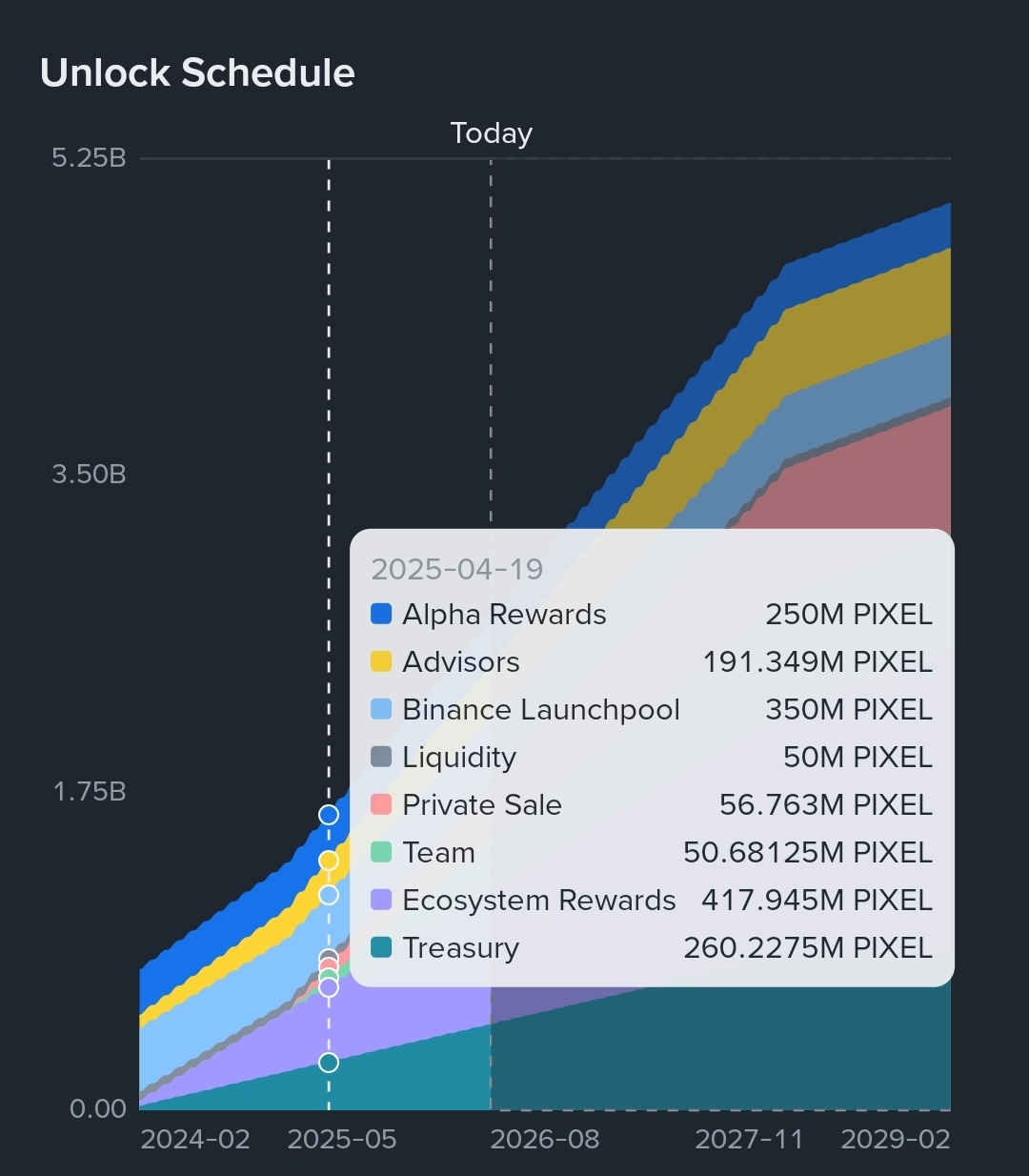
That is why I do not read Pixels as just another farming game with a token attached.
The more I look at this setup, the more it feels like an economy design experiment where incentives, unlocking, and internal competition are meant to interact. Staking helps decide which games deserve more backing. Games compete to attract that backing by proving retention, spending quality, and ecosystem contribution. Meanwhile, the broader token structure keeps releasing supply over time, so the system cannot rely on novelty forever. It has to rely on better sorting.
I also had my own small trading reminder of how active this market can be. I closed a PIXELUSDT perpetual move from 0.007496 to 0.007476 for an 8.34% gain. I do not treat that as the main story, though. For me, that kind of profit is short-term noise unless the underlying ecosystem can show that its token structure is directing support in a smarter way over time.
That is why my interest in Pixels is less about one trade and more about the logic underneath the system. I get more interested when a token stops acting like a passive reward machine and starts forcing an ecosystem to reveal what it actually values. In Pixels, the combination of a large ecosystem rewards bucket, a long unlock schedule, and game-specific staking pools all point to the same question: can this ecosystem direct more support toward the games that genuinely strengthen it?
That is the part that feels more serious to me.