

I was scrolling late again, kind of tired of seeing the same recycled crypto takes over and over. Every post feels like a copy of the last one. AI agents, modular chains, “next big thing,” “mass adoption is here.” It’s always “here,” but somehow never actually here in real life.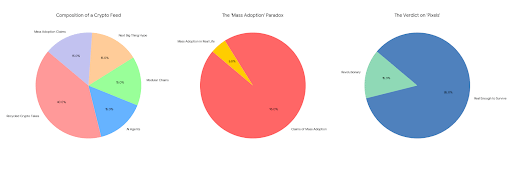
Then I randomly started looking into Pixels. Not because I expected anything special, but more like… I just wanted to see if something—anything—felt different for once.
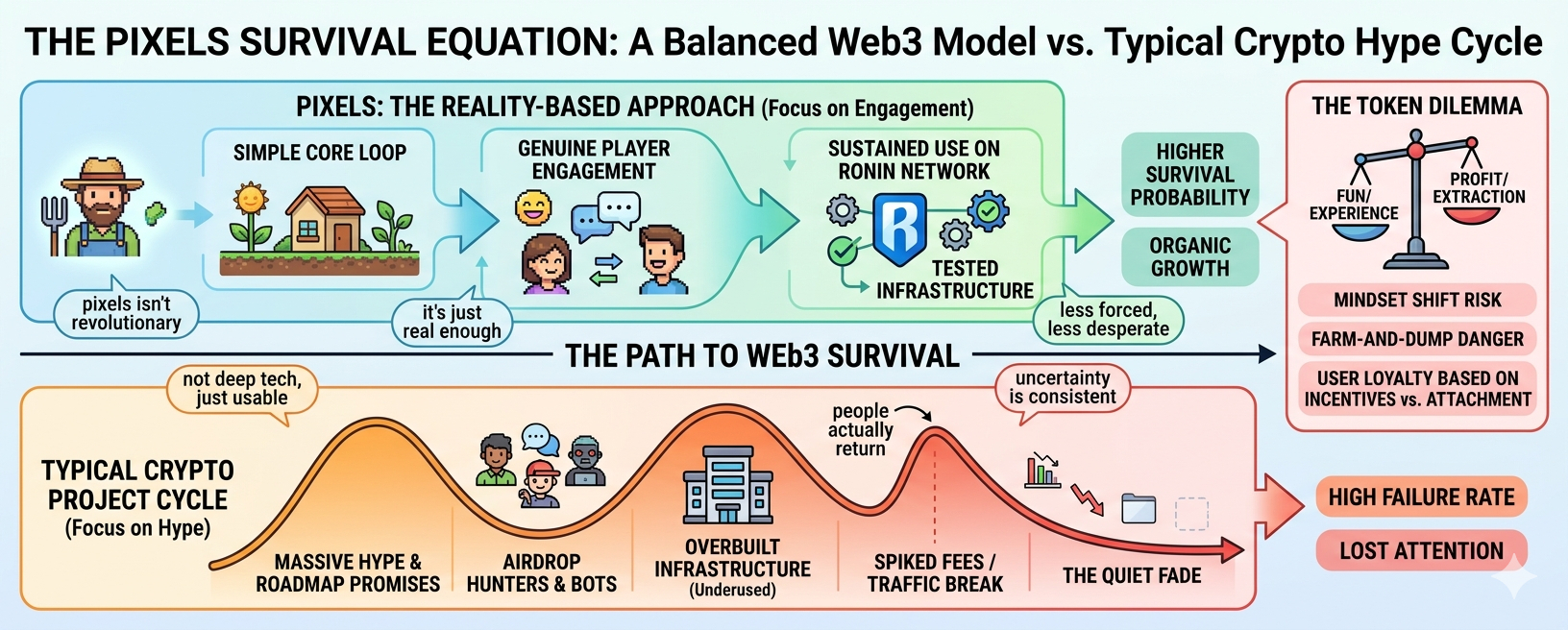
At first glance, it honestly looks too simple. Just farming, walking around, collecting stuff. No flashy promises, no overcomplicated mechanics. The kind of game you’d normally ignore. And maybe that’s exactly why it works a little better than most things in this space.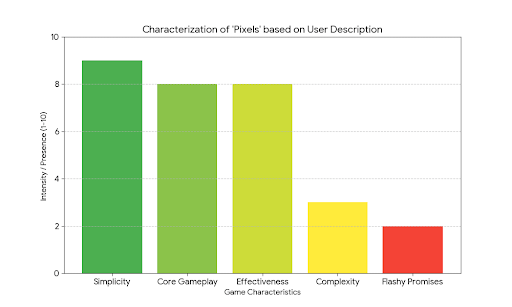
Because right now, crypto is full of projects trying too hard.
Everything is overbuilt, overexplained, and underused. Teams talk about infrastructure like they’re solving global problems, but when you actually look at user activity, it’s mostly empty. Or worse—bots and airdrop hunters pretending to be users.
Pixels doesn’t come in with that energy. It’s just… there.
And weirdly, people are actually playing it.
Not just clicking once for rewards and leaving, but coming back. That’s rare. Like genuinely rare in Web3. Most games don’t fail because they’re bad ideas—they fail because nobody sticks around long enough to care.
Part of this probably comes from being on the Ronin network. It’s not perfect, but it’s been through real usage before. And that matters more than all these theoretical performance claims we keep hearing about. A chain doesn’t prove itself in whitepapers—it proves itself when real users show up and start stressing it.
And that’s something people underestimate.
A lot of “advanced” ecosystems look great until actual traffic hits. Then everything slows down, fees spike, and suddenly the experience breaks. Not because the tech was fake, but because it wasn’t tested properly.
Pixels, at least for now, seems to be handling real activity better than most.
But then comes the complicated part—the token.
Of course there’s a token. There’s always a token.
And this is where things usually start going wrong.
Because the moment people stop playing for fun and start playing for profit, everything changes. The mindset shifts. It becomes less about the experience and more about extracting value.
And I’ve seen this pattern too many times.
People come in early, farm rewards, optimize everything, and once the rewards slow down or prices drop, they leave. Just like that. No loyalty, no attachment.
Pixels is kind of standing in the middle of that right now.
On one side, you have genuine players who seem to enjoy the game. On the other side, you’ve got people already thinking, “How do I maximize this?”
That question alone can slowly kill a game if it takes over.
Still, I can’t ignore that Pixels is doing something most projects fail to do—it’s keeping people engaged. Not through hype, not through complicated narratives, just through something simple that people actually return to.
And maybe that’s the real difference.
Not better graphics. Not deeper tech. Just… something that people don’t mind opening again the next day.
But even then, nothing in crypto is that stable.
Liquidity is always fragile. If the token starts dropping, sentiment changes fast. The same people praising it today will turn negative tomorrow. That’s just how this space works.
And users? Even worse.
Crypto users are not loyal. They follow incentives. If something new pops up with better rewards or stronger hype, they move instantly. No second thought.
So the real challenge isn’t growth—it’s staying relevant when the hype fades.
Pixels is still growing, still evolving. There are updates, improvements, attempts to make the game deeper and more sustainable. That’s a good sign. But I’ve learned not to trust roadmaps too much. Plans are easy. Execution over time is what matters.
I’m not overly bullish. I’m not bearish either.
I’m just watching.
Because right now, Pixels feels like one of those rare experiments where something might actually work—not in a massive, “this will change everything” way—but in a smaller, more real way.
Like… maybe it just becomes something people actually use.
And honestly, that alone would be enough.
But I’ve also been around long enough to know how this usually ends.
Excitement slows down. Rewards normalize. New projects steal attention. And slowly, people stop showing up—not because anything broke, but because nothing pulled them back.
That quiet fade is what kills most projects.
So yeah, Pixels is interesting.
It feels more real than most things right now. Less forced. Less desperate.
But in crypto, that doesn’t guarantee anything.
Maybe it keeps growing.
Maybe it finds a balance between fun and incentives.
Or maybe it just becomes another name we mention later when we talk about things that almost worked.
I don’t know.
And honestly, that uncertainty is the only thing in crypto that actually feels consistent.
It might work.
Or one day, people just stop logging in.