

I’ve been studying Pixels closely, not just from the outside, but from how it actually feels to play over time. And the more I dig into it, the more I realize something most people sense but rarely say clearly:
Land NFTs haven’t just created advantage… they’ve quietly redefined who the game is really for.
At a surface level, Pixels looks like a success story. It scaled faster than almost any Web3 game. At one point, it crossed 1 million daily active users, onboarded millions of wallets, and became the go-to example of “mass adoption” in blockchain gaming.
But numbers can be misleading.
Because what matters isn’t just how many players enter the system.
It’s how many can actually build momentum inside it.
When I look at Pixels today, I don’t see a single unified player experience.
I see two completely different games running in parallel.
One for players who own land.
And one for players who don’t.
That difference isn’t cosmetic—it’s foundational.
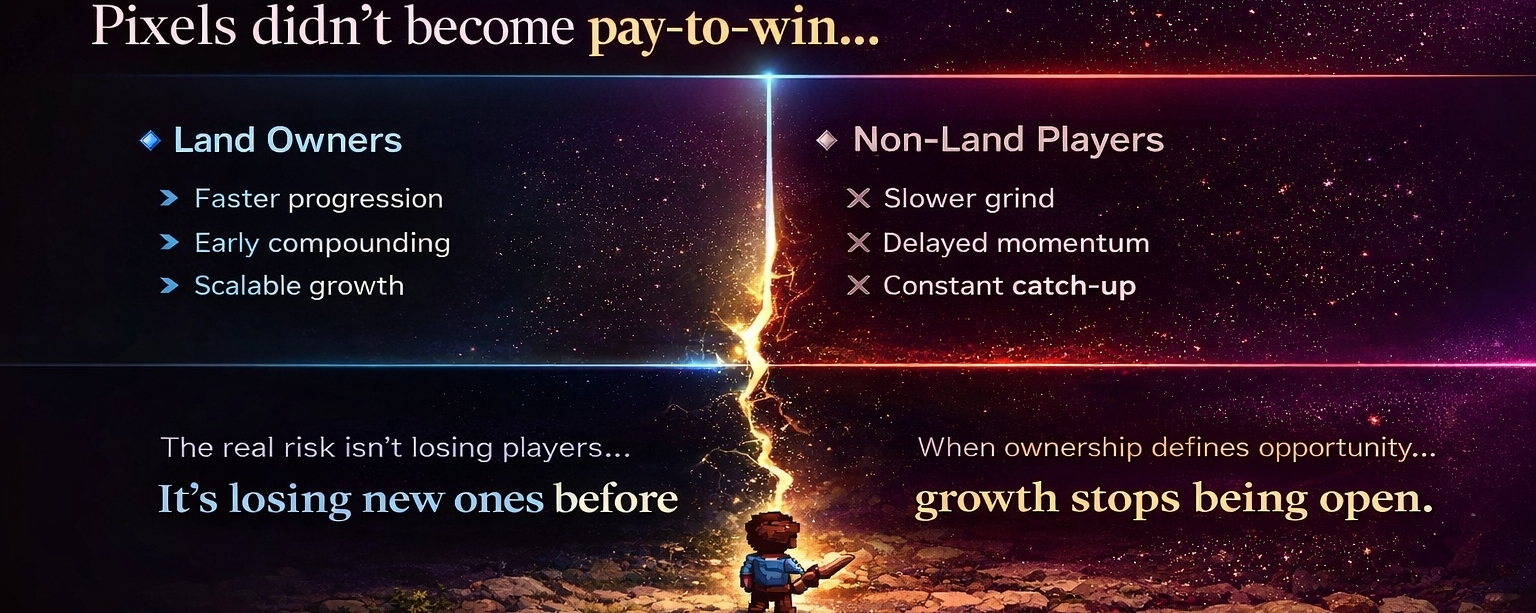
Land owners operate in a version of the game where:
Resource generation is faster and more consistent
Progression feels smooth and scalable
Opportunities to reinvest come earlier
Small advantages compound into larger ones
Non-land players exist in a different loop entirely:
Slower earnings
Longer grind cycles
Limited ability to scale
Constant pressure to “catch up”
And over time, that gap doesn’t just remain—it widens.
The uncomfortable truth is this:
Land in Pixels functions like a hidden premium tier.
It’s not labeled as one. You’re not forced to buy it. The game remains technically “free-to-play.”
But in practice, land ownership changes your trajectory so significantly that not having it starts to feel like playing a restricted version of the game.
That’s where the problem begins.
What makes this especially important is timing.
Early players entered Pixels when the system was still forming. Land was more accessible, competition was lower, and the economy hadn’t fully optimized yet.
Today, new players are entering a completely different environment.
They’re stepping into:
A mature economy where efficient strategies are already known
A player base that has already positioned itself advantageously
A system where the most valuable assets are already distributed
In simple terms:
They’re late to a game where early positioning matters more than skill.
This creates a psychological barrier that’s easy to overlook but incredibly powerful.
New players don’t leave immediately. They explore, they grind, they try to understand the system.
But then something happens.
They start comparing.
They notice others progressing faster. Earning more. Scaling quicker.
At first, it feels like a skill gap.
Then slowly, it becomes clear it’s an ownership gap.
And that realization changes everything.
Because the moment a player thinks:
“I can’t realistically compete without investing”
The experience shifts from opportunity to limitation.
To be fair, land NFTs aren’t inherently flawed.
They do exactly what they’re supposed to do:
Reward early believers
Anchor value in the ecosystem
Create long-term incentives
Drive market activity
From a design perspective, this is logical.
But design doesn’t exist in isolation.
It interacts with player behavior.
And in Pixels, that interaction is starting to reveal a deeper issue.
The core problem isn’t just that land gives advantages.
It’s that those advantages compound over time.
Land owners don’t just earn more—they accelerate faster.
They reinvest sooner. Optimize earlier. Expand more efficiently.
Meanwhile, non-land players move forward—but at a slower, linear pace.
So what you end up with is a system where:
One group compounds
The other struggles to keep up
And the longer this continues, the harder it becomes for new players to meaningfully integrate into the economy.
I’ve also noticed a subtle shift in how people approach the game.
Earlier, the main question was:
“How do I play this efficiently?”
Now, it’s increasingly becoming:
“How do I get land?”
That shift is not small.
It signals that success is no longer perceived as gameplay-driven—but asset-driven.
And when that happens, the identity of the game begins to change.
It stops being a game where skill and time lead to progress.
And starts becoming a system where ownership defines opportunity.
Does this mean Pixels is failing?
No.
In many ways, it’s one of the most important experiments in Web3 gaming.
It proved that:
Incentives can drive massive growth
Onboarding friction can be reduced
Player-owned economies can scale
But it also revealed something equally important:
Growth built on advantages must eventually face the consequences of those advantages compounding.
Over time, this creates pressure on the system:
New players churn faster because they feel behind
Retention depends more on rewards than enjoyment
The economy becomes harder to balance
Organic growth slows as accessibility declines
And eventually, the system reaches a point where it needs to choose:
Continue rewarding early ownership…
or rebalance for new player inclusion.
That’s the real tension Pixels is navigating right now.
Not growth vs decline.
But ownership vs accessibility.
Because if new players feel like they can’t realistically progress without upfront investment, then the barrier isn’t just economic—it’s experiential.
And once a game starts feeling closed instead of open, growth doesn’t just slow.
It quietly stalls.
Pixels didn’t make a mistake.
If anything, it executed its vision too effectively.
It built a system where ownership truly matters.
But now it’s facing the natural side effect of that success:
When early advantages compound too far, they stop being incentives… and start becoming barriers.
And if that balance isn’t carefully adjusted, the biggest risk isn’t losing current players.
It’s losing the next wave of players before they ever fully arrive.