
Most people think play-to-earn games are just about making quick money and that they never last long. They see hype cycles rise and fall and assume the model itself doesn’t work. But Pixels is trying a different direction. Instead of focusing on fast speculation,,,,
it aims to build a long term gaming ecosystem where fun gameplay comes first and blockchain ownership is added in a meaningful, balanced way.
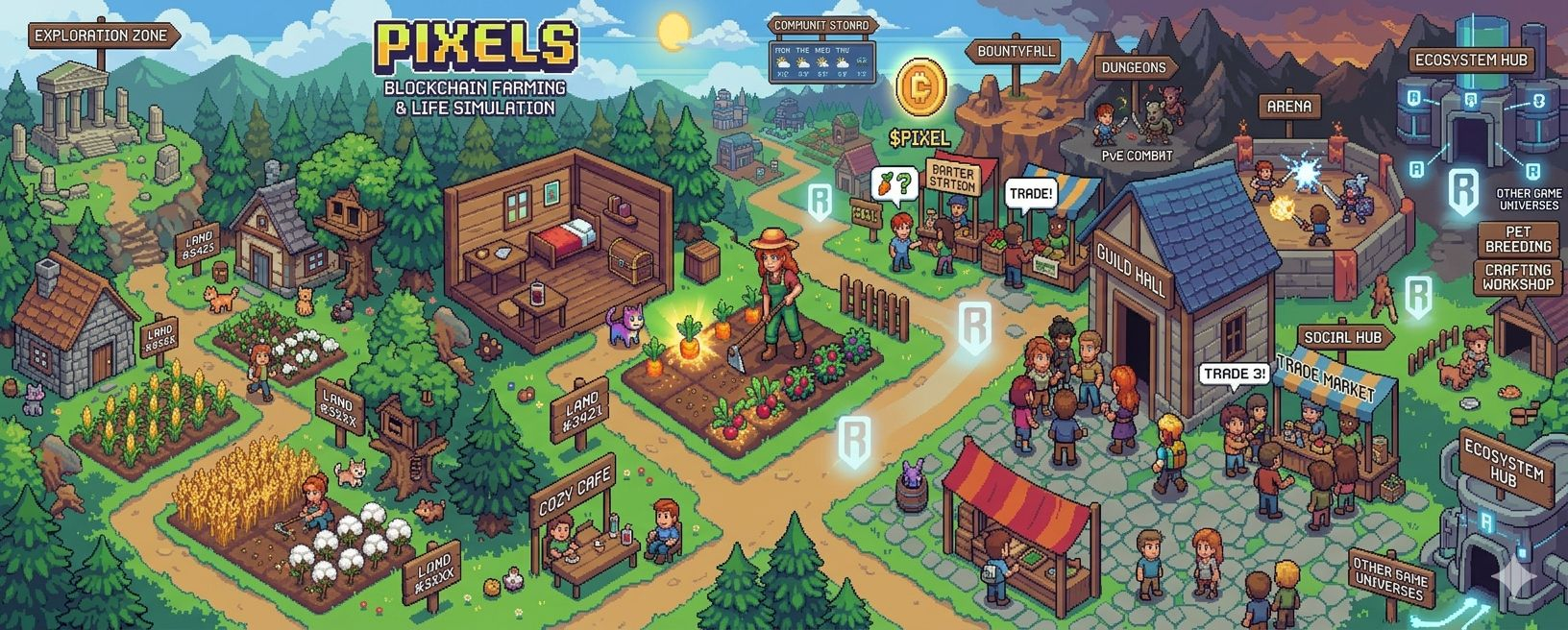
The project has been developing slowly and carefully. The team didn’t rush with big promises or hype marketing. Instead, they focused on building a game that feels enjoyable on its own. Only after that did they introduce ownership systems and token rewards. Pixels is an open world pixel style farming and life simulation game where players grow crops, craft items, complete quests, and interact with others in a shared environment. It runs on the Ronin blockchain, which keeps transactions fast and low-cost so players don’t feel friction while playing.
At its core, the gameplay is simple and relaxing. You start with basic tools and a small piece of land. You plant seeds, water crops, harvest them, and sell produce. As you progress, you improve skills like farming, crafting, and exploration. You also interact with other players, join communities, and collaborate on larger activities. It has a cozy feel similar to games like Stardew Valley, but the key difference is that you are playing in a shared online world with real time interaction.
What makes Pixels different is ownership. Land, items, and progress are linked to blockchain based assets, meaning players actually own what they create. This gives long-term value to in game effort. Instead of everything being controlled by a central server, your achievements and items remain tied to you.
The biggest challenge in earlier play-to-earn games was economic imbalance. Most projects rewarded players heavily with tokens to attract users quickly. This created short-term farming behavior where players joined only to earn rewards, sold everything immediately, and left. As a result, token prices dropped and player bases collapsed. The systems were built around extraction rather than sustainable value creation.
Pixels tries to fix this by redesigning its economy. The main token, $PIXEL, is not just a reward currency. It is used inside the game for real utility. Players spend it on VIP access, energy boosts, crafting advanced items, joining guilds, and minting NFTs. This creates constant demand from actual gameplay instead of pure speculation.
At the same time, basic in game transactions are handled using a separate off chain currency called BERRY. This reduces pressure on $PIXEL and prevents it from being overused for small actions. It also keeps everyday gameplay smooth and affordable while preserving the value of the main token.
Staking $PIXEL adds another layer to the system. Players who stake can earn rewards and unlock in game benefits or governance participation. This encourages long-term holding and engagement instead of quick selling. It also helps reduce fake accounts and short-term farming behavior because rewards are tied to real participation.
A major innovation in the ecosystem is the Stacked system. It distributes rewards based on meaningful contributions rather than simple repetitive actions.
Players can earn by creating content, helping new users, participating in events, or supporting the community... This shifts the focus from mindless farming to active participation and ecosystem building.
Over time, Pixels has expanded its gameplay structure. New updates introduced more social and competitive elements.
Chapter 3, called Bountyfall, added team based battles where groups compete for resources and rewards. Players now engage in both PvE and PvP systems, including boss fights, raids, and competitive challenges....
This adds depth beyond farming and makes the game more dynamic and engaging.
The long term vision is to build a connected gaming ecosystem. Players will be able to carry their identity, reputation, and assets across multiple games within the same universe. Smaller experimental games are already being developed, including pet style and casual side experiences, all tied to the same $PIXEL economy. This creates a broader network where everything is interconnected.
Accessibility is another strong point. Players can start for free without buying NFTs or making upfront investments. While land ownership provides advantages like higher output and passive earning potential, free players can still progress, earn, and participate meaningfully. This lowers the barrier to entry and helps onboard a wider audience.
Visually, the game uses a simple pixel art style, but it has depth and charm. The world feels alive with day-night cycles, seasonal changes, growing ecosystems, and interactive environments. Players can customize homes, visit others, trade items, and socialize in real time. The social layer is an important part of the experience.
Choosing the Ronin network helps the game scale efficiently. It supports a large number of players with low latency and minimal fees. At peak activity, Pixels has reached hundreds of thousands of daily users, showing that blockchain games can scale when designed properly.
The onboarding process is simple. Players can access the game directly through a browser using pixels. xyz and connect a Ronin wallet. Early gameplay starts with basic quests from NPC guides like Farmer Barney, who teaches planting, harvesting, and crafting fundamentals. Energy is the main limiting resource and regenerates over time, encouraging balanced play sessions.
Progression is skill based. As players level up farming, crafting, and exploration, they unlock better tools, higher value crops, and advanced quests. Trading also plays a major role. Players can sell items in the marketplace or directly to others. Landowners can allow others to farm on their land and share profits, creating passive income opportunities.
Guilds add another layer of strategy. Strong guilds pool resources, organize events, and provide collective benefits... Many guild activities require $PIXEL, reinforcing the token’s real utility within the ecosystem.
The developers carefully manage token supply. Staking rewards are controlled to prevent inflation, and systems like vPIXEL an internal non tradable version of the token help stabilize the in game economy...
These mechanisms ensure that growth does not lead to unsustainable token dumping.
Overall, Pixels is not trying to become everything at once. It is building step by step, focusing on stable gameplay, sustainable economics, and meaningful ownership...Blockchain elements exist in the background while the main focus remains fun and social gameplay.
The long term goal is to onboard millions of users into Web3 gaming without requiring them to understand crypto complexity upfront. Players simply enjoy the game while ownership and value systems operate quietly underneath.
In conclusion, Pixels represents a more mature approach to play-to-earn.
Instead of relying on hype, it builds systems that reward consistency, community participation, and long term engagement... It avoids the common “boom and bust” cycle by linking rewards to real gameplay value.
If you are looking for a blockchain game that actually feels like a game first and an economy second, Pixels is one of the strongest examples so far. It shows that play-to-earn doesn’t have to fail if it is built with balance, patience, and real gameplay at its core.