
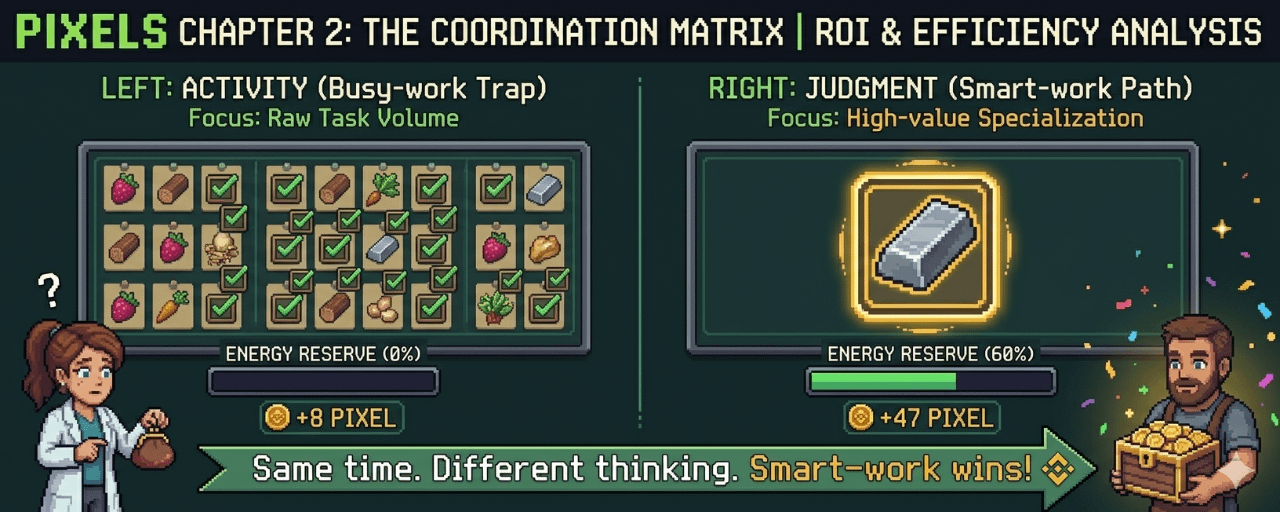
I want to be honest about something. When I first started playing Pixels, my mental model was simple: more time in = more $PIXEL out. That logic made sense. It's how most games work. It's how most jobs work.
Chapter 2 broke that mental model completely.
The shift happened quietly. The Task Board moved inside your Speck. $BERRY disappeared. Coins arrived. And suddenly the players who were grinding 8 hours a day started complaining -because they were earning less than players who logged in for 40 minutes and left.
What changed? The game started pricing judgment, not just time.
Think about what the Energy Floor concept actually means in practice. If your most efficient activity converts 1000 Energy into 50 $PIXEL, then every task that falls below that ratio is literally costing you money. You're not just "not earning" - you're destroying value. The game doesn't tell you this. You have to figure it out yourself.
This is where I think most players are stuck. They confuse activity with progress. Completing 20 small tasks feels productive. The task counter goes up. The animation plays. Dopamine hits. But the wallet doesn't reflect it.
The players climbing the leaderboard right now are doing something different. They're treating their Energy bar like a budget. They're asking "what's the best return on this energy?" before they act, not after.
I find this genuinely fascinating because it mirrors something in real investing. The biggest mistake beginner investors make isn't picking the wrong asset - it's overtrading. Moving constantly, reacting to every signal, staying busy. Meanwhile the patient investor who made three decisions all year outperformed them.
Pixels, intentionally or not, is teaching the same lesson.
The founder Luke Barwikowski said Chapter 2 was designed to "shift earnings towards further-progressed players." On the surface that sounds like it's about skill level or time invested. But I think the real filter is something harder to measure: the ability to do nothing when the conditions aren't right.
Waiting for a high-value task cycle while your energy sits at 60% feels uncomfortable. Everything in your brain says "use it." But that discomfort is exactly where the edge is.
I'm not saying I've mastered this. Honestly I still catch myself completing tasks I know aren't worth it, just to feel like I did something. But I'm getting better at noticing that feeling - and stopping.
The question I keep coming back to: in a game that rewards patience and selective action, what's your decision-making process at the Task Board?