
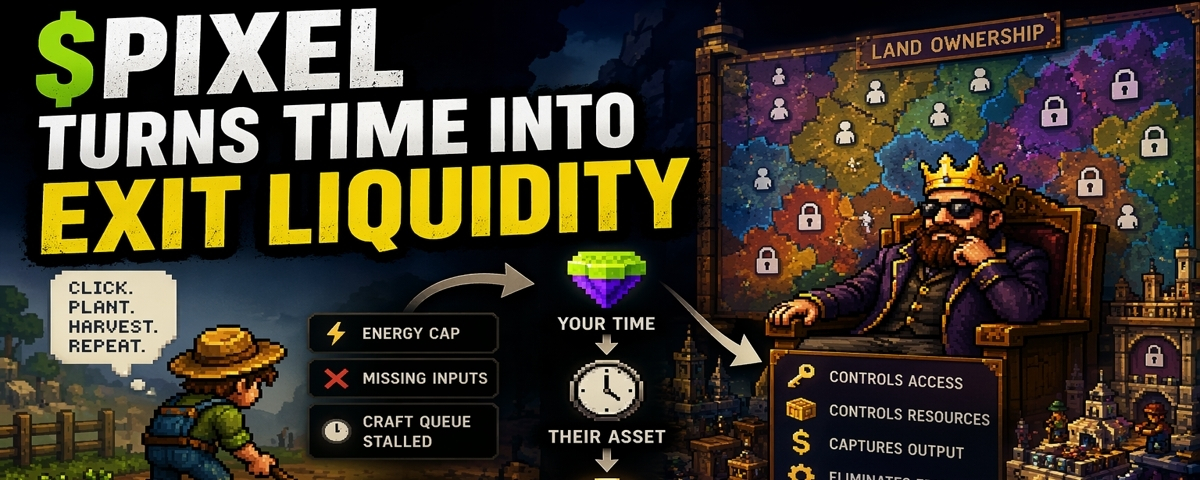
It’s not the crops that break you. It’s the moment your loop stops scaling and you realize the bottleneck isn’t effort — it’s position.
Everyone starts inside the same illusion. Click, plant, harvest, repeat. A smooth onboarding designed to feel like progress. “Specks” look like freedom, but they’re just a controlled sandbox — low yield, low impact, and completely disconnected from real throughput. You’re not early. You’re contained.
Then friction creeps in.
Energy caps. Missing inputs. Craft queues stalling because one critical component sits behind someone else’s land tier. That’s when the system reveals itself: it’s not starving you of rewards — it’s starving you of access. And in Pixels, access is the real currency.
Rented plots feel like progression, but they’re just structured leakage. More space, better output — sure — but everything you produce bleeds value. A soft tax, always on. You’re routing your time through someone else’s asset, paying rent indefinitely while convincing yourself you’re moving forward.
Ownership flips the equation completely. Not by increasing rewards, but by changing your role.
You stop being the one producing…
and start being the one others produce through.
Now it’s not gameplay — it’s allocation. You decide who gets access, who generates output, and how much of that flow you capture. A clean, on-chain sharecropping model where labor spends time and capital captures it.
Most people misread where the value actually comes from. They fixate on $PIXEL emissions — inflation, sinks, token flow — treating it like a standard play-to-earn system.
That’s the wrong layer.
The real source of value is resource generation.
The real sink is time — wasted in inefficient loops.
Resources aren’t evenly distributed. They’re gated, fragmented, and intentionally inconvenient. High-tier inputs sit behind ownership, progression barriers, or logistical friction that forces coordination. You don’t just farm them — you negotiate, route, or pay for them.
That’s not bad design. That’s deliberate market structure.
Once resources become the bottleneck, everything reorganizes around them. Crafting turns into a timing problem. Movement becomes optimization. Players specialize not by choice, but because generalists get punished with idle time and broken loops.
And idle time is the hidden tax.
You think you’re earning — but half your session is spent waiting, traveling, or compensating for missing inputs. That inefficiency doesn’t vanish. It gets absorbed by whoever controls access.
Landowners don’t grind more.
They remove friction.
They internalize supply chains.
They compress time.
They turn other players into throughput.
That’s why $PIXEL hasn’t collapsed like most emission-driven systems. It’s not sustaining the economy — it’s settling it. The token sits downstream of real activity, not at the center of it.
As long as access remains uneven and resources stay constrained, $PIXEL has somewhere to flow.
Remove that asymmetry — flatten access, eliminate scarcity — and the system breaks fast. It becomes just another liquidity cycle with a game attached.
But maintain controlled friction, and something else emerges:
Not a game economy — a managed one.
And that’s the uncomfortable shift.
This isn’t trending toward fun.
It’s trending toward efficiency.
Players optimizing routes.
Operators optimizing players.
Capital optimizing both.
Most are still chasing marginal gains — better crop cycles, slightly higher output per hour.
Meanwhile, a smaller group is mapping dependencies, locking resource control, and converting the rest into flow.
That’s the real game.
A quiet land war — slow, structural, and largely decided before most even notice it’s happening.
You don’t win by playing better.
You win by owning the constraint everyone else has to route around.