

I didn’t pay attention to Pixels at first. It looked like something I already understood before even opening it. A farming loop, a soft social world, a token somewhere underneath—it didn’t feel like it was asking for attention, and I didn’t feel like giving it any.
That’s usually how it goes. After a while in this space, you stop reacting to new releases. You’ve seen too many versions of the same idea dressed differently. Some look better, some feel smoother, but most of them eventually run into the same problem—they can’t hold up once people stop playing casually and start playing seriously.
Pixels stayed in the background for me for a bit. Not because it stood out, but because it didn’t disappear. And sometimes that’s the only reason something earns a second look.
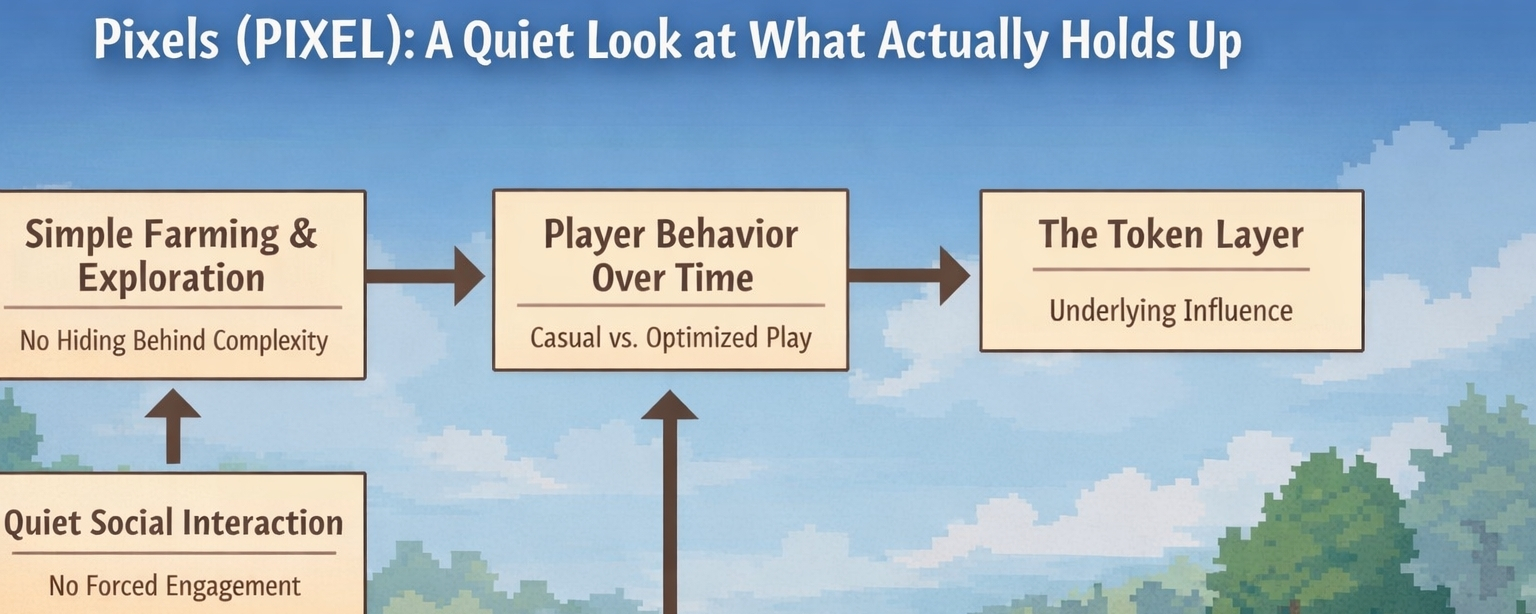
When I finally spent time with it, nothing really surprised me. You plant, you harvest, you move around, you repeat. It runs on the Ronin Network, which makes sense for something trying to stay light and accessible. The world is simple, the mechanics are easy to understand, and there’s no attempt to make it feel more complex than it is.
At first, that almost works against it. It feels too basic, like it might not have enough depth to keep anyone around for long. But the more I sat with it, the more I realized that simplicity puts it in a different position. There’s nowhere for it to hide. If the system doesn’t work, you’ll notice quickly.
And that’s usually where things fall apart.
Not at launch, not when everything is new, but later—when players start pushing the system instead of just following it. When they look for shortcuts, when they optimize every action, when they stop caring about the experience and focus only on the outcome. That shift changes everything, and most Web3 games aren’t built to handle it.
Pixels doesn’t fully escape that pressure, but it doesn’t immediately break under it either. It feels like it’s being adjusted while people are already inside it, which is risky but also a bit more honest. Instead of pretending everything is finished, it reacts. Small changes, small corrections. Nothing dramatic, but enough to show that it’s paying attention to how people actually use it.
What stands out more than anything is what it doesn’t force. The social side is there, but it’s quiet. You see other players, you cross paths, but you’re not pushed into interaction. There’s no pressure to perform or participate beyond what you feel like doing. That creates a different kind of space—one where you can just exist in the loop without constantly thinking about efficiency.
That matters more than it sounds.
Because once everything becomes about optimization, the game stops feeling like a place and starts feeling like a system. And once that happens, people tend to leave as soon as the numbers stop working in their favor.
The token layer sits underneath all of this, quietly shaping behavior whether you notice it or not. It’s always there, influencing decisions in small ways. What you choose to do, how long you stay, what you expect in return. If that layer becomes unstable, it doesn’t matter how calm or simple the surface feels—it eventually shows.
That’s still the part I’m unsure about.
Pixels doesn’t feel like it’s trying to be something bigger than it is, which I respect. It stays close to its core, even if that core is limited. But staying simple also means there’s less room for error. If something goes wrong, it won’t be hidden behind complexity or hype.
For now, it feels steady enough to keep watching. Not impressive in a loud way, not groundbreaking, just consistent in a space where consistency is rare.
I don’t know if that’s enough yet.
But it hasn’t given me a reason to stop paying attention, and that’s more than most projects manage..