

There’s a small government office not far from where I live. Every morning, people gather outside before it opens. Some come for documents, some for approvals, others just to fix mistakes they didn’t even know existed. The strange part is not the crowd—it’s the process. Two people can arrive at the same time, ask for the same thing, and yet walk away with completely different outcomes. One gets processed quickly because they “know someone” or understand the hidden steps. The other is sent back and forth between counters, stuck in a loop of unclear rules and shifting expectations.

What stays with me is not the inefficiency alone, but the invisible system behind it. On the surface, everything looks structured. There are forms, procedures, official instructions. But underneath, there’s a second layer—unwritten logic that actually determines who succeeds and who doesn’t.
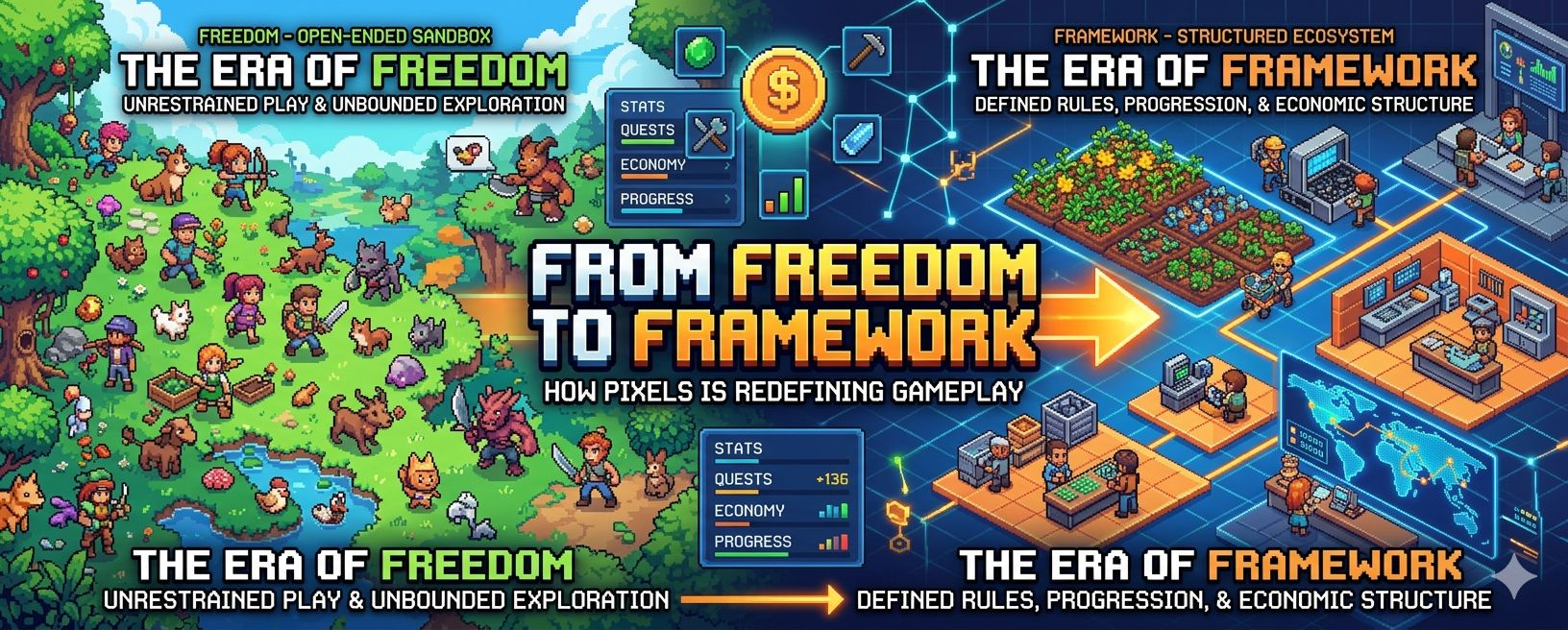
The more I think about Pixels, especially after its recent Bountyfall update on the Ronin Network, the more it starts to feel less like a simple farming game and more like a system trying to organize effort, reward, and participation in a controlled environment. At first glance, it presents something peaceful and predictable: plant, harvest, expand, repeat. A loop that feels fair because it appears consistent. But systems rarely stay simple once incentives are introduced.
The idea behind Pixels is not new, but its execution is evolving. A game that slowly transforms into an economic layer raises a quiet but important question: when does structured gameplay become managed participation? And who really benefits when that shift happens?
With the introduction of Bountyfall, the system seems to move closer toward intentional reward distribution. Tasks, incentives, and progression are no longer just about time spent, but about alignment with the system’s design. It begins to resemble something more curated—almost like the office example, where understanding the system matters more than simply participating in it.
This is where things get interesting. Most Web3 projects spend enormous energy on visibility—token listings, partnerships, narratives about “community ownership.” But they often avoid addressing a deeper issue: how rewards are actually distributed over time. Not in theory, but in practice. Who consistently benefits? Who gets filtered out? And how much of that process is visible to the average participant?
Pixels, to some extent, attempts to make this process more structured. The inclusion of token sinks, like upgrades and land improvements, suggests an awareness of economic balance. Burning tokens to control supply is a logical step. But logic on paper doesn’t always translate into fairness in reality. If rewards are still disproportionately distributed through emissions, then the burn mechanism becomes less of a solution and more of a narrative tool.
It raises a subtle tension between efficiency and fairness. A system can be efficient in maintaining value while still being uneven in how that value is accessed. And in a game environment, this tension becomes even more complex. Players are not just participants—they are also contributors to the system’s growth. Their time, attention, and behavior all feed into the ecosystem.
So the question shifts slightly. Is Pixels optimizing for player experience, or for system stability? And can those two goals truly align over the long term?
There’s also a philosophical layer here that’s hard to ignore. Games traditionally represent freedom—spaces where outcomes are flexible and exploration is encouraged. But as economic structures become more embedded, that freedom starts to narrow. Actions become calculated. Decisions become strategic, not playful. The system begins to reward not creativity, but efficiency within predefined rules.
Bountyfall, in this sense, feels like a step toward more controlled participation. It introduces direction, but also constraint. It guides behavior, but also filters it. And while that can improve clarity, it also risks reducing the organic nature of gameplay.
At the same time, it would be unfair to dismiss what Pixels is attempting. There is a genuine effort to create something that is not purely speculative. A system where actions have consequences, where resources are managed, and where value is not entirely detached from activity. In a space filled with short-term hype cycles, that alone is worth acknowledging.
But intention and outcome are rarely the same. A well-designed system can still produce unintended imbalances. Early participants may benefit disproportionately. Highly active users may dominate reward flows. New entrants may find themselves navigating a structure that is already optimized against them.
And this brings us back to the original example. Systems don’t fail only because they are inefficient. Sometimes they function exactly as designed—but the design itself favors certain behaviors, certain people, certain levels of understanding. The complexity is not always in the rules, but in how those rules are experienced.
So where does that leave Pixels?
Somewhere in between a game and a system. Not fully one, not fully the other. It reflects a broader shift in Web3 gaming—a move toward environments that are not just played, but navigated. Where success is not only about participation, but about understanding the underlying logic.
The real question is not whether this model works in the short term. It often does. The more important question is whether it remains fair, engaging, and sustainable as it grows. Can a system maintain balance when incentives continuously reshape behavior? Can it preserve a sense of play while introducing layers of economic control?
Or does it eventually become something else entirely—something closer to that office, where outcomes depend less on effort and more on how well you understand the system behind the system?
Pixels doesn’t answer these questions directly. But it makes them harder to ignore.
And maybe that’s its real significance. Not as a perfect model, but as a signal. A sign that games are no longer just about playing, and economies are no longer just about trading. The two are merging, slowly and quietly, into something more complex.
Whether that complexity leads to better systems or just more sophisticated imbalances is still uncertain.
But one thing is clear—once a game starts shaping behavior like a system, it stops being just a game. And at that point, the stakes are no longer virtual.
