I’ll be honest, when I first looked at Pixels, I thought it was just another farming game with token rewards attached. Plant crops, complete tasks, upgrade land, earn tokens, and repeat. It looked simple on the surface, like a familiar Web3 loop dressed in softer colors and social gameplay. But the longer I watched how the system actually moved, the less it looked like a game about farming and the more it looked like a lesson in behavior.
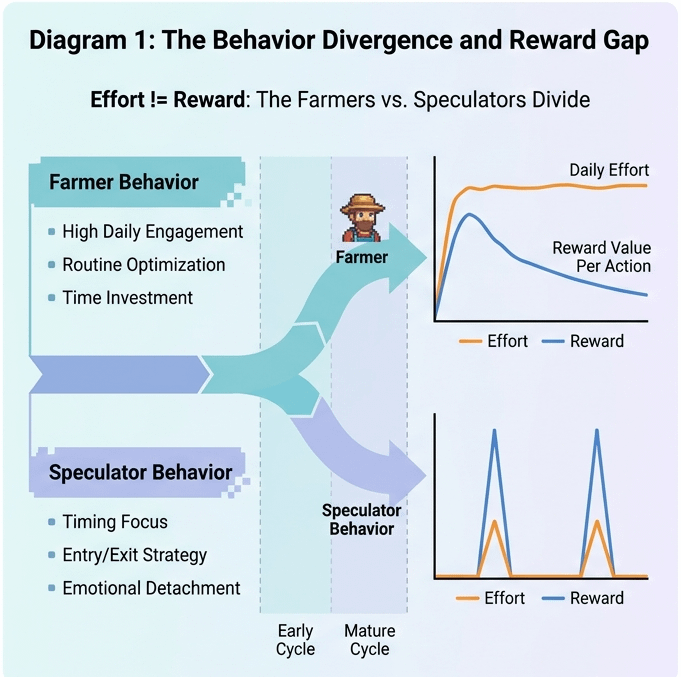
That’s where things became interesting for me. Most people enter Pixels believing effort creates reward. If you show up daily, optimize your land, improve your tools, and stay consistent, you should naturally come out ahead. That feels fair, and honestly, that belief is what keeps most players engaged. But after spending enough time observing how value moves inside the system, I noticed something uncomfortable: the people working the hardest were not always the ones winning.
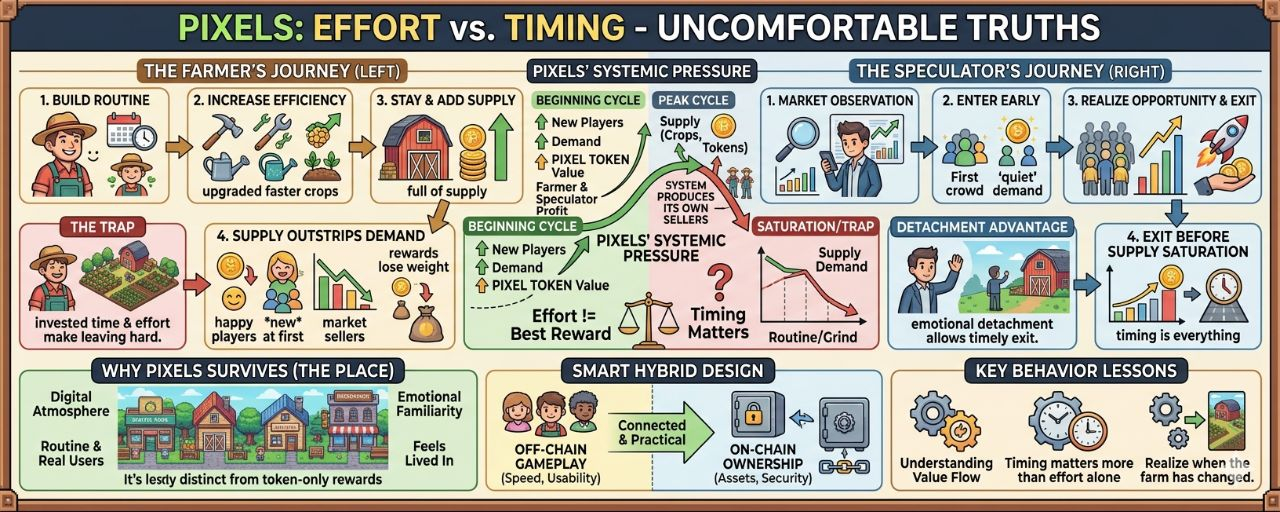
In many cases, the opposite was true. The real divide inside Pixels is not skilled players versus bad players. It is farmers versus speculators, and they are playing two completely different games. Farmers think in routines. They care about efficiency, upgrades, better yields, and long-term progression. They build habits, invest time, and stay because staying feels productive. Speculators think in timing. They enter early when demand is quiet and leave when the crowd arrives. They are less emotionally attached, and that distance gives them an advantage.
That difference changes everything. At the beginning of every cycle, both sides look successful. New players arrive, demand increases, resources hold value, and the PIXEL token starts moving. Farmers feel validated because the grind feels profitable and the effort feels justified. But that phase never lasts forever. As more players join and more people start farming, supply increases too. More crops, more items, more tokens, and more daily sellers begin entering the system.
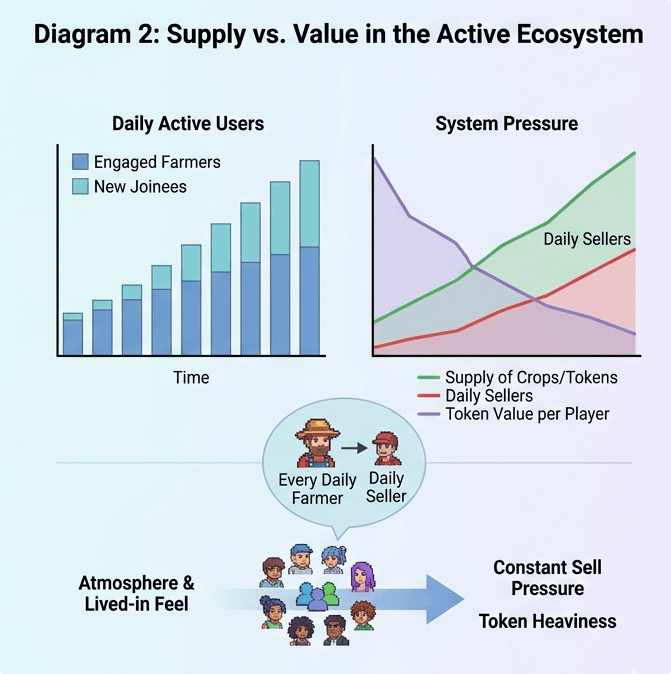
That is where the hidden pressure starts building. The game feels healthier because more people are active, but the economy gets heavier underneath. Rewards do not disappear, they simply lose weight. You still earn, but what you earn matters less over time. Selling becomes harder, prices stop reacting the same way, and the market starts feeling slower. This is where the trap begins.
Farmers usually stay because they have already invested too much to leave. Their land is upgraded, their routine is built, and walking away feels like wasting progress. So they continue. Meanwhile, speculators are already planning exits. It is not because they understand the game better. It is because they are emotionally detached enough to leave on time. That realization completely changed how I look at Pixels.
But here is the part people often miss. Pixels still works, and that matters. Unlike many empty Web3 projects, @Pixels actually feels alive. It has real users, real habits, and something most crypto games fail to build: atmosphere. It reminds me of an older version of the internet, not because of nostalgia marketing or pixel art, but because it feels like a place.
You log in, recognize names, follow familiar paths, notice who is around, and leave without feeling like the game is demanding your full attention. It feels less like a product and more like a digital environment you slowly become familiar with. That softness is powerful because people stay longer in places that feel lived in. I think that is one of the main reasons Pixels survives where many projects fail. It does not rely only on token rewards. It builds routine and emotional familiarity.

But even that creates a contradiction. The same active player base that makes the world feel alive also creates constant economic pressure. Every engaged player farming daily adds supply. Every reward converted into something more stable creates selling pressure. The system produces its own sellers. That is why the token often feels heavy. The pressure is not coming from outsiders. It is coming from the players themselves.
There is also another important layer that many people ignore: Pixels is not fully on-chain, and honestly, that is a good thing. If every action had to go through blockchain confirmation, the game would feel painfully slow. Instead, gameplay happens off-chain for speed, while ownership, assets, and important transactions connect to blockchain where it actually matters. It is not purity, it is practical design. A smart hybrid built for usability rather than ideology.
And maybe that is the real lesson here. The best systems are rarely the purest ones. They are the ones that understand human behavior the best. Pixels taught me that effort alone does not guarantee advantage. Timing matters. Detachment matters. Understanding how value flows matters.
Sometimes the smartest move is not farming harder. Sometimes it is simply realizing when the farm itself has changed.