
Most days in crypto start to feel the same after a while. You scroll, you skim, you see a new project trending, and within seconds your brain already knows the pattern — clean branding, big promises, a token attached to it, and a timeline that feels a little too confident. I used to get pulled in by that. Visibility felt like validation. If everyone was talking about something, it had to matter.
Now, I mostly scroll past.
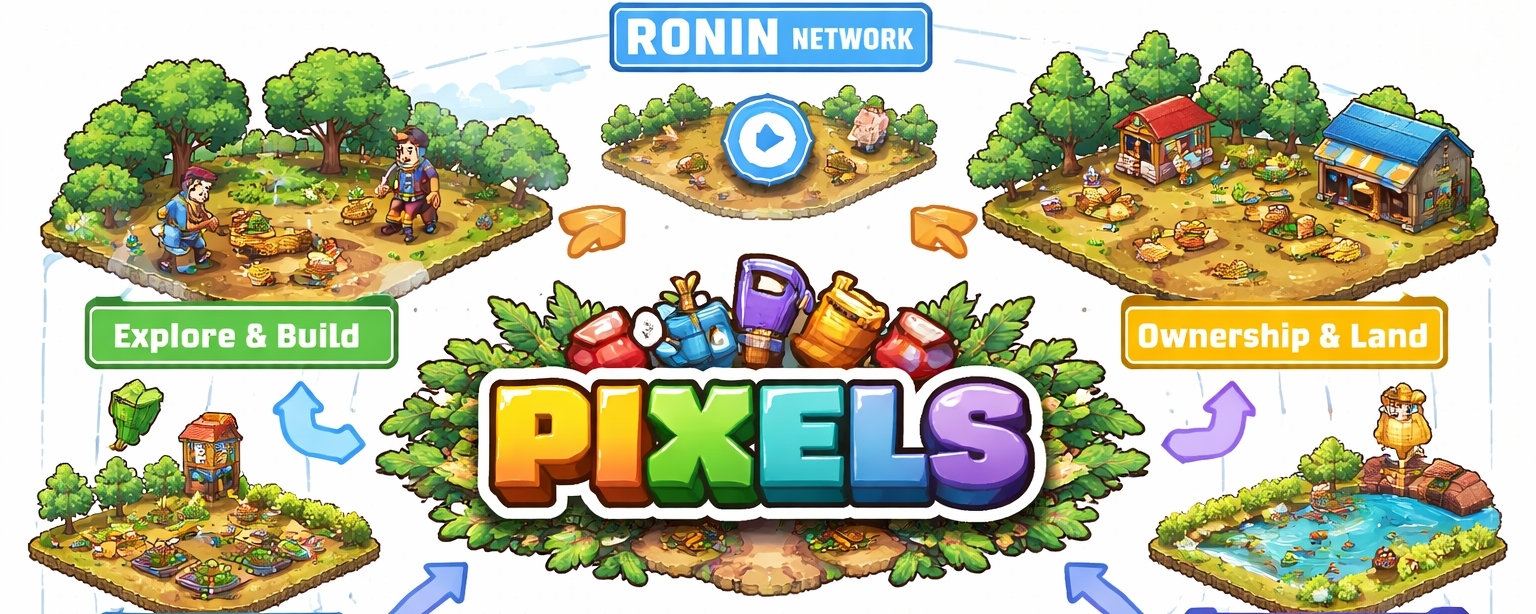
Pixels didn’t stop me immediately. It wasn’t loud enough for that. It just kept appearing — casually mentioned, lightly discussed, almost like background noise. A farming game on Ronin. Social, open-world, Web3. The kind of description that used to sound exciting, but now mostly raises quiet questions.
So I didn’t jump in. I just paid attention.
At its core, Pixels is simple in a way that feels intentional. You farm, you explore, you build, you interact. It doesn’t try too hard to impress you upfront. And that’s probably the first thing that made me pause — it doesn’t rely on complexity to create value, at least not on the surface. But under that simplicity, there’s something else going on. You start to notice that the project isn’t really about farming or crafting. It’s about behavior.
That’s where things get more interesting.
If you’ve been around Web3 games long enough, you’ve seen the same cycle repeat. Reward people for showing up, and they will — but not because they care about the game. They come for the token, optimize their time, extract what they can, and eventually leave. The system gets drained, and what’s left behind is a shell of what was supposed to be a community.
Pixels feels like it’s trying to avoid that — not perfectly, but consciously.
The PIXEL token is a good example of that shift. It exists, it’s useful, but it doesn’t dominate everything. You don’t need it just to play the game or make progress. That might sound like a small design choice, but in Web3, it’s actually a big one. When a token becomes mandatory for basic interaction, the entire experience starts revolving around it. Here, it feels more optional — something that enhances rather than controls.
You can use it to speed things up, unlock certain items, customize your space, or access extra features. But the core loop of the game doesn’t depend on it. And that separation matters. It creates a space where gameplay can exist on its own, instead of being constantly tied to financial behavior.
Still, having utility is one thing. Having meaningful usage is something else entirely.
Pixels tries to tie the token into participation — rewarding players for being active, for contributing to the ecosystem in ways that are supposed to matter. New tokens enter the system in a controlled way, and there are sinks designed to pull value back out. On paper, it feels balanced. But systems like this always depend on one fragile detail: what counts as “real” participation?
Because people are very good at finding shortcuts.
If rewards are tied to activity, users will optimize for activity — not necessarily for value. They’ll do what qualifies, not what contributes. And over time, that gap becomes visible. Pixels seems aware of this risk, which is why you can see small adjustments in how the economy is structured — separating currencies, adding limits, refining how rewards are distributed. It doesn’t feel static. It feels managed.
That’s a good sign. But it’s also where things get difficult.
The introduction of staking adds another layer. Locking PIXEL to support parts of the ecosystem, earning rewards, having some level of influence — it’s an attempt to turn passive holders into something more engaged. Not just people waiting for value, but people connected to where that value is being built.
In theory, that alignment makes sense.
In reality, it depends on why people are participating.
Are they staking because they believe in the ecosystem? Or because the rewards make it worth it for now? That difference doesn’t show up immediately. It reveals itself over time — especially when incentives start to normalize.
And that’s really the core of how I look at something like Pixels now.
Not through its launch phase, not through its activity spikes, but through what happens after things calm down. When the excitement fades a bit. When the easy rewards are gone or reduced. When showing up requires a reason that isn’t purely financial.
That’s when you find out what’s real.
Pixels hasn’t fully reached that moment yet, but you can see that it’s preparing for it. The structure, the adjustments, the way it tries to separate gameplay from speculation — all of it suggests a project that understands the problem it’s dealing with. And honestly, that already puts it ahead of many others that never even acknowledged the issue.
But understanding the problem and solving it are two very different things.
What would make me believe in something like this isn’t growth charts or token distribution stats. It’s quieter than that. It’s players coming back because they want to, not because they’re being rewarded to. It’s an economy that doesn’t constantly need correction. It’s a system where holding a token actually connects to something real inside the experience.
Right now, Pixels feels like it’s somewhere in between. Not just another hype-driven project, but not fully proven either.
And maybe that’s why it stays on my mind more than louder projects do.
Because the ones that last are rarely the ones that demand attention right away. They’re the ones that slowly build something that people choose to stay part of — even when there’s less noise, less hype, and fewer obvious incentives.
That’s the phase that matters.
And that’s the phase that will decide what Pixels really is.
