
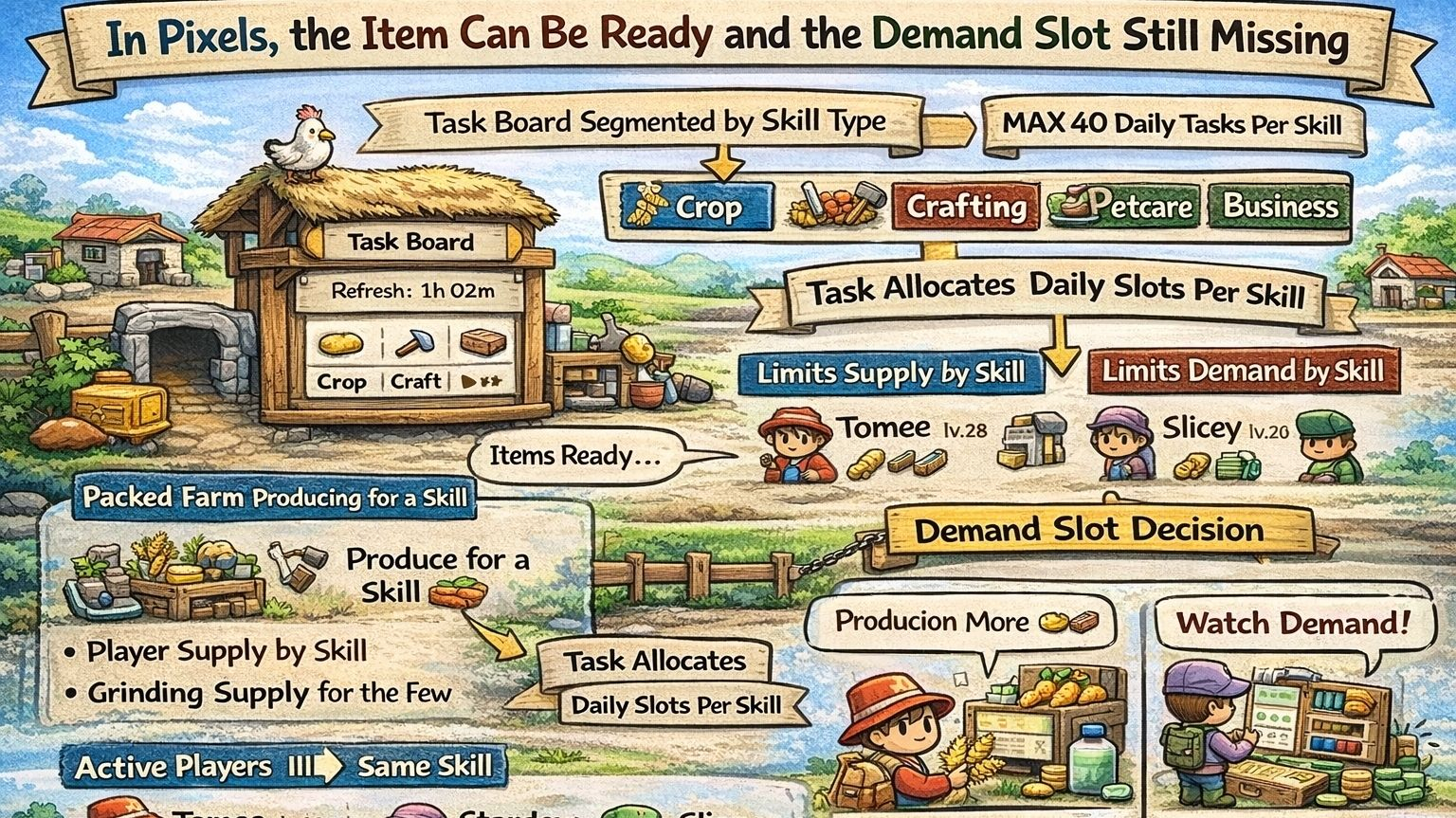
The Task Board in Pixels looks simple until you stop reading it like a normal job list. A player can have the right item ready, the right skill leveled, and the time to grind. But if the board does not open enough demand for that skill, the player is not really competing in a free market. They are competing inside a limit.
That is the part that changed how I read the Infinifunnel.
Pixels has used Task Board segmentation by skill type, daily task limits, a maximum of 40 tasks per skill, and a maximum of 4 of any skill showing at one time. That sounds like normal balancing at first. But it means the Task Board is not only rewarding what players produce. It is deciding how much visible demand each skill gets in the first place.
This matters because the Task Board is not a decorative system. It is one of the main ways players earn $PIXEL, Coins, and EXP inside Pixels. So when task demand is capped by skill, that cap does not just affect convenience. It affects which types of work feel worth doing.
A player can specialize in a skill and still face the wrong kind of scarcity. Imagine someone spends time building around one production route, prepares inventory, and comes back expecting the board to absorb that effort. The items are ready. The setup works. The player did the work. But if only a few tasks for that skill are visible, or the daily allocation is already tight, the earning route narrows before the player even submits anything.
The item can be ready, but the demand slot may not be.
That is a harder problem than normal grinding. In most games, the simple idea is that more effort should create more reward. In Pixels, effort still matters, but the board decides how much of that effort can be converted into tasks for each skill. A skill can be useful and still be underfed by the board.
This is why I read the Task Board less like a notice board and more like a demand valve. It can help Pixels spread activity across different skills. It can stop one category from flooding the system. It can protect the economy from becoming too one-sided. Those are real benefits.
But the cost is also real.
Once demand is segmented and capped, skill value becomes partly controlled by the system. The player is no longer only asking, “Can I produce this?” The better question becomes, “Will the board keep asking for this enough?” Those are different questions. One is about player ability. The other is about system-side demand.
That difference matters for retail readers watching $PIXEL. A busy game does not automatically mean every skill economy is strong. More players can create more supply, but the Task Board still controls how much demand appears for each skill. If too many players move into the same skill while task slots stay limited, the pressure does not disappear. It moves into competition for the few places where that skill can actually earn.
This also changes how I read specialization. Specializing sounds strong because it gives players focus. But in a capped Task Board system, specialization can become exposure. A player who only understands production may keep making more of the same thing. A player who understands demand slots will watch where the board actually creates opportunity.
That is the sharper edge.
Pixels is not wrong to do this. Without limits, the Task Board could become messy. One skill could dominate. Some reward paths could become too easy to farm. Some tasks could crowd out others. A controlled board gives Pixels a way to manage daily demand and keep the economy from being swallowed by one route.
Still, it means the board has power. It can make a skill feel liquid or crowded. It can make strong production feel useful or stuck. It can make players rethink what they should level, craft, gather, or sell.
For me, that is the real point. In Pixels, the scarce thing may not only be land, time, items, or energy. It may be task demand itself. The Infinifunnel does not simply absorb whatever players bring to it. It filters opportunity through skill categories and caps.
So the strongest player may not be the one who only grinds harder. It may be the one who notices where demand is allowed to appear.
If Pixels keeps using the Task Board this way, skill value will not be decided only by what players can make. It will be decided by how much demand the system lets that skill receive. And that means the player who understands demand slots may beat the player who only understands production.
