
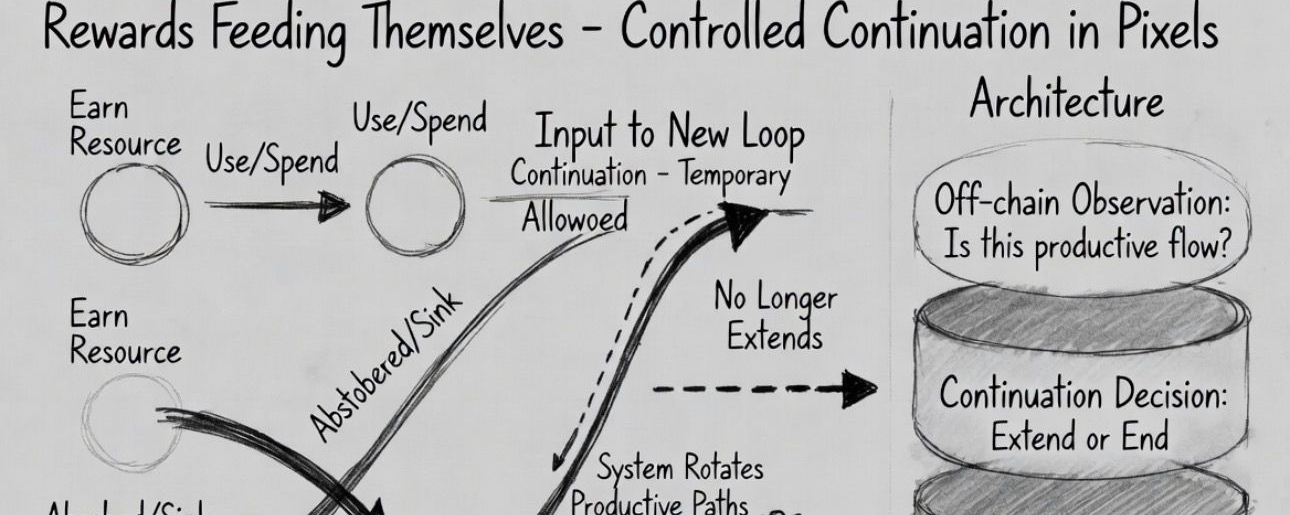

I didn’t expect rewards to start feeding themselves.
In most systems, rewards are the end of the loop. You earn something, you spend it, and the loop resets. If it feels good, you repeat it. If too many people repeat it, the system inflates.
That’s the pattern.
So when I spent more time inside Pixels, I was watching for that same break point.
Instead, something else showed up.
I wasn’t just earning and spending anymore.
Some rewards were starting to extend the loop on their own.
Not all of them. Only certain ones.
That difference is where the mechanism sits.
In Pixels, rewards don’t automatically close a loop.
Some of them reopen it.
Off-chain is where that gets decided.
The system isn’t just tracking what I earn. It’s tracking whether what I’m doing still contributes to the overall flow of the economy. Which loops are still productive, which ones are saturated, and where value is actually circulating instead of just being extracted.
That layer doesn’t change the reward itself.
It changes what the reward does next.
I felt it when a resource I had been treating as an endpoint suddenly became an input somewhere else.
Same item.
Different role.
What used to be something I spent once now started feeding back into another loop that generated more output.
Not infinitely. Not freely.
But enough to keep movement going without resetting everything.
That’s when it clicked.
The system isn’t just distributing rewards.
It’s deciding which rewards are allowed to sustain activity.
That’s a very different design.
Most systems rely on sinks to balance rewards. You earn something, then the system forces you to spend it somewhere to remove it from circulation.
Here, the system doesn’t rely only on removal.
It controls continuation.
Some rewards get absorbed and disappear.
Others get routed back into loops that keep generating value.
That’s how rewards start “paying for themselves.”
But it’s not automatic.
If every reward could do that, the system would inflate instantly.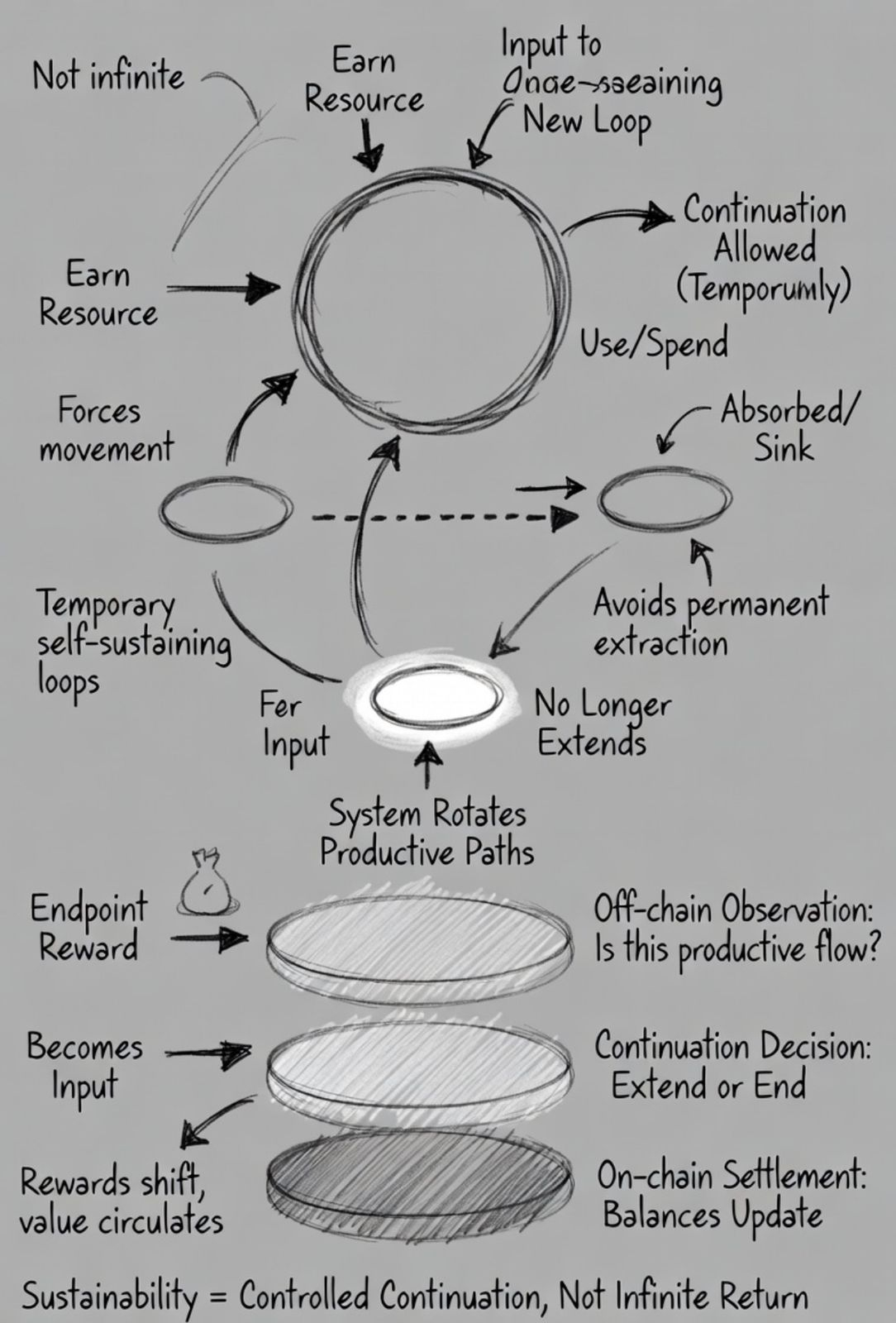
So Pixels doesn’t allow that condition to fully form.
It filters which rewards are allowed to extend.
Off-chain behavior → continuation decision → on-chain settlement.
That’s the architecture again.
The first layer observes how rewards are being used. Not just earning, but where they go next. Are they being recycled into productive loops, or just extracted and held?
The second layer decides whether that reward should be allowed to continue generating activity.
Only then does anything finalize.
Balances update. Assets move. Ownership settles.
But by that point, the reward has already been classified.
Extend or end.
That’s why the system feels stable even when activity increases.
Because not all rewards are treated equally.
I noticed this when I tried to build a loop around one resource.
At first, it worked. I could earn it, use it, and get consistent output from it. It started to feel like I had found something self-sustaining.
Then slowly, it stopped scaling.
The same resource still worked, but it wasn’t feeding forward the same way.
It started acting like a normal reward again.
So I moved.
Different loop, different interaction.
And suddenly, another resource started behaving that way instead.
That’s not randomness.
That’s the system rotating where continuation is allowed.
It doesn’t let one path become permanently self-sustaining.
Because that’s how systems break.
If one loop can pay for itself indefinitely, it turns into extraction. Players lock into it, value stops moving, and everything around it weakens.
Pixels avoids that by making self-sustaining loops temporary.
They exist.
But they don’t stay.
That forces movement.
And movement is what keeps the economy alive.
Because sustainability isn’t about infinite return.
It’s about controlled continuation.
Rewards can feed into new loops, but only as long as they contribute to the system.
Once they stop doing that, they lose that ability.
They don’t disappear.
They just stop extending.
That’s why it doesn’t feel like inflation.
You never see rewards endlessly multiplying in one place.
You see them shifting.
One moment, something feels powerful and productive.
Later, it becomes neutral.
Something else takes its place.
That rotation is what maintains balance without hard resets.
And it’s also why it feels different from traditional reward systems.
You’re not just optimizing for the highest return.
You’re adapting to where the system is allowing continuation.
That’s a subtle shift, but it changes everything.
It means the best strategy isn’t to find one loop and stay there.
It’s to stay in motion.
To recognize when something is no longer feeding forward, and move before it fully stops.
That’s how you stay aligned with the system.
And that’s how rewards start to feel like they’re paying for themselves.
Not because they always do.
But because, at the right moment, the system allows them to.
That resolves the tension.
At first, the idea of rewards sustaining themselves sounds like a path to inflation.
Inside Pixels, it doesn’t turn into that.
Because the system controls when that behavior is allowed, and for how long.
It never lets it settle into permanence.
And that’s what keeps everything from collapsing.