
PIXEL is no longer in its storytelling phase.
This is where I stop listening… and start observing.
Because I’ve seen this cycle too many times—
same polished narratives, same recycled promises, same confidence dressed up as inevitability.
Ownership. Community. The future of gaming.
All clean words.
But none of that matters once the mood shifts.
What matters is simple:
Does it still work when belief fades?
That’s where PIXEL is sitting right now.
I don’t look at PIXEL and see some revolutionary future.
I see friction.
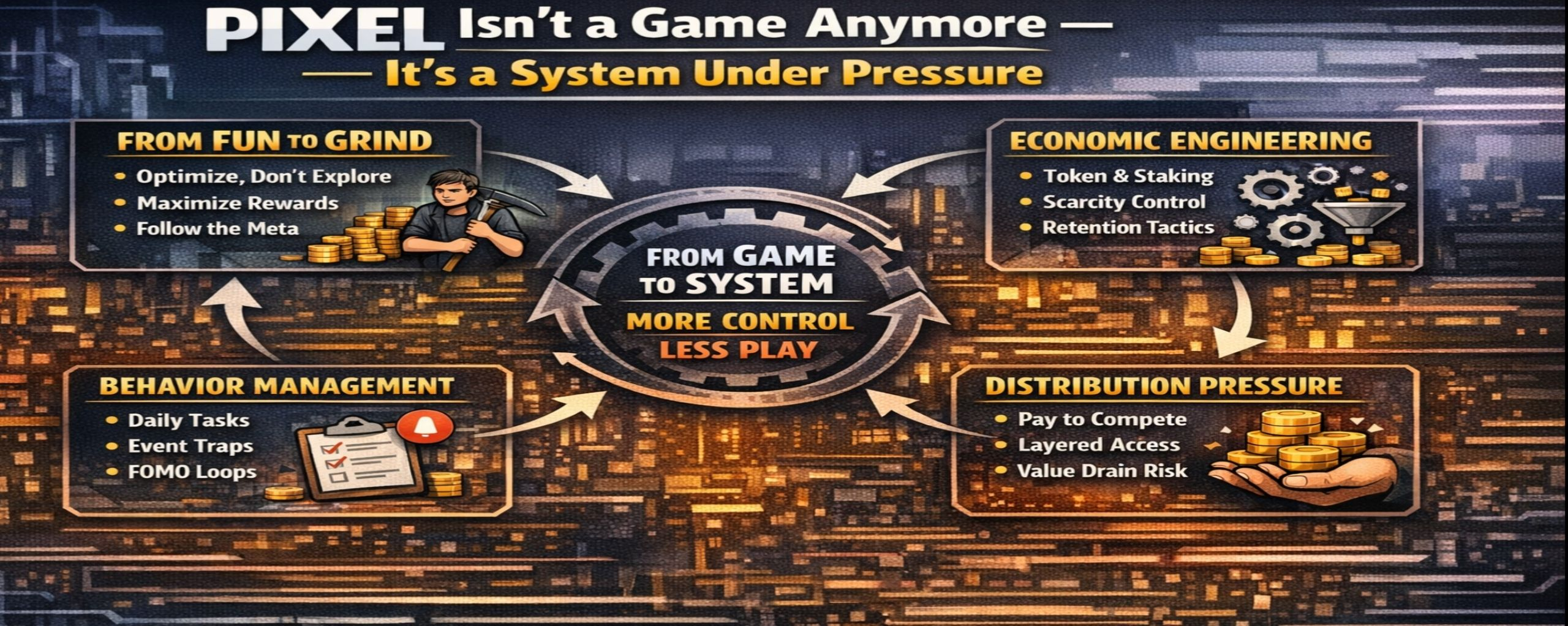
A live economy trying to pass itself off as a game.
And maybe that tension is the entire story.
Because once you introduce a token…
then staking…
then layered reward systems…
It stops being “just a game.”
The art can stay soft.
The world can feel friendly.
But underneath?
It’s pressure.
Distribution.
Retention engineering.
Behavior control.
Constant effort to stop value from leaking faster than belief can refill it.
This is the part most people ignore.
They talk about ownership.
They talk about earning while playing.
But ownership inside a controlled system is never what it sounds like.
Because the real power isn’t in the asset.
It’s in the rules.
Who earns.
Who gets diluted.
Who moves faster.
Who gets priced out.
That’s the real economy.
Not the slogans.
Right now, PIXEL feels less like a game with a token…
…and more like a reward machine wrapped in a game world.
Not an insult.
Just evolution.
Every update now does two jobs:
It has to feel like content…
and secretly function as economic control.
New features aren’t just features.
They’re filters.
Gates.
Scarcity tools.
Ways to decide who progresses efficiently…
…and who gets pushed into the slow lane.
This is where things get interesting.
Because this is where projects reveal what they really are.
Not when things are simple—
but when complexity starts stacking.
When players stop exploring…
…and start optimizing.
When the question shifts from
“Is this fun?”
to
“What pays?”
“What gets nerfed next?”
“Where’s the edge?”
And once players start thinking like that…
You don’t have a game anymore.
You have a system.
I think PIXEL is already crossing that line.
The novelty is gone.
No serious participant is impressed just because there’s a token attached.
That phase is finished.
The market has seen too much.
Too many inflated promises.
Too many drained economies.
Too many communities that were really just temporary extraction cycles.
Now the standard is different.
And honestly?
It should be.
The real test isn’t whether PIXEL keeps shipping.
Shipping is easy now.
The real question is:
Do these updates reduce the grind…
or just rearrange it?
Do they create real reasons to stay?
Or just reinforce habit, sunk cost, and the hope that value survives one more cycle?
Because most of these systems don’t build freedom.
They build managed behavior.
They optimize:
Activity.
Consistency.
Retention.
Spending.
Everything calibrated.
Everything controlled.
PIXEL isn’t unique in this.
If anything, it’s a clean example of where the entire space has landed.
Less fantasy.
More tuning.
Less freedom than advertised.
More dependence on keeping the loops alive.
And here’s the uncomfortable part:
That actually makes it more honest.
Pressure reveals truth.
Break markets reveal truth.
User fatigue reveals truth.
That’s when you find out if people are there because they want to be…
or because the system still pays just enough to keep them in.
PIXEL, to me, is still unresolved.
Still mid-transition.
Still caught between two identities:
A world people want to exist in…
and a machine that needs constant maintenance to survive.
Maybe that’s the real future of this sector.
Not games.
Not markets.
But something in between.
Half-play.
Half-labor.
Half-finance.
Where the lines blur so much…
no one can clearly tell where fun ends
and extraction begins.
I keep watching PIXEL with one question in mind:
How much weight can this system carry…
before everything starts feeling like accounting?
Or maybe…
it already does.
And people are just better at pretending it doesn’t.
