
Let’s be direct. GameFi didn’t collapse because the idea was flawed. It collapsed because most projects forgot they were supposed to be games.
Everything got built around tokens. Emissions, rewards, APYs. Meanwhile, the actual experience of playing was treated like a secondary feature. The result was predictable. People showed up for earnings, not enjoyment. And the moment rewards weakened, so did the player base.
That cycle repeated across almost every Web3 game.
Pixels approaches it differently, and that difference shows up the moment you spend real time inside it.
Start with gameplay.
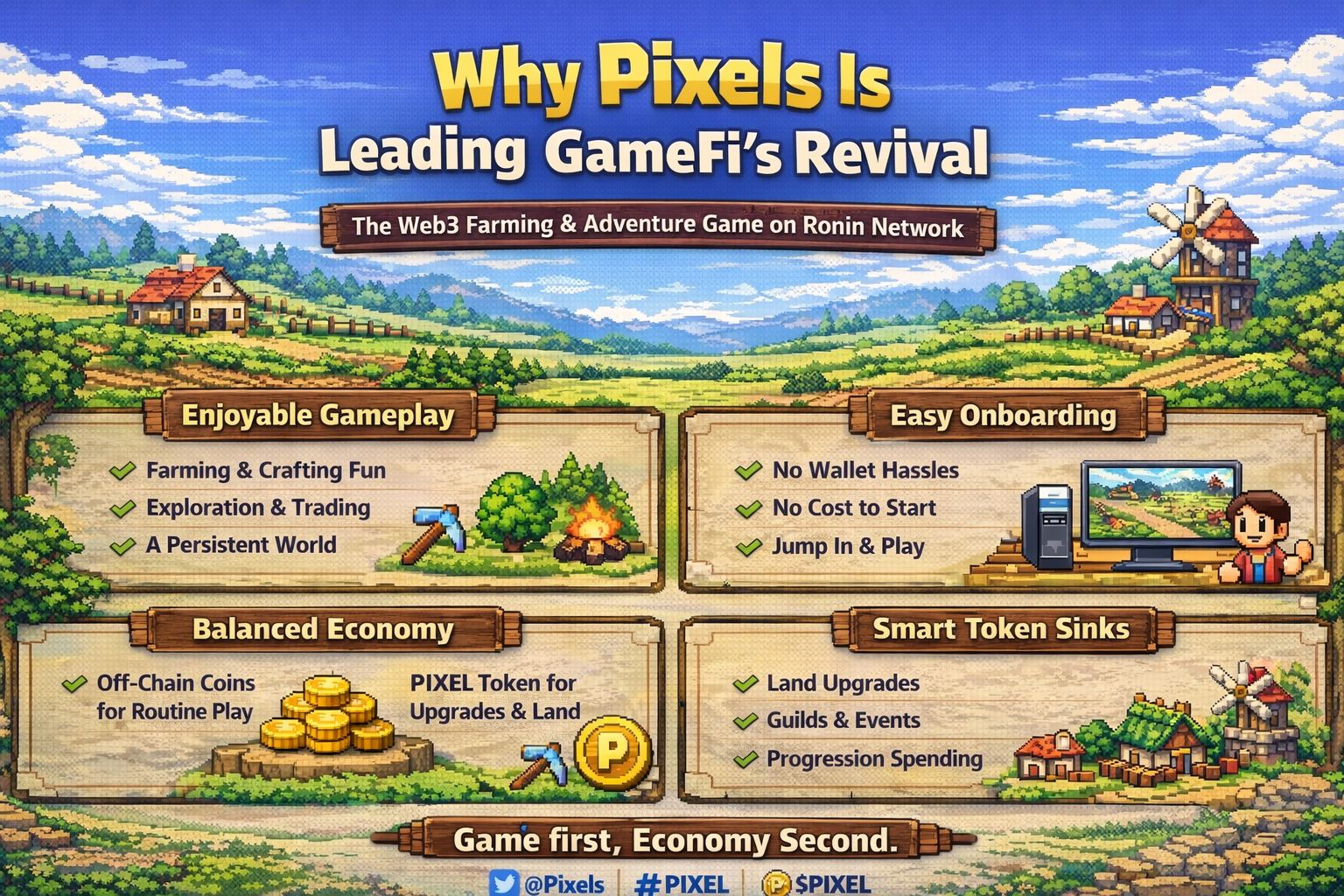
Pixels doesn’t try to overwhelm you with complexity. It leans into something familiar. Farming, gathering, crafting, trading, exploring. The loops are simple, but they’re coherent. More importantly, they’re actually enjoyable to engage with. You’re not logging in to optimize yield every second. You’re logging in because the environment feels active and responsive.
That shift changes behavior.
In most GameFi systems, players act like extractors. In Pixels, they start acting like participants. They build routines, interact with markets, coordinate with others. The world doesn’t feel like a temporary farming ground. It feels like something that persists.
That persistence is critical.
Then there’s onboarding, which Pixels quietly gets right.
Most Web3 games lose users before they even begin. Wallet setup, gas fees, bridging assets, upfront token purchases. For anyone not already deep in crypto, it’s a barrier that kills curiosity instantly.
Pixels removes a lot of that friction. You can enter, explore, and understand the game before making financial decisions. That alone expands the type of player willing to try it. It stops filtering only for crypto-native users and starts behaving more like an actual game ecosystem.
Now look at the economy, where most systems fail.
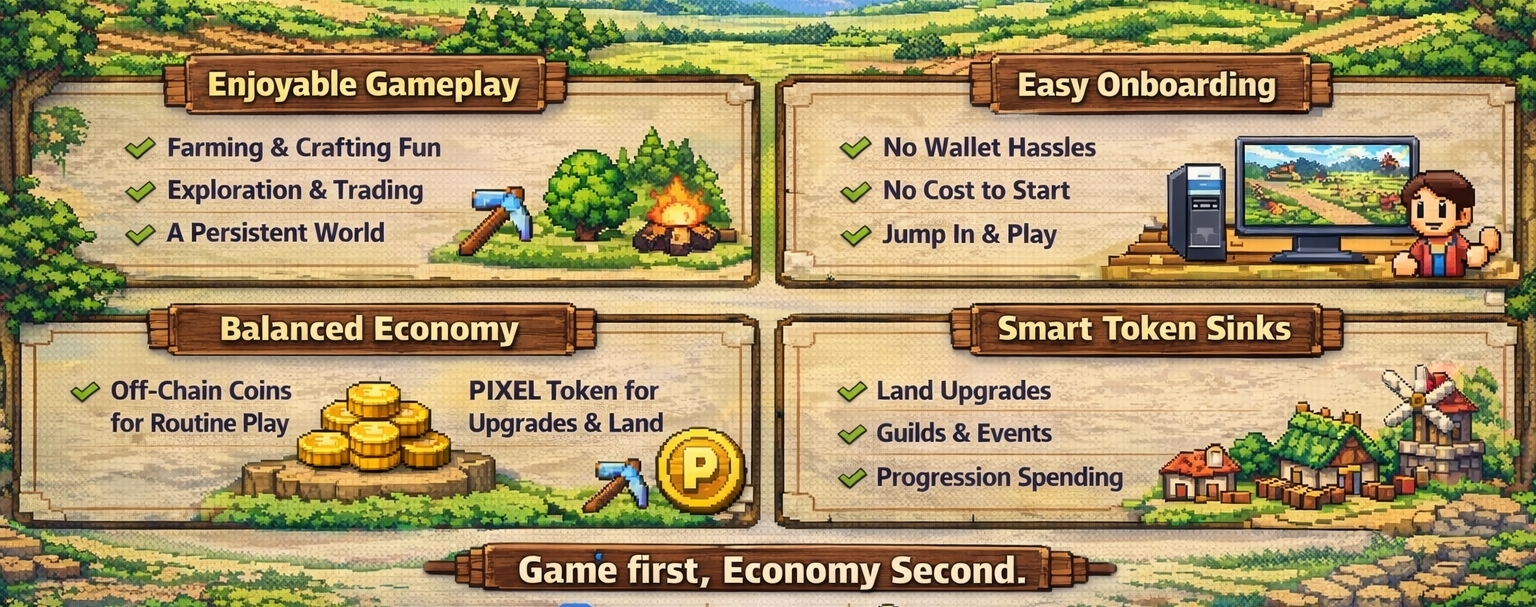
Pixels runs on a dual-structure that separates everyday activity from high-value decisions. Off-chain Coins handle routine actions like farming and crafting. Meanwhile, PIXEL is positioned for more meaningful use cases upgrades, guild mechanics, land progression, and premium actions.
That separation matters more than it seems.
In older GameFi models, everything flows through a single token. That creates constant sell pressure because every action leads to extraction. In Pixels, not every action translates directly into token output. The system controls what actually converts into value, which reduces unnecessary inflation at the source.
It’s not a perfect solution. But it’s a smarter structure.
And then there are token sinks.
This is where most projects get it wrong. They either don’t have enough sinks, or they create ones that feel forced and punitive. Players recognize that quickly, and they disengage.
Pixels builds sinks into progression itself. Spending isn’t framed as a loss. It’s tied to moving forward upgrading land, improving efficiency, participating in larger systems like guilds. That makes reinvestment feel natural instead of mandatory.
Even so, it’s important to stay realistic.
No GameFi economy has solved long-term inflation completely. Not one. It’s still a balancing act between rewarding players and maintaining value stability. Pixels doesn’t eliminate that risk. What it does is manage it more carefully. It slows down the typical collapse cycle and extends the lifespan of the system.
That alone puts it ahead of most competitors.
Another layer that often gets overlooked is behavior.
Pixels doesn’t just reward activity. It starts to favor consistency and repeatable patterns. Players who show up, refine their loops, and engage with the economy in structured ways tend to scale better over time. That creates a subtle shift from random play to intentional participation.
And that’s where it starts feeling less like a game with a token and more like a functioning digital economy.
Zooming out, the difference comes down to priorities.
Most GameFi projects tried to financialize gaming without understanding gaming itself. Pixels flips that. It builds a playable system first, then layers the economy on top in a way that supports it instead of distorting it.
That doesn’t mean it’s finished. There are still risks. Market conditions, player behavior shifts, and future updates will all test how strong the system really is.
But right now, Pixels represents something the space has been missing.
A project that actually learned from the failures around it and made structural changes instead of cosmetic ones.
And in a market full of recycled ideas, that’s exactly why it’s worth paying attention.