
I have spent enough time around crypto games to notice when an economy is rewarding motion more than commitment.
At first, that always feels generous. Later, it usually feels noisy. What caught my attention here is that the network seems to be admitting that scale alone is not the same thing as health.
The old temptation in onchain game design is obvious: let activity explode, let rewards flow, and assume the crowd will sort out the rest. But large participation by itself does not create a stable economy.
It can just as easily create extraction. When progression, marketplace access, and token liquidity sit too close to pure repetitive grinding, the system starts favoring accounts that are optimized for volume rather than users who are actually embedded in the world.
That is where friction shows up. Not as a dramatic collapse, but as a slow loss of trust in what effort really means.
In a game economy, that matters more than people admit.
A city does not become stronger just because more trucks drive through it; it becomes stronger when access roads, tolls, and permits filter traffic toward useful activity.
That is why the shift toward a reputation-gated, spend-led design looks less like a cosmetic update and more like a change in economic philosophy.
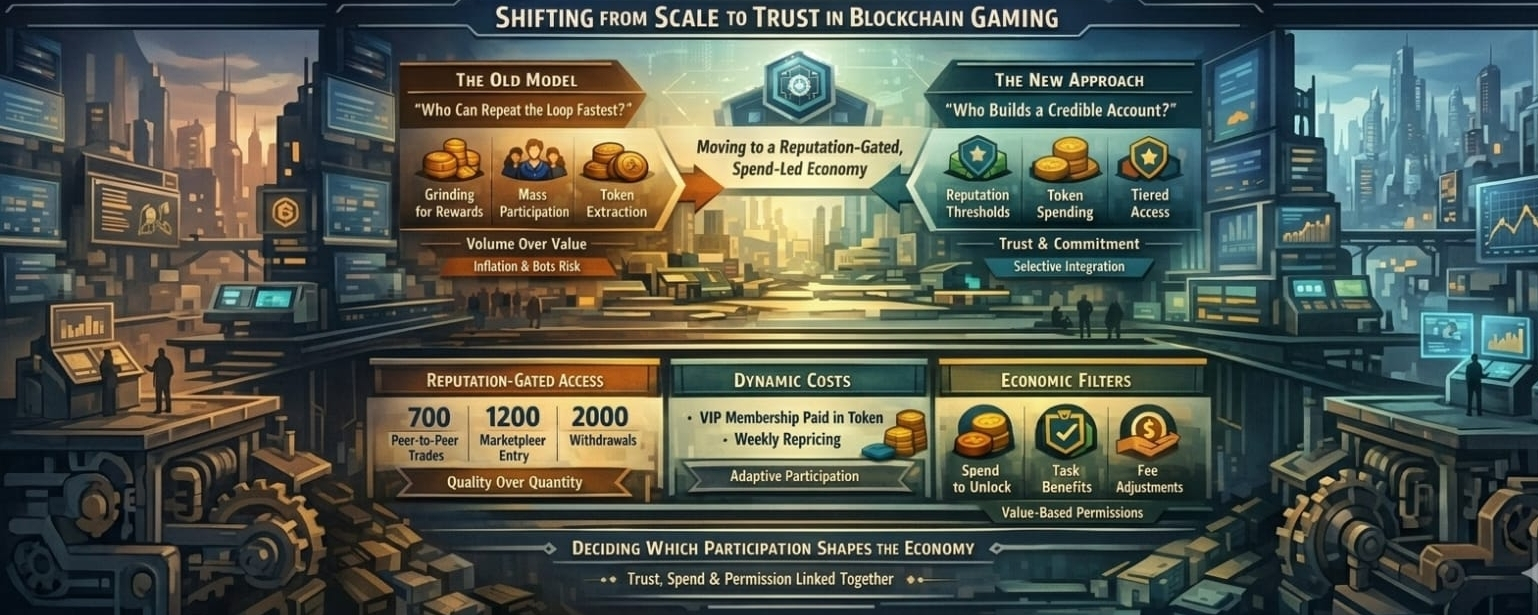
The network already ties important permissions to reputation thresholds: balanced peer-to-peer trades require 700 reputation, marketplace access requires 1200, and withdrawals require 2000. VIP status also adds a meaningful reputation boost and unlocks additional task-board benefits, while the membership itself is paid in the native token and priced on a recurring basis.
The same documentation also frames reputation as a trust layer meant to distinguish loyal participants from those trying to exploit the system.
I think that changes the center of gravity.
Instead of asking, “Who can repeat the loop fastest?” the system is increasingly asking, “Who is willing to build a credible account, stay inside the rules, and direct value back into the economy?” Those are very different questions.
The first one produces throughput. The second one produces social and financial legibility.
The main friction being addressed is not just inflation or botting in isolation. It is the broader mismatch between open participation and trustworthy participation. Pixels has already said that a live onchain soft currency was difficult to manage, especially because web3 makes it easier for farmers to grind harder and sell faster. Its earlier move away from $BERRY toward an offchain coin economy linked to $PIXEL was explicitly framed as a sustainability decision.
That matters because once a system accepts that raw issuance is not enough, it has to find a better filter for who gets access, who gets convenience, and who gets economic leverage.
What I find interesting is that the filter is not built as a single wall. It is layered.
At the state-model level, the chain does not seem to treat every account as economically equivalent. Reputation acts like a state variable attached to account capability. It determines whether an account can enter certain market functions, not just how many tokens it holds.
That is a subtle but important distinction. In many token systems, balance alone becomes the main gate. Here, account history and trust score are part of the operating state.
A user is not only a wallet with assets; the user is also a reputation-bearing participant whose permissions can expand in stages.
At the consensus-selection level, the design logic is also becoming clearer even if it is not presented in formal validator language. Economic access is being selected through reputation and spend rather than through pure presence.
In practice, that means the network is choosing which actors get deeper integration into trading, withdrawals, premium tasks, and convenience rails.
It is a softer kind of consensus, but still a selection mechanism: the system recognizes some forms of behavior as economically weightier than others.
I think that is exactly what a farming-heavy environment eventually has to do.
At the model layer, the spend-led piece matters because it introduces price negotiation back into progression. Coins can be purchased using the token through the bank, VIP is purchased in the token, and the VIP price updates on a weekly cadence.
That means access is not fixed in a static subscription logic. It is periodically repriced, which turns participation into an ongoing negotiation between player demand, token-denominated cost, and the value of the benefits received.
Not a speculative negotiation, but an operational one.
You are effectively deciding whether better access, more tasks, listing capacity, energy support, and reputation acceleration justify the cost at that point in time.
That weekly repricing is a small detail, but I do not think it is trivial.
It suggests the team does not want premium access to become a permanently underpriced leak in the economy. If participation advantages exist, they need to stay adjustable.
Otherwise the system eventually hardcodes a subsidy that players learn to arbitrage. A spend-led economy only works if spending is not symbolic. It has to be an active sink, and sinks need calibration.
The cryptographic flow here is also more grounded than people might assume. The user moves from wallet-held token balance into in-game balances and paid permissions. In other words, token ownership is not the end state; it is the input.
The system then translates that input into offchain coins, VIP status, task access, or reputation-linked progression.
That bridge between onchain asset and in-game state is where the design is doing most of its work. The chain records the scarce asset layer, while the game server can enforce the account-state consequences with much finer control.
That is probably the only realistic way to preserve flexibility without letting every economic parameter become immediately gameable.
Fees, staking logic, and governance also become easier to interpret through this lens. Fees are no longer just frictions on exchange; they are part of account quality filtering.
Older VIP structures even referenced preferred fee treatment, which shows that transaction cost itself can be tuned as a behavioral tool. Spending the token resembles a functional stake in the network’s economic privileges, even if it is not framed as classical lock-and-slash staking. Governance, then, is not only about voting rights in the abstract.
It is also about what kind of player the system wants to privilege: the one extracting temporary value, or the one accepting recurring cost to remain in good standing.
To me, that is the real story. This is not simply a game becoming more expensive or more exclusive. It is a game trying to make economic identity matter more than raw repetition.
In a web3 environment, that feels necessary. Open systems attract scale very quickly, but scale without filters usually turns into noise, then pressure, then distrust.
A reputation-gated, spend-led economy is not perfect. It can over-reward incumbency if the balance is off. It can make access feel too procedural if reputation becomes a blunt instrument. But I still think the direction makes sense.
When a network starts treating trust, spend, and permission as linked variables instead of separate features, it is usually trying to answer a harder question than growth.
Not how to get more players.
How to decide which participation should shape the economy.
