
I’ve stopped expecting clean systems in crypto. The longer you stay around, the more you realize that every mechanism built to “solve” trust just rearranges it. It doesn’t disappear—it shifts shape, hides in different layers, shows up later when you thought you were past it.
So when I look at something like Pixels and the way it leans into credentials and token distribution, I don’t see a neat solution. I see an ongoing experiment. One that’s going to be tested in ways the designers probably expect—and in ways they definitely don’t.
At a distance, credential systems feel almost comforting. You do something, it gets recorded, maybe verified, maybe rewarded. There’s a sense of order to it. A feeling that behavior can be tracked, understood, even trusted.
But that feeling doesn’t last.
Because credentials don’t age well. They sit there, static, while everything around them changes. The person behind a wallet changes. Their motivations shift. The environment evolves. Incentives come and go. What once looked like genuine participation can later look like calculated positioning. Same data, different context.
And context is where things get messy.
Introduce rewards—even small ones—and you can almost watch behavior bend in real time. Not dramatically at first. It’s subtle. People adjust just enough to qualify. Then a little more. Then they start finding edges. Patterns emerge. Not because people are malicious, but because they’re responsive. They learn the system faster than the system learns them.
That’s when credentials start telling a different story.
Not a story of trust, but a story of adaptation.
You see activity, consistency, engagement—but underneath that, there’s often a quieter question: is this behavior meaningful, or just optimized? And the system, no matter how well designed, usually can’t tell the difference. It just records what it’s told to value.
Over time, that gap widens.
Some players keep interacting naturally. Others lean into efficiency. A few go further—automating, coordinating, scaling their actions in ways that stretch the system thin. And suddenly, credentials don’t feel like proof anymore. They feel like footprints. Useful, yes—but incomplete.
That’s where my perspective has shifted over the years. I don’t look at these systems expecting them to create trust anymore. I look at them as ways to preserve evidence.
And evidence is tricky. It doesn’t speak for itself.
A long history doesn’t necessarily mean reliability. A dense cluster of activity doesn’t automatically signal value. Sometimes it just means someone understood the rules better than others—or found ways around them.
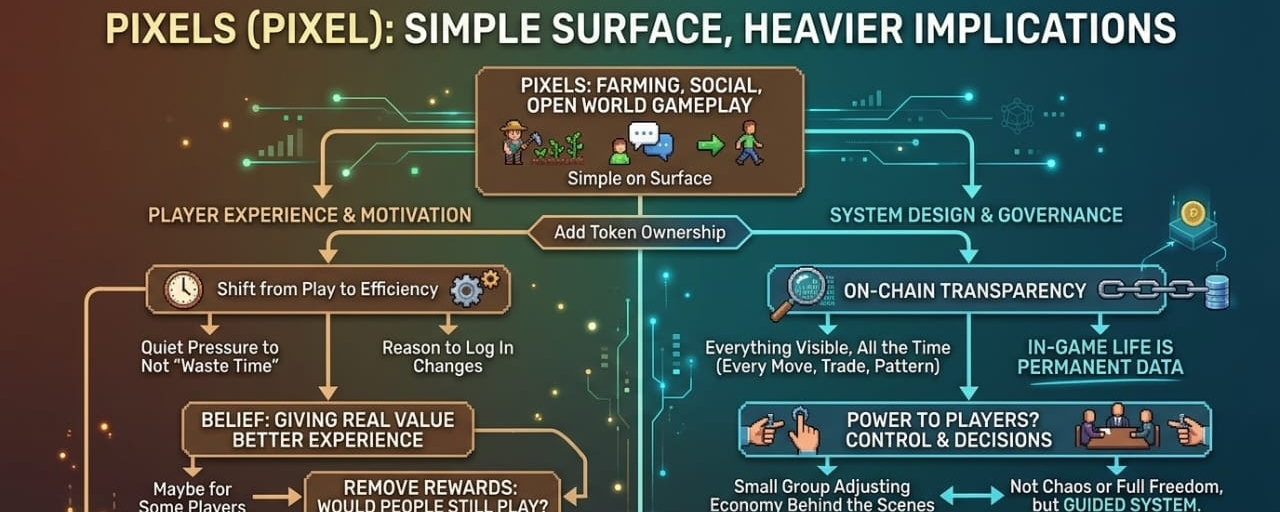
Pixels sits right in the middle of this tension. It’s a game, which makes things even more interesting. Games are naturally about incentives, about pushing boundaries, about figuring out how systems work and where they break. That mindset doesn’t disappear when tokens are introduced—it intensifies.
So now you’ve got a space where behavior is both playful and strategic. Where participation can be genuine one moment and purely extractive the next. And layered on top of that, you’ve got credentials trying to make sense of it all.
I don’t think they fully can. But maybe they’re not meant to.
What matters more, at least from where I’m standing, is whether the system stays readable over time. Whether you can still look at someone’s history and ask reasonable questions about it. Not accept it blindly—but not dismiss it either.
Because that’s the real shift, isn’t it?
It’s not about instant trust anymore. That idea feels outdated. Too clean for what crypto has become. Instead, it’s about giving people the ability to examine trust. To question it. To revisit it later when circumstances have changed.
And those circumstances always change.
Issuers, for example—the ones deciding what counts as valuable behavior—they don’t exist outside the system. They’re influenced by incentives too. Over time, their priorities can drift. What they reward today might not align with what they reward tomorrow. And when that happens, older credentials start to feel… misaligned. Not wrong, just out of sync.
That’s when people start asking uncomfortable questions.
Why did this matter before? Why does it matter less now? Who decided that?
There aren’t always clear answers. And when answers feel shaky, trust doesn’t collapse instantly—it fades. Quietly. Gradually. People become more cautious, or more opportunistic. Sometimes both at the same time.
I’ve seen that pattern repeat enough times to stop being surprised by it.
What I haven’t fully settled on is whether systems like this are getting better at handling that erosion—or just better at delaying it.
Pixels, in its own way, feels like it’s leaning into the reality instead of pretending it doesn’t exist. It doesn’t eliminate noise. It structures it. It records behavior, even when that behavior is imperfect, reactive, or self-serving.
There’s something honest about that. But also something unresolved.
Because recording trust isn’t the same as understanding it.
And understanding it requires interpretation—by users, by communities, by whoever’s paying attention closely enough to notice when patterns stop making sense.
That part can’t be automated. Not fully.
So where does that leave things?
Somewhere in the middle, I think. Not cynical enough to dismiss the effort, but not convinced enough to rely on it either. Just watching how it evolves. Watching how people interact with it when incentives change, when pressure builds, when the easy phase passes.
Trust doesn’t arrive fully formed in systems like this. It moves. It weakens, strengthens, fractures, reforms.
And credentials? They just sit there, quietly keeping track.
Whether we interpret them correctly—that’s still an open question.