
I faded Pixels the first time I saw it.
Looked like the same old loop we’ve all been farmed by before—plant crops, wait on timers, harvest, dump the token, pretend you’re early. Close tab, move on. I didn’t even bother opening docs. Felt like I’d already seen the ending.
Then I actually touched it.
Not deeply. Just enough to realize something felt… off.
⸻
It’s Not Just “Farm → Dump”
Most GameFi loops are trivial to model:
input time → output token → sell pressure → collapse
Pixels resists that in subtle ways.
You still farm, sure. But the system keeps taxing you quietly:
crafting consumes resources you thought were “profit”
upgrades absorb tokens instead of amplifying extraction
land interactions introduce dependency, not just yield
progression slows you down just enough to break linear scaling
So instead of a clean extraction curve, you get friction everywhere. Death by a thousand sinks.
And that friction matters more than people think.
⸻
The Real Game Isn’t the Farm—It’s the Meta Layer
The weirdest (and most under-discussed) part is the social layer—often referred to as Tastemakerz dynamics.
This is where Pixels stops being a farming sim and starts behaving like a market.
The “optimal strategy” isn’t fixed. It’s discovered:
players experiment with loops
someone finds a slightly more efficient path
that knowledge spreads (Discord, Twitter, guilds)
the edge disappears
new meta forms
So instead of a solved economy, you get a constantly shifting one.
It’s closer to trading than farming.
And importantly: information becomes an economic asset.
⸻
What Happens When Tokens Don’t Leave the Ecosystem?
This is the part most people miss.
In typical P2E:
tokens are outputs
players are sellers
the game is just a faucet
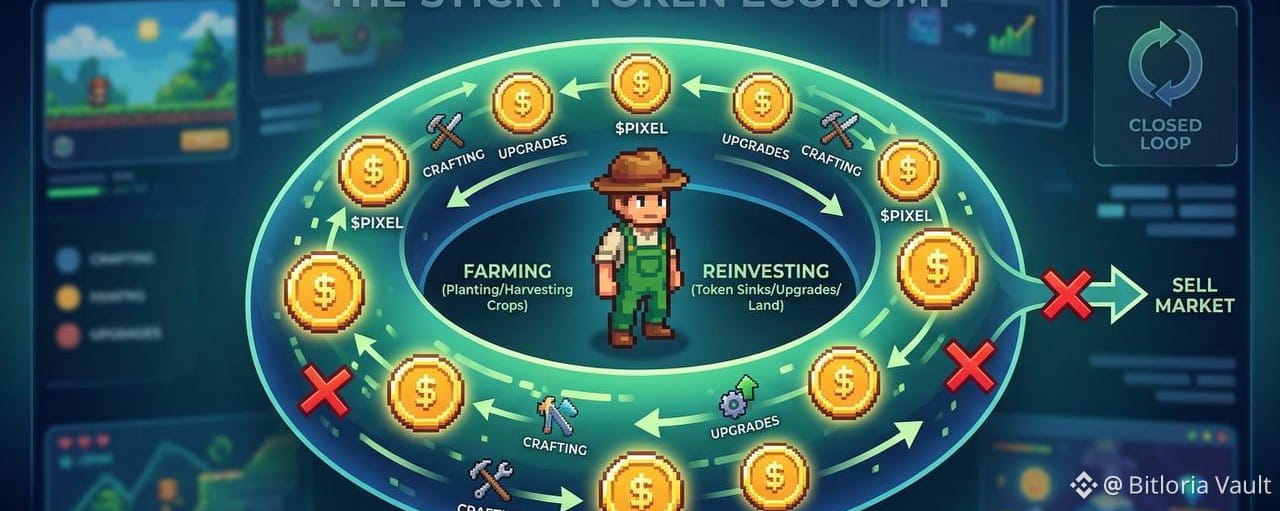
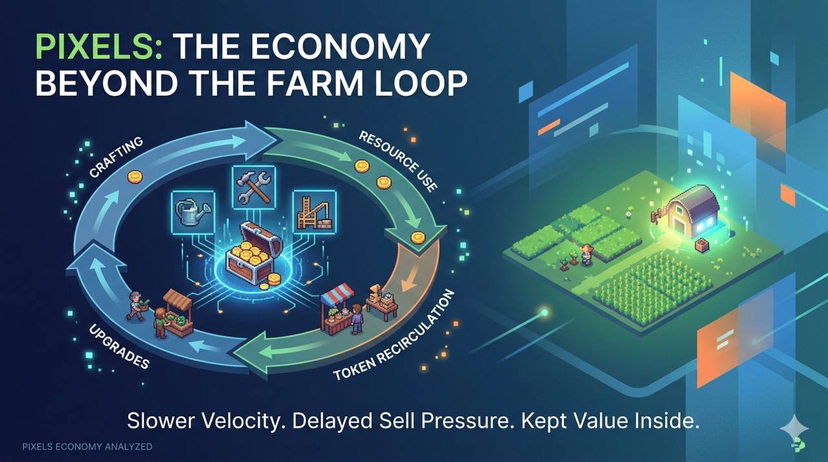
In Pixels, tokens behave more like internal fuel than payout.
They circulate.
⸻
Closed-Loop Pressure (Why It Feels Different)
When tokens don’t immediately leave the system, a few things happen:
1. Velocity drops
Players aren’t instantly dumping. Tokens get reused—crafting, upgrading, unlocking.
2. Sinks become meaningful
Most games pretend to have sinks. Pixels actually enforces them. You feel the burn.
3. Price pressure gets delayed, not removed
This is important. It’s not magic. Sell pressure still exists—it’s just not immediate.
4. The game starts acting like an economy, not a faucet
Resources, time, and decisions matter. Not just emissions.
⸻
But Let’s Not Romanticize It
A closed-loop system doesn’t mean “sustainable forever.”
It just means:
the system can absorb pressure longer
the collapse (if it comes) is slower and more complex
the game has time to evolve before extraction dominates
That’s a big upgrade from most GameFi, but it’s not a free pass.
If inflows dry up or sinks lose relevance, the loop breaks like anything else.
⸻
The Subtle Shift
What Pixels gets right isn’t some revolutionary mechanic.
It’s restraint.
Instead of letting you:
farm efficiently → extract immediately → leave
It forces you into:
farm → reinvest → adapt → compete → maybe extract
That “maybe” is doing a lot of work.
⸻
Final Thought
I went in expecting another disposable farm loop.
What I found was something stickier—not because it pays better, but because it slows you down just enough to keep you inside the system.
And in GameFi, that’s half the battle:
not printing value…
but preventing it from escaping too quickly.