
You ever had one of those days where you did everything right—showed up on time, followed the rules, put in the effort—and still felt like the outcome didn’t fully match what you gave?
Not in an obvious, unfair way. Just slightly off. Like something behind the scenes was shaping the result more than your effort was.
That’s the feeling you slowly start to recognize inside Pixels.
At first, it feels peaceful. You plant crops, harvest them, upgrade tools, expand your land. There’s a rhythm to it. It rewards consistency, and for a while, it really does feel like effort equals progress.
But if you stay long enough, you start noticing something subtle. Two players can put in similar effort… and still end up in very different positions. And that’s where the illusion begins to crack.
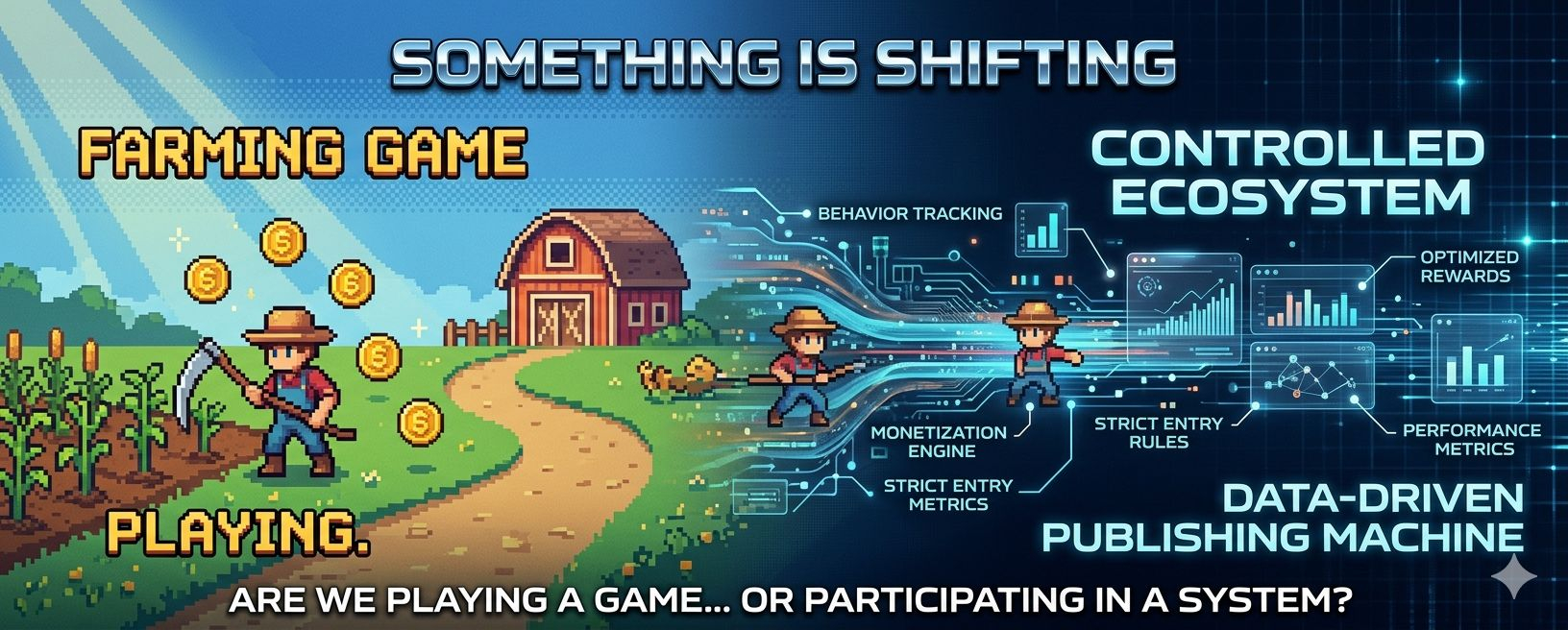
Because Pixels isn’t just a game. It’s a system.
And like any system, it has rules that aren’t always visible at the surface.
Every player inside it is essentially working—turning time into output. The token, PIXEL, becomes both your reward and your requirement. You earn it through playing, and you spend it to keep progressing. And then, sitting quietly in the background, are the developers—the ones who shape how fast rewards come, where they go, and how the whole thing stays balanced.
That balance is where things get interesting.
New PIXEL is constantly being created. You earn it from farming, tasks, events—basically, from participating. It feels like income. But at the same time, the system asks you to spend it. Upgrade your tools, improve your land, unlock better efficiency. Some of that PIXEL disappears from the system through these actions, which is meant to keep things stable.
But here’s the part most people don’t think about: the system usually creates a little more than it destroys.
Not enough to panic. Just enough to matter over time.
So what keeps things running smoothly? It’s not just supply mechanics—it’s behavior. Players are encouraged to reinvest what they earn. To keep upgrading. To stay engaged. Because the moment players stop cycling their tokens back into the system and start pulling value out, the pressure starts to show.
And that’s where design plays its role.
The demand for PIXEL doesn’t just happen naturally. The game creates it. Progress is intentionally a bit slow. Efficiency is slightly out of reach. And PIXEL becomes the shortcut, the optimizer, the thing that makes everything smoother. It feels like a choice, but it’s also part of the structure.
Then there’s timing.
If you came in early, things felt different. Rewards were stronger, assets were cheaper, and the competition wasn’t as intense. You could build position more easily. Land, items, upgrades—they weren’t just tools, they were advantages that compound over time.
If you come in later, you’re not locked out. But you’re playing a different version of the same game. Costs are higher, margins are thinner, and you’re competing with people who already have momentum. Your effort still counts, but it doesn’t stretch as far.
From a trader’s point of view, all of this translates into something very simple: flows matter more than stories.
When more players are active, when updates push people to spend, when the system is absorbing tokens faster than it’s giving them out, things feel strong. Price tends to reflect that energy.
But when players start taking more than they’re putting back, when engagement drops after the excitement of an update fades, or when rewards feel less meaningful, the balance shifts. And price starts telling a different story.
You’ll notice it if you pay attention. The same cycle plays out again and again, just with different packaging each time. A new update brings attention. Players rush in. Rewards feel good. Activity spikes. Then slowly, people start cashing out. The system tries to stabilize things. Interest cools off. And eventually, something new arrives to restart the loop.
It’s not random. It’s a pattern.
And then there’s the deeper layer—the one most people feel but don’t say out loud.
Price and players move together. When PIXEL goes up, more people show up. When more people show up, demand increases. It feeds itself. But the same thing happens in reverse. If price drops, attention fades. Less activity means less demand. And the system can start slowing down faster than expected.
That’s the fragile part.
Because at the end of the day, Pixels isn’t trying to reward everyone equally. It’s trying to keep itself alive. It rewards people who understand when to push, when to hold back, and how the system actually works—not just how it looks.
Effort is part of the equation. But it’s not the whole equation.
And once you see that, you stop playing it like just a game.
You start reading it like a system.
In Pixels, the real advantage isn’t how much you play—it’s how well you understand what’s quietly shaping the outcome.