
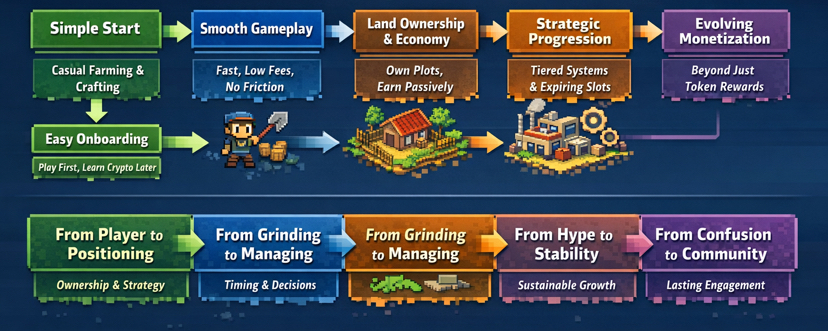
Pixels feels like one of those rare crypto projects that does not try to win attention through noise. Instead, it invites people in through atmosphere, rhythm, and a sense of place. In a market often dominated by speculation, pressure, and fast-moving narratives, Pixels offers something gentler. It is a social casual Web3 game built on the Ronin Network, but its deeper appeal lies in how naturally it blends play, community, and digital ownership into a single living world. The experience feels less like a product being pushed and more like a space being discovered.
At the center of Pixels is a simple but powerful idea: people do not always want complexity, they want connection. Farming, exploration, and creation may sound modest compared with the loud promises that often surround crypto gaming, yet that is precisely what gives the project its strength. These activities carry a human pace. They reward patience, routine, and curiosity. They create the kind of loop that players can return to without feeling exhausted. In a digital economy that often moves too quickly for its own good, this slower rhythm can feel surprisingly valuable.
The open-world structure adds to that appeal. Instead of reducing the game to a narrow objective, Pixels gives players room to wander, build, and shape their own experience. That sense of freedom matters in Web3, where ownership can sometimes be presented as the only feature that matters. Ownership is important, but alone it is not enough. A token, a wallet, or a marketplace cannot sustain attention without a world worth inhabiting. Pixels understands this better than many projects. It does not treat gameplay as decoration around the token economy. It treats gameplay as the foundation.
Ronin also plays a meaningful role in the story. As a network associated with blockchain gaming, Ronin provides the kind of environment that makes a project like Pixels more practical and more believable. For a game built around frequent interaction, accessible movement, and community-driven progression, the underlying chain matters. Players want smooth experiences, not friction. They want a system that feels alive rather than technical. By operating on Ronin, Pixels positions itself within an ecosystem that already understands the needs of Web3 games and the importance of keeping the player experience clean.
What makes Pixels especially interesting is the emotional tone it creates. There is something comforting about a game that values ordinary actions. Farming may seem small, but in a digital world it becomes symbolic. It suggests care, patience, and continuity. Exploration brings a feeling of possibility. Creation turns the player from consumer into contributor. Together, these elements give the game a softness that is unusual in crypto, where language often leans toward urgency, hype, and domination. Pixels feels more like growth than conquest.
That emotional quality may be one of its strongest long-term advantages. Crypto projects often struggle because they ask people to care about abstract systems before those systems have earned trust. Pixels takes a different route. It asks people to care about a world first. When the world feels pleasant, social, and rewarding, the token layer becomes easier to understand and easier to value. This does not remove risk, of course. No crypto project is free from market volatility, shifting player attention, or broader ecosystem pressure. But it does mean that Pixels is building on something more durable than speculation alone.
There is also a broader cultural story here. Web3 gaming has spent years trying to prove that digital ownership can be more than a slogan. Many projects have struggled because they focused too heavily on mechanics that felt financial rather than fun. Pixels belongs to a newer generation that seems more aware of what players actually want. People want worlds that feel alive. They want social environments that reward participation. They want a reason to come back tomorrow, not just a reason to buy today. If Pixels can continue to deliver that feeling, it may become more than just another name in the market. It may become a reference point for what casual blockchain gaming can look like when it is built with care.
The beauty of Pixels is that its ambition feels restrained in the best possible way. It does not need to shout to be noticed. It does not rely on towering complexity to appear serious. Instead, it offers a calm digital life that still carries economic meaning. That combination is rare. It speaks to a future where crypto games do not have to choose between being enjoyable and being meaningful. They can be both. They can be warm, social, and economically interesting at the same time.
In that sense, Pixels is not only a game. It is a reflection of where the Web3 space may be heading when it grows up a little. Away from constant noise, away from empty promises, and toward experiences that are simple enough to enjoy and deep enough to matter. That is a quiet kind of progress, but often the most lasting kind.