
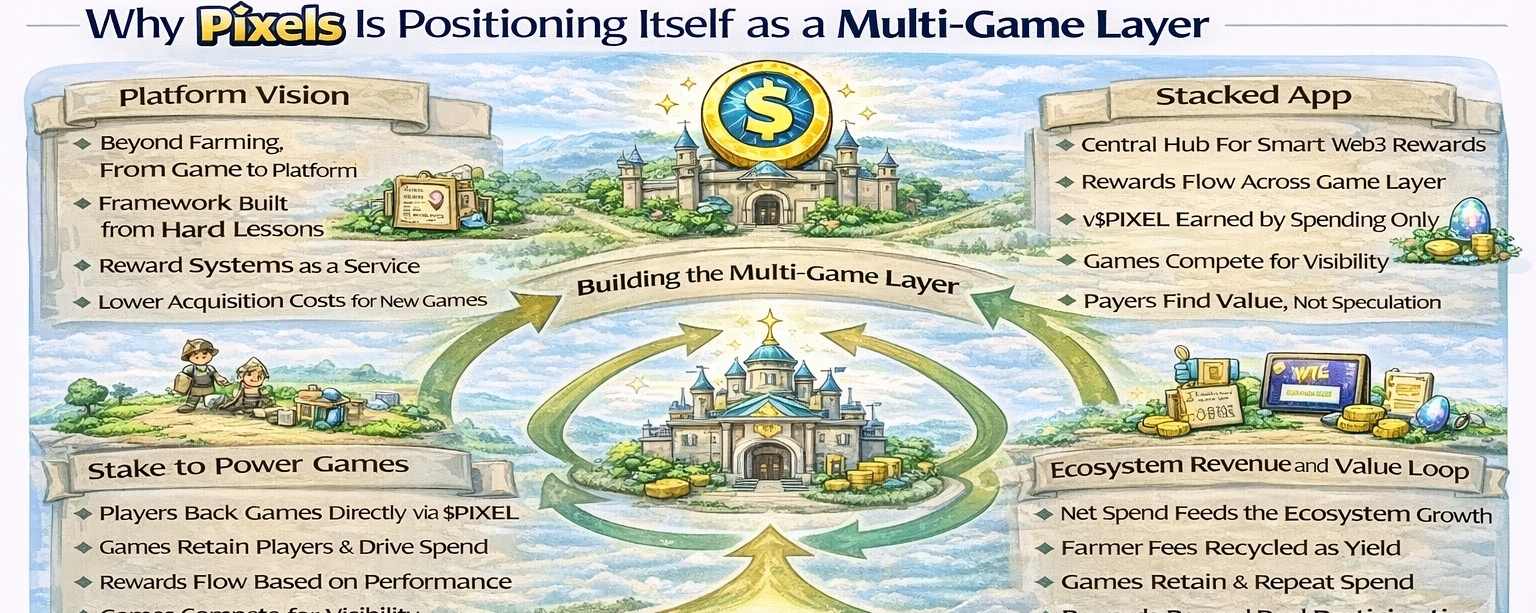

@Pixels I think the most important thing to understand about Pixels right now is that it is no longer acting like a studio that wants one game to carry one token. It is acting like a company that learned how hard it is to make an onchain game economy hold up over time, and then decided to productize that lesson. That is why the “multi-game layer” framing matters. It is Pixels admitting that a single hit game has limits when rewards, extraction, and retention collide inside the same economy.
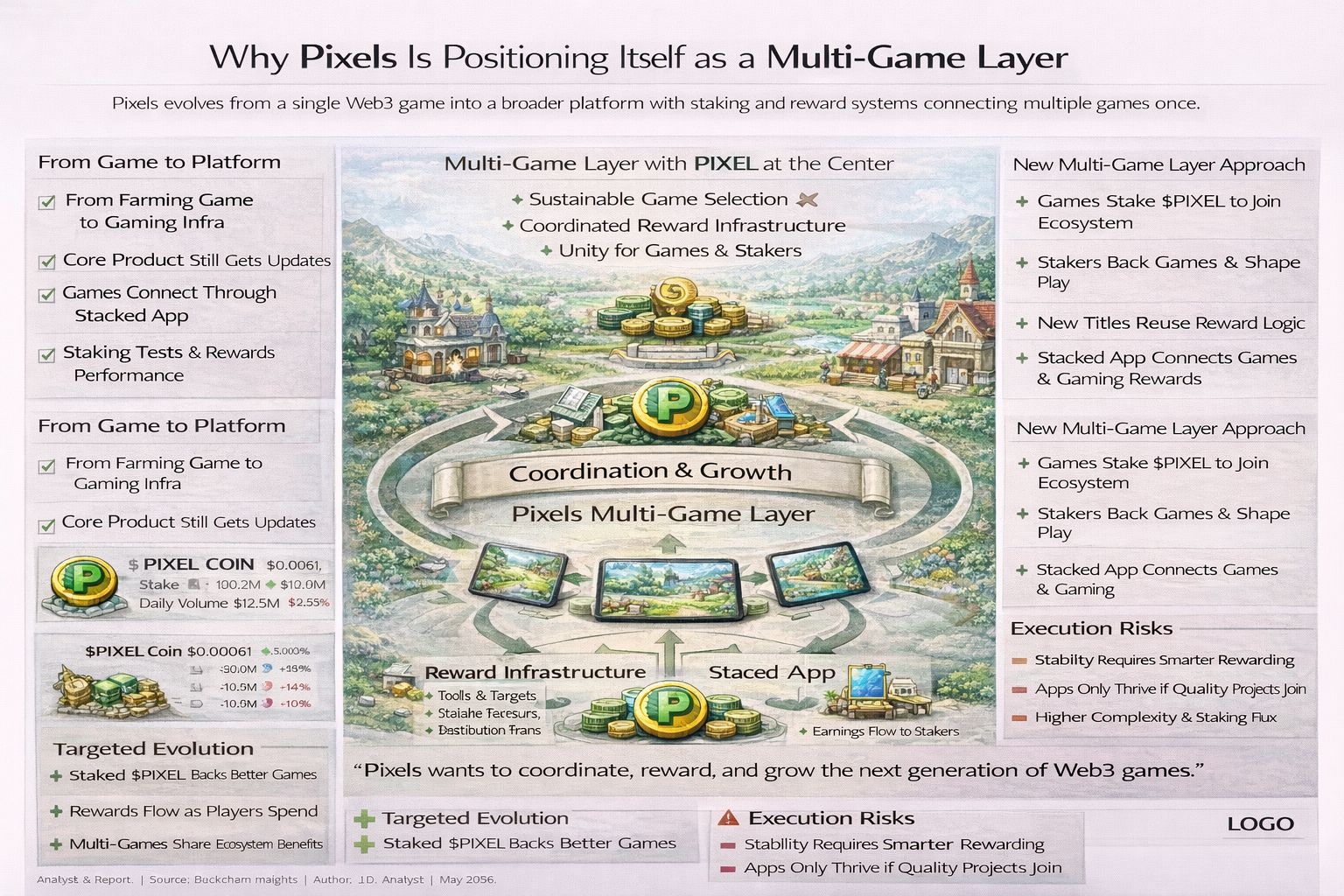
What changed my view is the team’s own language. On its main site, Pixels now describes itself as a platform where users can build games, not just as a farming game. In the whitepaper, the team says its ambition was always broader and lays out a flywheel built around fun-first design, smarter reward targeting, and lower acquisition costs as more games join the system. That suggests Pixels wants to own the reward logic, data loop, and distribution layer underneath games, not just the first game that got attention.
To me, this is a rational response to the project’s own scars. Pixels says that in 2024 it generated $20 million in revenue and became the top web3 title by daily active users, but it also says token inflation, sell pressure, and badly targeted rewards hurt the ecosystem. That matters because crypto gaming is judged on the wrong scoreboard. People see a token rally or a burst of users and assume that proves durability. Pixels is arguing the opposite: a game can be popular and still have a weak economy. Building a multi-game layer is its attempt to reward behavior that compounds value.
The core mechanism is staking, but not in the old passive sense. Pixels says games themselves become the primary validators of the ecosystem. Players stake $PIXEL toward games, those games compete by retaining players and generating net spend, and rewards flow according to performance. I think that is the smartest part of the thesis because it turns the token from a simple in-game reward into a coordination tool. It also gives Pixels a way to test which games deserve more support. The real question becomes whether several games can create repeatable demand, not whether one flagship can carry everything forever.
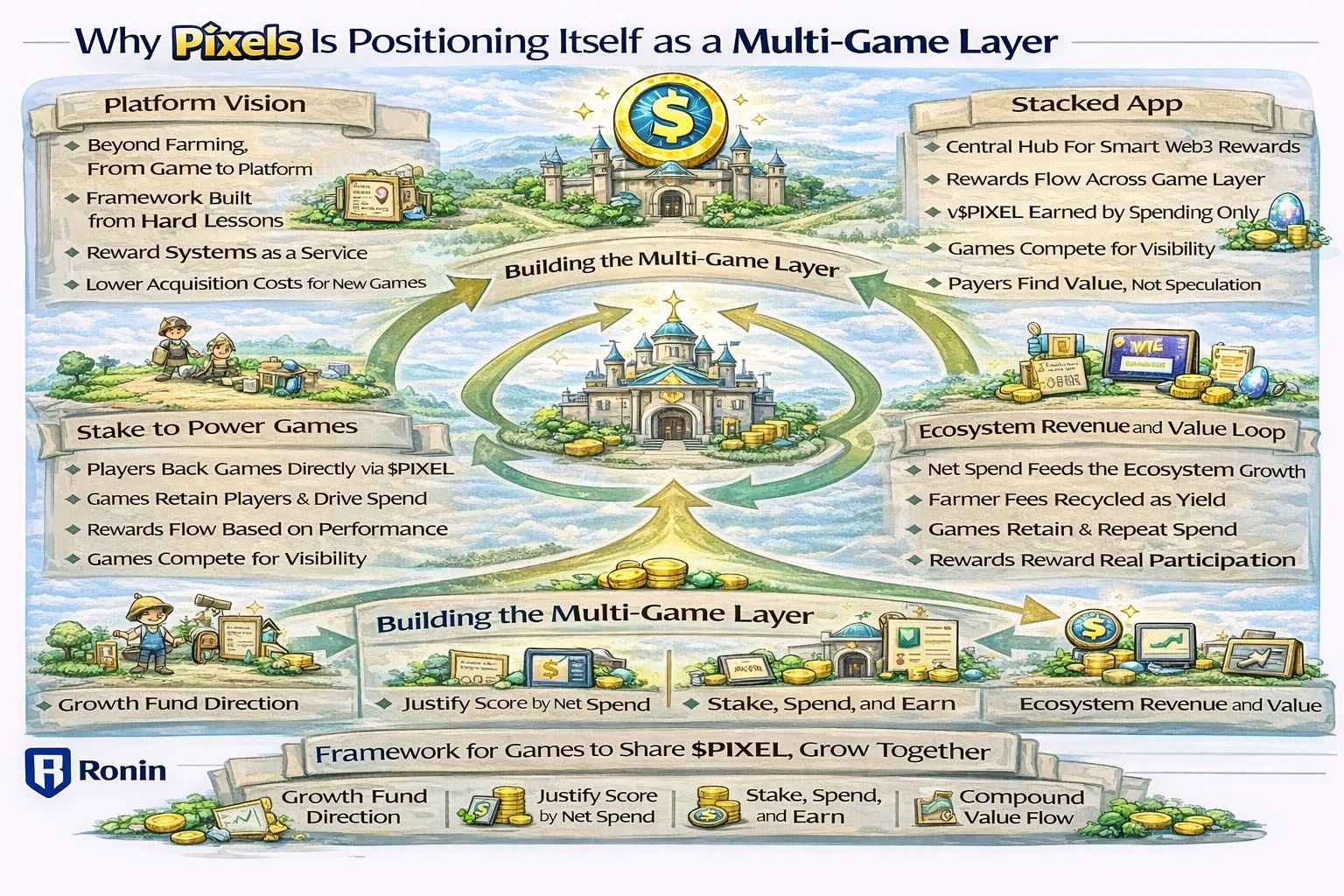
What makes this matter now is that the infrastructure is already moving from theory into product. The official staking rollout began in May 2025 with phases meant to expand from a curated game set toward broader eligibility. In March 2026, the team said Stacked was already integrated into Pixels and that the standalone app would surface rewards across multiple games. It also framed Stacked as the reward system built from hard lessons about sustainable play-to-earn. Meanwhile, the core product is still shipping updates, including a large Tier 5 content release on April 15, 2026. That tells me the team is extending the platform without abandoning the base game.
I still think the risks are real. A multi-game story can sound stronger than the execution underneath it. More games do not automatically create better economics; they can also multiply complexity and low-quality supply. The model depends on good data, targeted rewards, and games that can convert activity into durable spending. If that loop fails, the layer thesis starts to look like narrative cover for a token that needs new demand. There is also a short-term tension in the project’s own messaging: it wants $PIXEL to stay central for staking while reducing constant sell pressure.
My takeaway is simple. I would not analyze Pixels today as a single farming game, and I would not analyze it as a pure token trade either. I would analyze it as an attempt to become a gaming coordination layer whose value depends on whether multiple games can share rewards, data, and monetization more efficiently than they could alone. The upside is platform utility. The risk is execution drag. For me, the right lens is to watch whether more games join, whether rewards get smarter, and whether core updates keep landing while the economy gets healthier. That is where the real proof will be.