
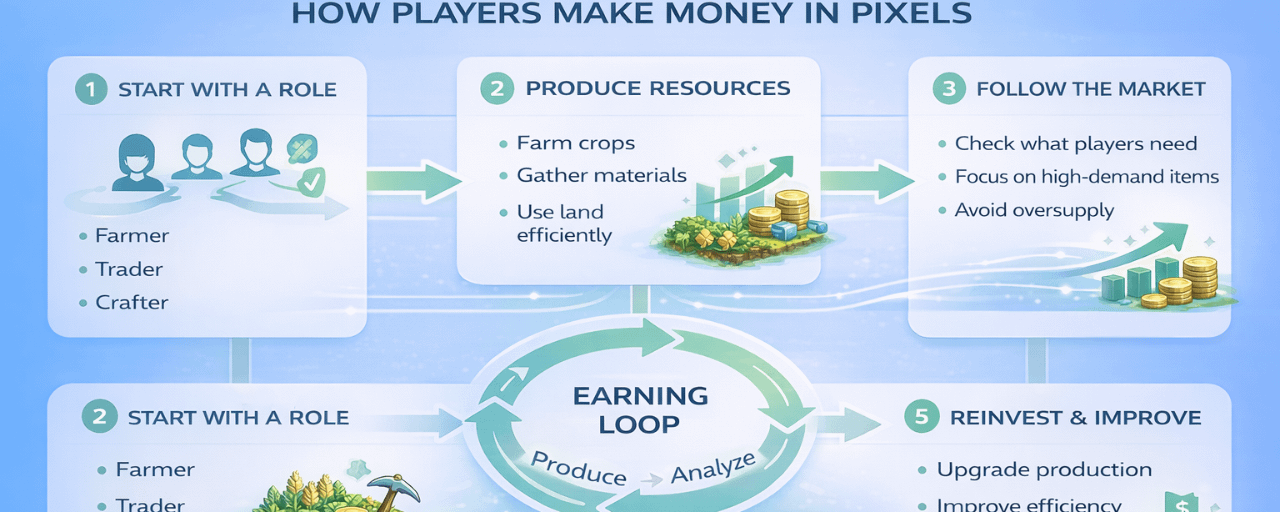
Most Web3 games say you “own” your assets—but in reality, you’re just holding them. They sit there, waiting for value to change, without really affecting how you play. And the more I thought about it, the more I started to question whether that kind of ownership actually means anything.
I used to think ownership in most Web3 games was mostly symbolic. You own an asset, a token, or a piece of land, and that ownership is supposed to represent value. But in practice, it often felt passive. You hold it, you wait, and maybe it appreciates over time. It didn’t always change how you actually engaged with the system.
So when I first looked at @Pixels , I assumed ownership would follow that same pattern—acquire something, keep it, and benefit later. At that point, ownership felt more like a status than a function.
But the more I paid attention, the more I started to see a different structure forming—ownership tied to responsibility, not just possession. In many systems, ownership is detached from activity. You can hold an asset without contributing anything to the ecosystem, and the value exists independently of how it is used.
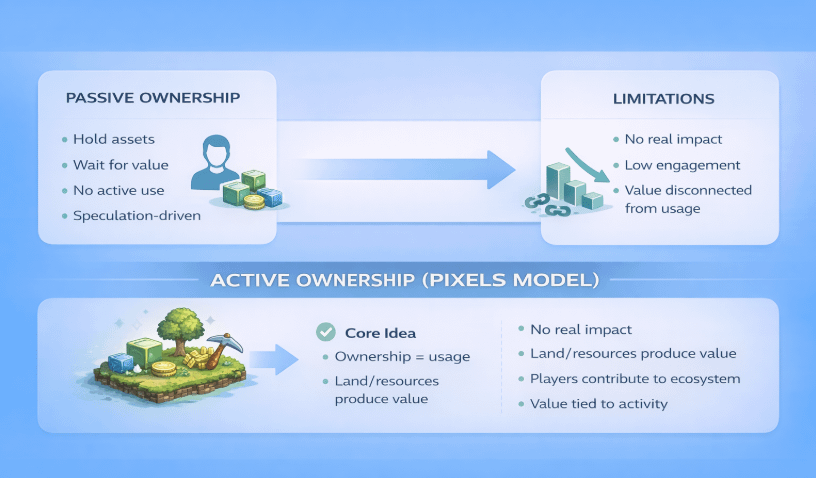
That creates a gap between owning and participating. Pixels seems to approach ownership differently, where what you own is not just something you keep—it’s something you use, manage, and integrate into the system. Whether it’s land, resources, or production capacity, ownership becomes part of how value is created.
Take land as an example. In a passive system, land is something you hold and potentially trade later. But in Pixels, land functions more like infrastructure. It’s a space where resources are produced, decisions are made, and activity is concentrated.
What you choose to do with that land matters. How you organize it, what you prioritize, and how consistently you engage with it all influence what it generates. This introduces a different dynamic, because now ownership carries expectations. You’re not just holding an asset—you’re operating it.
Once that shift happens, the system starts to feel different. Ownership is no longer separate from participation—it becomes part of it. This also changes how value is perceived. Instead of being based purely on scarcity or speculation, value becomes linked to productivity. An asset isn’t just valuable because it exists, but because of what it enables.
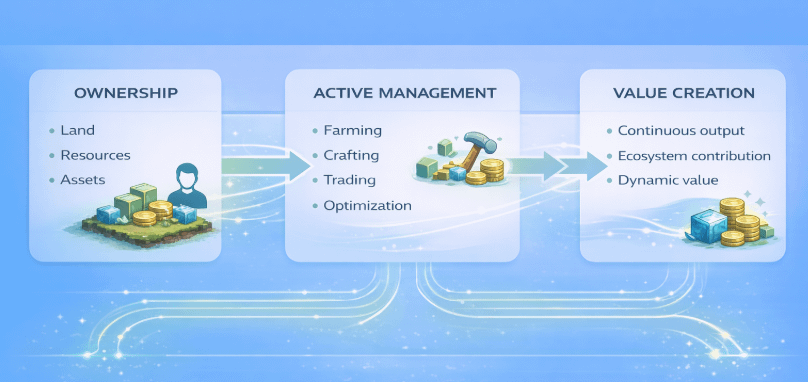
That creates variation, where two players can own similar assets but achieve completely different outcomes depending on how they use them. One may treat it passively, while another actively integrates it into the ecosystem, and over time those differences compound.
That’s where the feature becomes meaningful, because it rewards engagement through ownership, not just ownership itself. It also encourages long-term thinking. When ownership is passive, short-term behavior dominates—buy, hold, and potentially exit. But when ownership requires participation, the incentive shifts.
Players begin to think about sustainability: how to maintain output, how to stay relevant within the system, and how to adapt to changes in demand. These questions start to shape behavior, and that behavior feeds back into the system itself.
From a broader perspective, this kind of design creates stronger foundations. Active ownership leads to continuous contribution, and instead of assets sitting idle, they become part of ongoing activity that keeps the ecosystem moving. I
t also reduces reliance on constant external incentives, because engagement is driven by what players manage rather than what they are given. Of course, this kind of system requires balance. If the effort required becomes too high, it can discourage participation, and if contribution isn’t rewarded fairly, it can create friction. But when it works, it aligns ownership with purpose.
Looking at it now, I don’t see ownership in Pixels as something static anymore. It feels more like a role—a position within the system that carries both opportunity and responsibility. It changes how the entire experience is structured, because instead of separating players into owners and participants, it brings those roles together. You don’t just own part of the system—you operate within it. And maybe that’s the real shift. Not just ownership as a concept, but ownership as participation. Because in the end, what matters isn’t just what you hold, but how you choose to use it.
$PIXEL
