
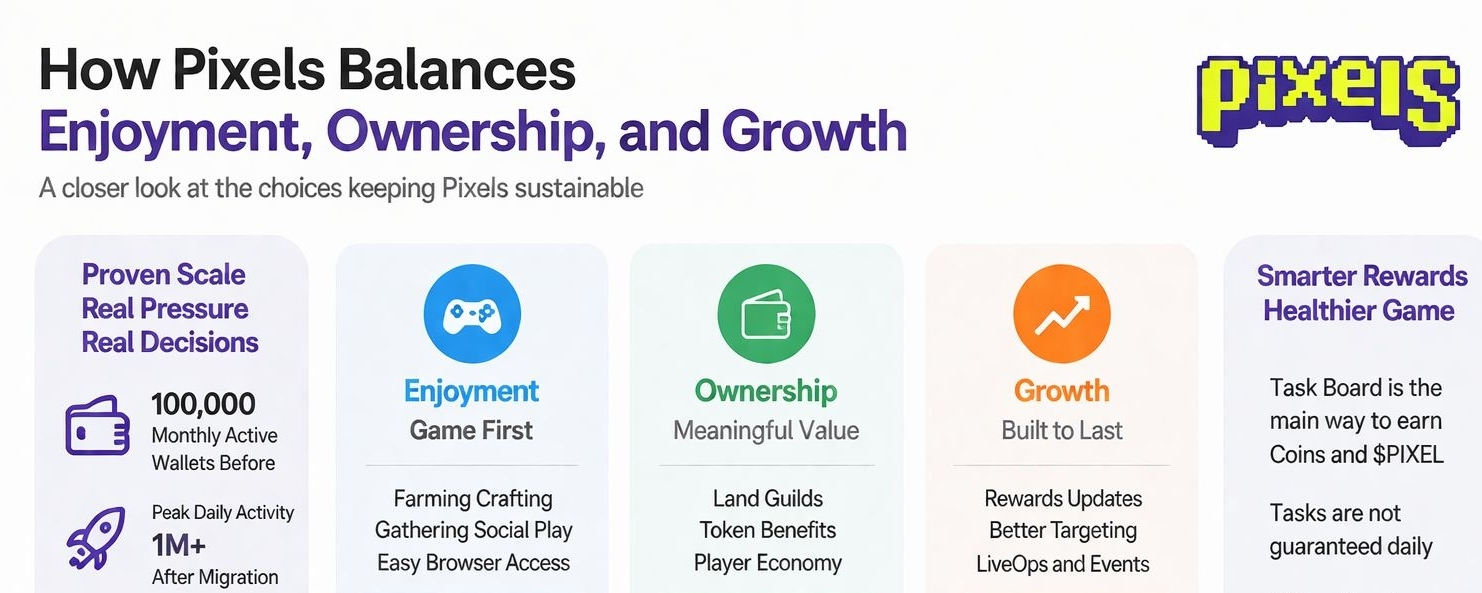

I keep coming back to Pixels because it forces a harder question than most blockchain games do and I am not really asking whether it can attract users for a season or whether its token can catch a narrative. What I keep asking instead is whether a game built around ownership can still feel like a game first. From the beginning Pixels framed its answer in unusually plain terms by saying that fun comes first while blockchain ownership matters and deeper decentralization should happen slowly enough that the product does not break under its own ideals.
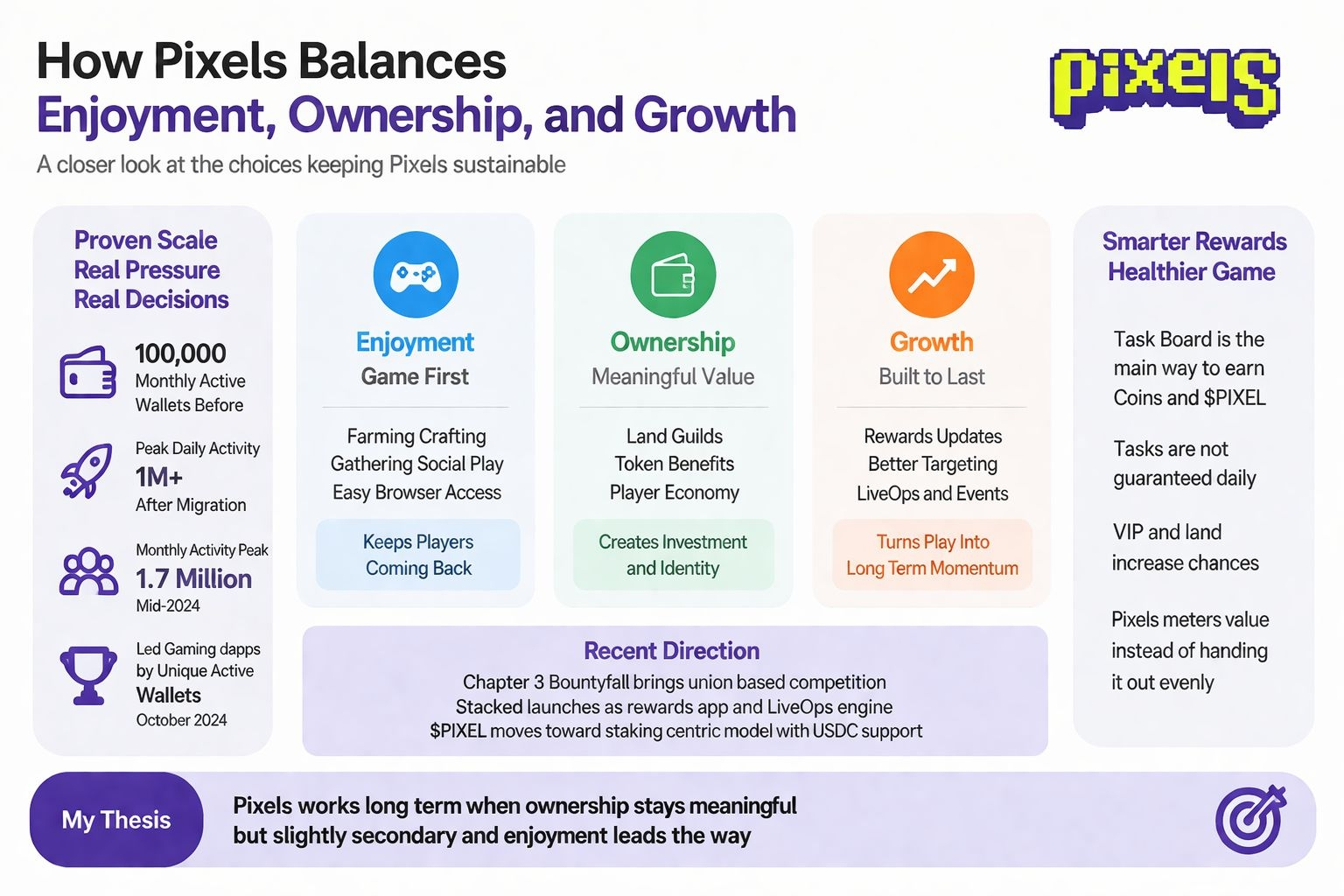
What makes Pixels worth taking seriously is that it has already gone through a real stress test. Ronin said that before the move Pixels had around 100,000 monthly active wallets and 5,000 daily active users. After the migration Ronin later described Pixels’ peak daily activity as moving from roughly 220,000 to more than 1 million while monthly activity peaked around 1.7 million in mid-2024. DappRadar also reported that Pixels led gaming dapps by unique active wallets in October 2024. That kind of scale is exactly why people still pay attention now because five years ago most of this category was still arguing in theory and Pixels has had to make decisions under pressure with enough players that design mistakes show up quickly and publicly.
I find it helpful to look at Pixels as a balancing act between three promises that naturally pull against each other. Enjoyment comes from the everyday loop of farming crafting gathering social play and a browser game that is easy to enter. Ownership comes from the parts that can be held traded or amplified across the system especially land guild structures and token-linked benefits. Growth comes from rewards updates and the game’s ability to turn casual play into a reason to come back tomorrow. The clever part is that Pixels does not treat all three equally at every moment and the game’s current reward structure makes that clear. The Task Board is described by Pixels as the primary way to earn Coins and $PIXEL in game and it explicitly says that $PIXEL tasks are not guaranteed each day while VIP and land ownership can increase the chance of seeing them. That tells me Pixels is not trying to hand out value evenly because it is trying to meter it.
That is also where the project’s strongest logic and its biggest weakness meet. The strong logic is easy to respect because earlier play-to-earn systems often failed when extraction was too easy and entertainment was too thin. Pixels’ own economics page warned against assuming blockchain games could sustainably monetize far above normal games and the team has since been more blunt. In a January 2026 AMA recap Pixels said that when daily activity peaked around one million in June 2024 it was giving out more than 100,000 rewards per day while bringing in only about $50,000 to $60,000 of daily revenue which it called unsustainable. I actually trust Pixels more because it has said that out loud. The weakness is that once you accept that lesson the game starts relying on filters such as reputation gates farmer fees staking spending tiers and better targeted rewards. Those systems may improve economics but they also risk making the experience feel less open and less legible for ordinary players.
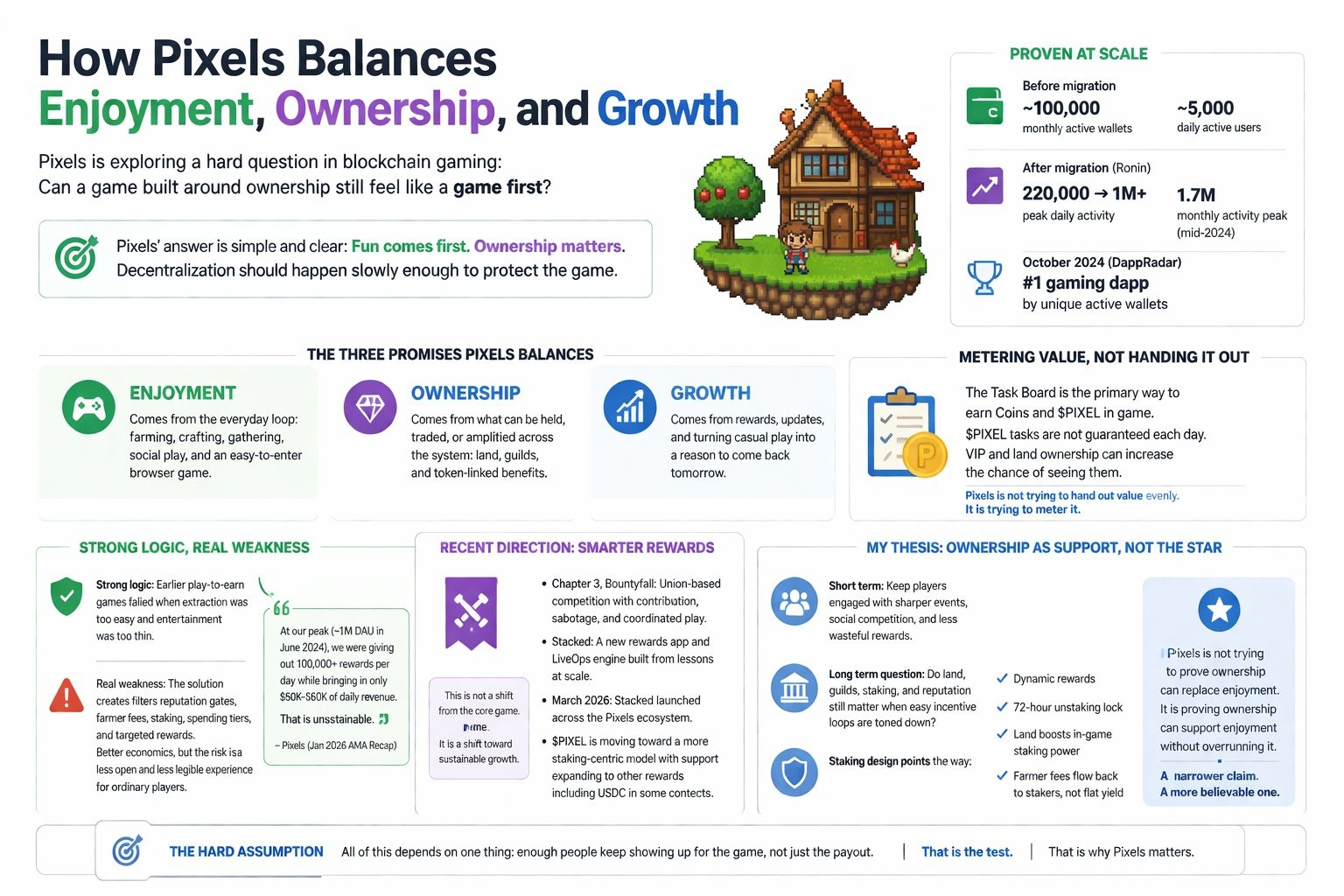
The recent direction makes the trade-off even clearer because Chapter 3 Bountyfall shifted Pixels toward union-based competition where rewards depend on contribution sabotage and coordinated play rather than simple passive farming. Around the same time the team began describing Stacked as the broader rewards system built from what Pixels learned at scale. In March 2026 it introduced Stacked as a rewards app and LiveOps engine while saying that it was launching first across its own ecosystem and signaling that $PIXEL is likely to become more staking-centric over time with support broadening to other reward types including USDC in some contexts. I used to think that would mean Pixels was drifting away from its core game but now I think it shows the opposite because the team seems to understand that growth based on blunt emissions is fragile while growth based on better reward targeting might actually preserve the game instead of hollowing it out.
My own thesis is that Pixels only works long term if ownership stays meaningful but slightly secondary. Not fake and not decorative but secondary. Right now what matters most is whether the game can keep players engaged with sharper events social competition and less wasteful rewards while later the deeper question is whether land guilds staking and reputation still matter when the easy incentive loops are toned down. Staking today already points in that direction because rewards are dynamic while unstaking has a 72-hour lock and land boosts in-game staking power as farmer fees flow back to stakers rather than promising a flat yield. That is a serious attempt to slow extraction and tie value to behavior even though it still depends on a hard assumption that enough people will keep showing up for the game and not just the payout. I think that is why Pixels is interesting because it is no longer trying to prove that ownership can replace enjoyment and is instead trying to prove that ownership can support enjoyment without eventually overrunning it. That is a much narrower claim and to me a far more believable one.
