
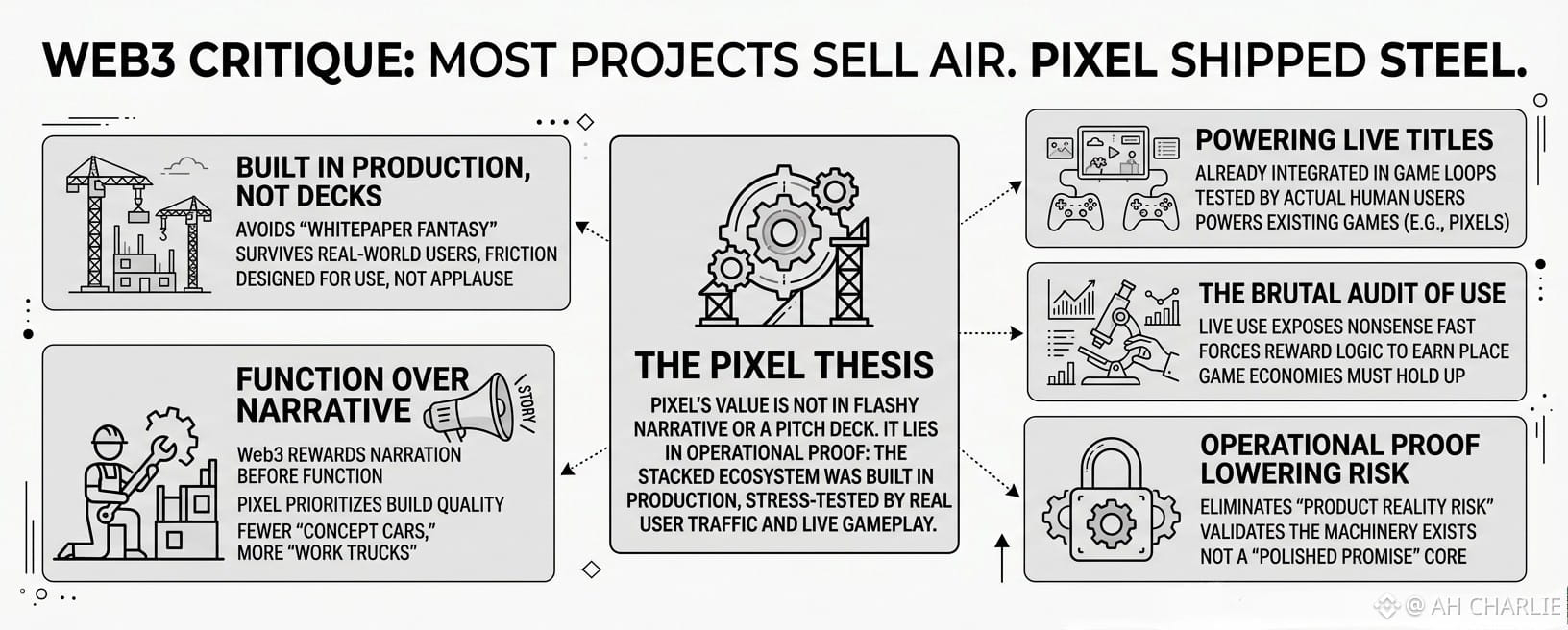
I’ve lost count of how many crypto projects were born inside a slide deck, dressed up in clean diagrams, fed a few shiny words, then pushed out into the market like they were finished machines. Same ritual every time. Big vision. Fancy roadmap. Token logic hanging in the air like smoke.
Then you look closer and there’s no real product. No real players. No pressure. Just theory wearing makeup. That is why PIXEL gets my attention. Not because the story is loud. Because it is not. The line that matters is simple, Stacked was built in production, not in a deck. That sounds small. It is not small.
In this industry, that is almost a moral statement. It means the system had to survive real users, real mistakes, real friction. Not a brainstorming session. Not a whitepaper fantasy. Real traffic. Real gameplay. Real failure points. That changes the whole conversation. A lot of Web3 projects feel like concept cars at an auto show. Polished shell. No engine underneath. You can admire the curves, sure. You just can’t drive the thing.
PIXEL, through Stacked, looks more like a work truck. Maybe less glamorous. Fine. But it starts in the morning and does the job. That difference matters because crypto has a habit of rewarding narration before function. Teams often raise attention first, then spend months, sometimes years, trying to build backward into the promise. Users become test subjects.
Token holders become patience providers. Everyone is told the product is “coming.” It is always coming. Strange little miracle, that. It never seems to fully arrive. Stacked cuts against that pattern. It already powers live titles like Pixels, Pixel Dungeons, and Chubkins.
That means the infrastructure is not sitting in an abstract diagram waiting for a future launch. It is already inside game loops. Already touching player behavior. Already being tested by the one thing that ruins weak systems fast, actual human use. People click weird things. They leave early.
They farm rewards. They break balance. They expose nonsense. A live game is a brutal audit. It does not care how nice the pitch deck looked. And that is exactly why this matters. When a system is built under live conditions, every feature has to earn its place. Reward logic cannot just sound clever. It has to hold up.
Game economy tools cannot be vague. They need to work when players flood in, when retention slips, when incentives get abused. Production is where elegant ideas go to get punched in the face. What survives is usually worth more than what merely impressed a room. That is the deeper case for PIXEL here. Not fantasy. Process.
The market is crowded with projects that sell possibility as if possibility alone were enough. But possibility has low value when the bridge between idea and execution is weak. Stacked gives PIXEL something most token stories do not have: operational proof. Not proof of perfection. That would be stupid. Nothing in gaming or crypto is clean for long. But proof that the machinery exists, runs, and has already been forced to deal with live conditions.
That lowers a certain kind of risk. Not price risk. Not market mood. Those are always there. I mean product reality risk. The risk that you are staring at a polished promise with no working core. In Web3, that risk is everywhere. It sits behind dramatic threads, huge claims, and clean branding. It is the hidden rot under a lot of “next big thing” talk. PIXEL feels different because its foundation was not built for applause first. It was built for use. And use leaves marks.
A real product gets messy. It gets patched. It gets stress-tested. It gets shaped by players who do not care about the founder’s grand vision. They care whether the thing works. Whether it is fun. Whether the rewards make sense. Whether the system feels fair or starts to smell like a trap. That feedback loop is ugly, but healthy. Whitepapers avoid that ugliness. Live products eat it every day. That is why I see Stacked as a rare clean signal in a dirty sector.
Not because it solves every problem. Not because PIXEL is above criticism. It is not. Any gaming token tied to ecosystem growth still has to prove that user activity is durable, that cross-title demand stays real, and that reward design does not turn into a rotating subsidy machine.
Those questions stay on the table. They should stay there. Healthy skepticism is not negativity. It is quality control. Still, I’d rather study a system that has already been bruised by real usage than one still hiding behind polished language. At least with PIXEL, you are not being asked to admire a blueprint and pretend it is a building.
Web3 has too many storytellers and not enough builders. Too many decks. Too many token theories floating around without ground contact. Stacked, powering live titles already, feels like the opposite of that disease. It feels mechanical. Tested. Useful. Not perfect. Just real. Today, that alone makes it stand out. And in crypto, real is rarer than people admit.
