
I want to tell you about something I noticed after spending a few weeks watching how people behave in Terra Villa.
Players in Pixels do not just walk through the world as anonymous characters. They carry their history on them. The avatar skin someone chooses signals which NFT communities they belong to. The pet following them around signals how long they have been playing, how much they have invested, and how much daily attention they give the game. The land someone hosts signals how seriously they take the ecosystem.
None of this is stated explicitly anywhere. It just accumulates. And that accumulation is one of the more psychologically interesting things Pixels has built, almost quietly, underneath the farming and token mechanics that get all the attention.
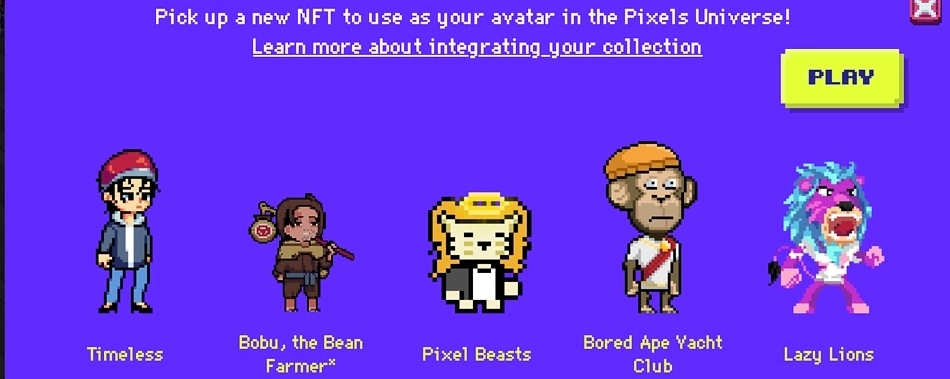
Pixels supports over 80 external NFT collections as playable in-game avatars, including collections like Pudgy Penguins, Bored Ape Yacht Club, Lazy Lions and Mocaverse. The game does not sell these avatars. It interoperates with them, meaning if you already own one of those NFTs, you can simply bring it into the Pixels world and play as it.
That distinction matters more than it might seem. Most games that involve NFTs are asking you to buy something new from them. Pixels is asking you to bring something you already own into a shared space where other people can see it. That is a fundamentally different relationship. It is closer to wearing a jersey at a game than buying a new costume from a shop.
The social signal is the point. When someone walks through the town square in Terra Villa as a Pudgy Penguin, other players who recognize that collection understand something immediately about who they are in the broader crypto world. Shared context is built into the visual layer of the game without a single word being spoken.
I find this genuinely clever because it solves a real onboarding problem. Getting people from existing NFT communities interested in a new game is hard. Pixels removes the friction entirely by making the NFT they already own the front door to a new experience. The community comes with the avatar.
Then there are the Pets.
Pixels Pets are NFTs minted on the Ronin chain that accompany players through the game world. Each pet has unique artwork with millions of possible trait variations and potential for rare combinations. Beyond appearance, pets provide real in-game utility: expanded storage capacity, a wider interaction radius with objects and other players, and daily care requirements that include food, water and playtime to keep them happy and functioning at full benefit.
The daily care requirement is the part I want to dwell on for a moment.
Requiring players to feed and care for their pet every day is not just a game mechanic. It is a retention mechanism disguised as an emotional one. Once you have a pet that depends on your daily attention, skipping a session has a small psychological cost that has nothing to do with token rewards. Your pet gets hungry. Its happiness meter drops. The benefits weaken.
The founder of Pixels described the pet system explicitly as similar to Tamagotchis, saying the goal was for players to feel that daily care responsibility as part of their routine in the game. That is an honest admission of the design intent. Tamagotchis were not financially valuable. People looked after them anyway because the emotional bond, however small and artificial, was real enough to create obligation.
In Pixels, that obligation comes with actual utility attached. A well-cared-for pet is mechanically stronger. It gives you more storage, better reach, greater efficiency in your daily activities. Neglect it and you feel it in your farming numbers. Care for it and the relationship pays off in ways that compound over time.
The Genesis Pets from the original Pixels migration to Ronin were play-to-mint, meaning they could only be obtained through actual gameplay rather than direct purchase. Fewer than one percent of the player base at that time could own one. That scarcity was intentional and permanent.
Scarcity creates reputation. A Genesis Pet owner in Pixels carries a verifiable record of having been there early and having put in the work. It is not just an asset. It is a timestamp.
This layered identity system, external NFT avatars bringing outside communities in, pets creating daily emotional investment, land signaling economic commitment, is what separates Pixels from games that treat players purely as token harvesters. A token harvester leaves when the math stops working. Someone with an identity inside the world, a pet they have fed for months, an avatar their community recognizes, a reputation built across dozens of player interactions, has much stronger reasons to stay.
The risks are worth naming honestly though. Identity investment also creates disappointment when the game disappoints. Players who built emotional connections to the Pixels world felt the token decline more personally than pure speculators did. The same features that deepen engagement can deepen frustration when things go wrong. And pets that require daily care add friction for players who travel, get busy, or simply want a break. The obligation runs both ways.
Pixels Pets provide utility based on individual stats including Strength, Speed and Luck, meaning two pets of the same visual rarity can perform differently depending on their underlying attributes. That adds a collectible depth that goes beyond simple cosmetics, making the pet market genuinely interesting for players who care about optimization.
Who this identity layer makes sense for: players who want their time inside a game to mean something that persists, who want their reputation to be readable, and who enjoy the social dimension of a shared world where identity carries weight. NFT holders from compatible collections who want an active space to use what they already own.
Who it does not suit: players who want purely anonymous gameplay with no daily obligations or social visibility. The identity systems in Pixels are opt-in at the avatar level but somewhat inescapable at the social level. The world sees you.
Over the next six months, watch whether Pixels Pals, the standalone pet companion app the team has discussed, develops into a meaningful extension of the pet system. If pets become useful across multiple Ronin games rather than just inside Terra Villa, the daily care routine starts carrying cross-game weight. That would be a meaningful expansion of what identity means in the Pixels ecosystem.
A game where you are genuinely recognizable, where your history shows, and where a small digital creature actually needs your attention every morning is doing something most Web3 games never attempted. Whether it scales is a separate question. That it works at all is worth understanding.