
Most digital products follow a familiar rule.
capture attention quickly and hold it through pressure.
Notifications, streaks, timed events, and constant prompts all push users to stay active.
The idea is simple if you keep attention through urgency, you keep retention.
It works in the short term, but rarely builds lasting connection.
Pixels takes a different approach.
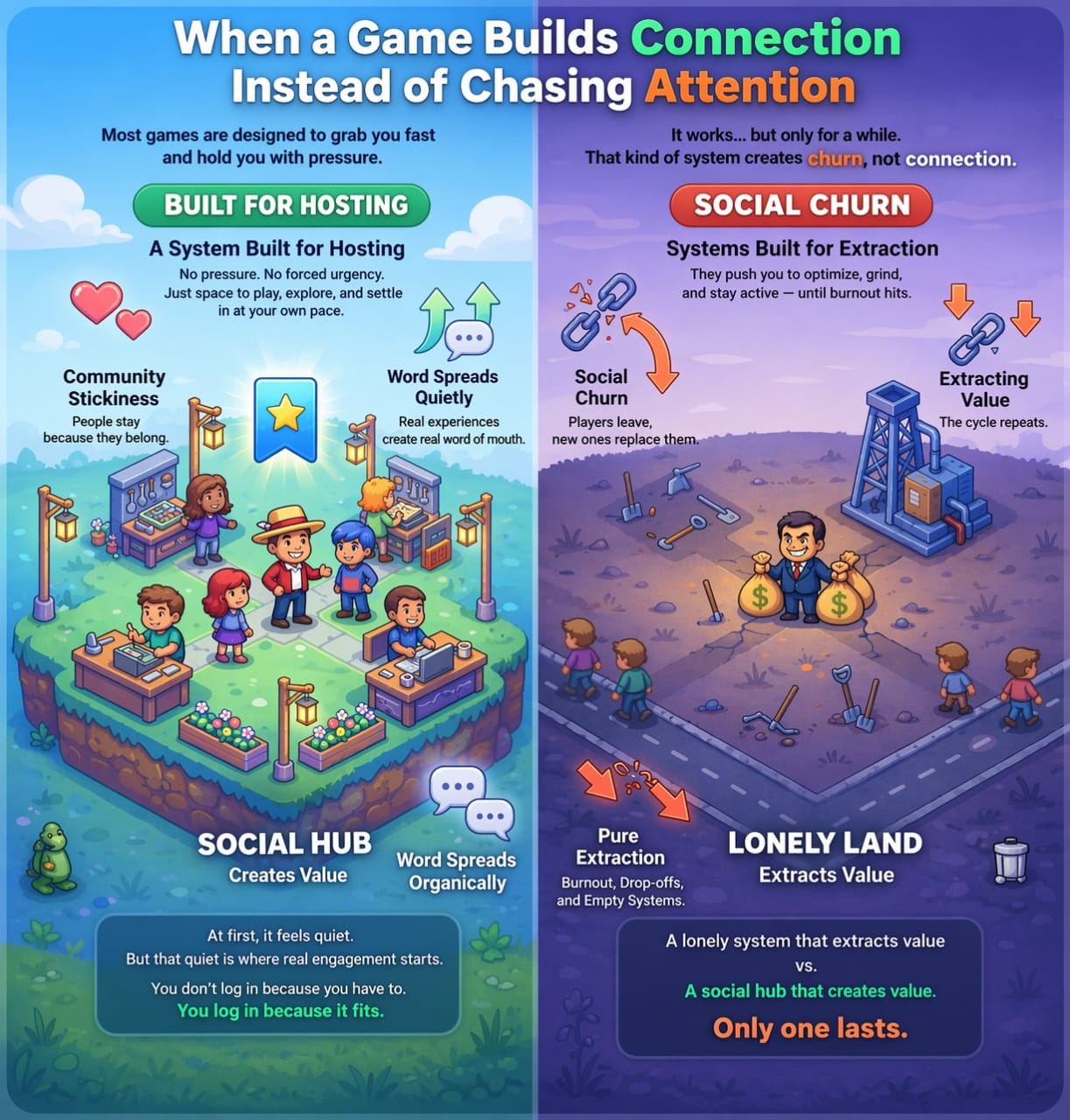
When you enter, there is no overwhelming push to optimize everything immediately.
No aggressive onboarding, no constant signals demanding your time.
You can move, farm, explore, and observe at your own pace. The system doesn’t force attention it allows it to form gradually.
At first, this feels unusually quiet.
There’s no strong feedback telling you you’re doing things “right,” and no urgency pulling you forward.
But that quiet isn’t emptiness. It creates space to understand the system without pressure.
Most platforms rely on early stimulation. They try to hook users within seconds, assuming intensity will lead to long-term retention.
In reality, that often creates shallow engagement. People respond to excitement, not structure.
Sustainable systems behave differently.
They don’t reveal everything at once. Instead, they unfold over time. Meaning isn’t delivered instantly it’s discovered through repetition.
This is where many experiences fail. Once the initial excitement fades, the underlying design becomes visible.
If it relies only on fast rewards or hype, users slowly drift away not because they’re pushed out, but because there’s nothing deeper to return to.
Pixels feels different in this phase.
Instead of constantly pulling you back with urgency, it allows behavior to settle into a rhythm.
You log in, harvest crops, check tasks, maybe explore a little and log out.
Nothing is forcing you to stay longer than you want.
Over time, that rhythm becomes the real form of engagement.
You don’t return because something is demanding it. You return because it fits naturally into your routine.
Logging in stops feeling like a decision that needs motivation. It becomes a small, familiar action almost automatic.
That shift from forced engagement to routine is what separates short-lived systems from sustainable ones.
Fast-growth designs often create spikes: high activity, strong hype, rapid attention.
But without deeper structure, those spikes fade quickly. When novelty disappears, so does engagement.
Routine based systems grow differently. They may feel slower at first, but they build consistency.
And consistency is what keeps systems alive over time.
In Web3 gaming, this difference matters even more. Many projects focus heavily on onboarding excitement or token incentives, but overlook what happens after the first wave of interest.
Attracting users isn’t the hardest part
keeping them without artificial pressure is.
Pixels leans more toward structure than stimulation.
It doesn’t constantly chase attention. Instead, it creates conditions where engagement can form on its own.
The most important phase of any system isn’t the beginning it’s what happens after the excitement fades. That’s when design is fully exposed.
If a platform can still hold attention without forcing it, it usually means there’s something deeper underneath.
Pixels operates in that space not by demanding attention, but by letting it develop naturally over time.
And that’s where its real strength begins to show.