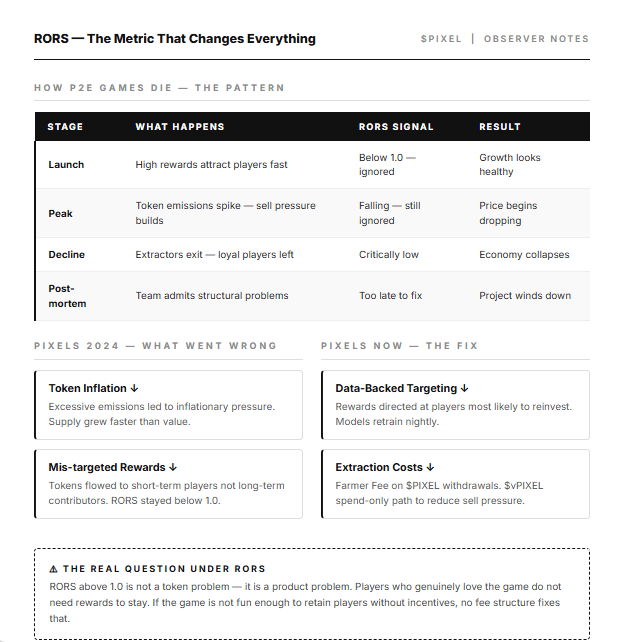
Every play-to-earn game fails the same way. The token inflates. The players extract. The economy collapses. Then the post-mortem arrives always after the damage is done.
Nobody wants to say that out loud while it is happening.
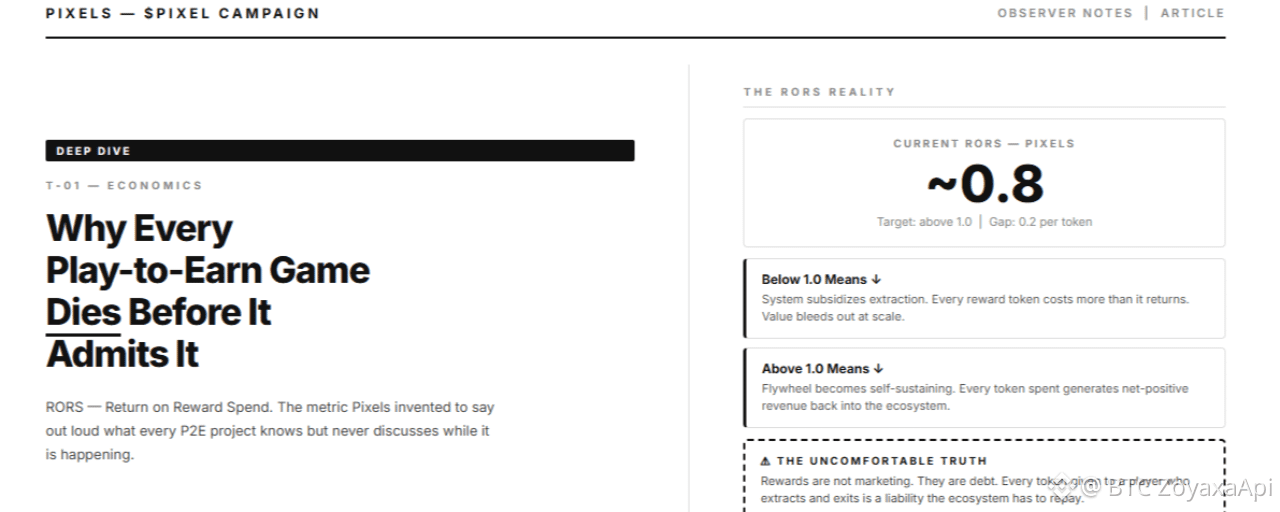
RORS Return on Reward Spend is Pixels' attempt to say it out loud before it happens again. The metric is simple. How much revenue does the ecosystem generate for every token distributed as a reward? Below 1.0 means the system is subsidizing extraction. Above 1.0 means rewards are generating more value than they cost.
Pixels' RORS currently sits around 0.8. Which means for every token given out as a reward, the ecosystem gets back 80 cents worth of value. Twenty cents bleeds out.
That gap sounds small. At scale it is not.
The 2024 numbers make this concrete. Pixels reached the top spot in Web3 gaming by daily active users. Generated $20 million in revenue.
and still faced token inflation, sell pressure, and mis-targeted rewards that damaged the economy. Record growth and structural bleeding at the same time.
Here is the unglamorous truth that most play-to-earn projects never acknowledge.
Rewards are not marketing. They are debt. Every token distributed to a player who extracts and exits is a liability against the ecosystem's future. The project borrowed player attention using token emissions and did not generate enough retained value to pay it back.
Traditional gaming solved this problem decades ago. Players pay to progress. The value flows inward. Play-to-earn inverted that model — and then discovered that giving value away freely does not automatically create a sustainable economy.
Pixels is trying to fix this with three interventions. Data-backed incentives that target rewards at players most likely to reinvest rather than extract. Liquidity fees on $PIXEL withdrawals that make extraction cost something. And $vPIXEL — the spend-only token that recycles value inside the ecosystem instead of letting it hit the open market.
Whether these interventions are enough depends entirely on one thing. Do the games inside the Pixels ecosystem provide enough genuine entertainment value to hold players past the reward cycle?
Because RORS above 1.0 is not a token mechanic problem. It is a product problem. Players who love the game do not need incentives to stay. Players who are only there for the rewards will extract and leave regardless of fee structures.
The metric is honest. The question underneath it is harder.
I am still watching whether Pixels has built something players actually want to play or something they want to get paid to play. Those are very different foundations for an economy.
What would make you stay in a blockchain game after the rewards stopped?