
I’ve seen a lot of Web3 gaming projects come and go, but my experience with Pixels felt fundamentally different the moment I understood how its smart-reward system actually works.
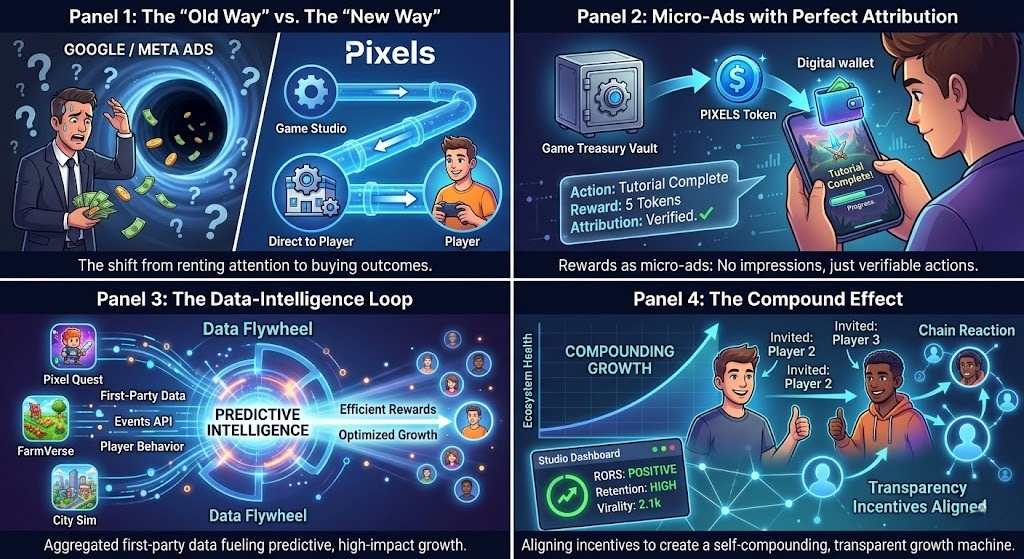
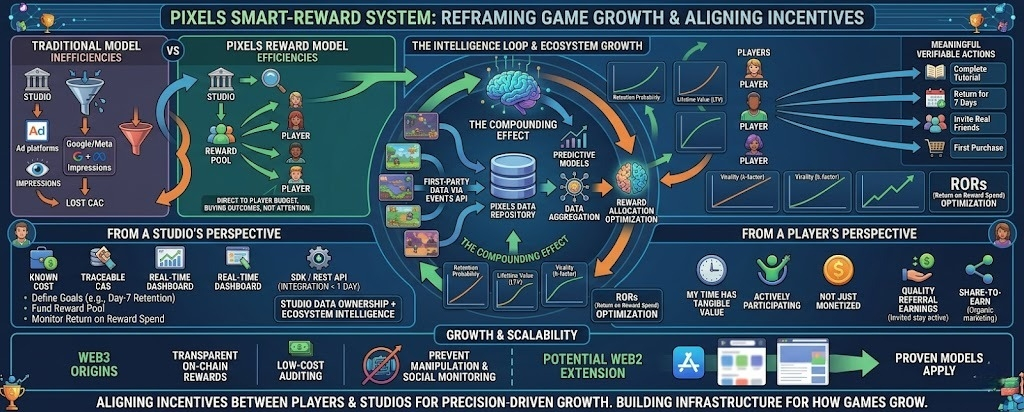
At first, I thought rewards were just incentives to keep players engaged. But Pixels reframed it for me: a reward is essentially a micro-ad with perfect attribution. Instead of studios paying platforms like Google or Meta for impressions that may or may not convert, Pixels flips the model. The budget goes directly to players, but only after they perform a meaningful, verifiable action. Whether it’s completing a tutorial, returning for seven consecutive days, inviting friends, or making a first purchase, every reward is tied to real impact.
That’s what clicked for me. This isn’t random token distribution, it’s precision-driven growth.
As a player, I felt the difference immediately. My time and actions had tangible value. I wasn’t just another user being monetized; I was actively participating in a system where my behavior directly influenced rewards. And from a studio’s perspective, it’s even more powerful. Instead of renting attention, they’re buying real outcomes like retention, lifetime value (LTV), and virality (k-factor), all at a known cost. Even better, every token movement, from treasury to wallet, is transparent, making customer acquisition cost (CAC) fully traceable.
What impressed me further is how Pixels uses data. The platform aggregates first-party data across all games in its ecosystem through a simple Events API. At first, that sounds technical, but in practice, it means every interaction, every behavior, and every pattern contributes to a larger intelligence system. Over time, this creates a powerful dataset that can predict how players behave, whether they’ll stay, spend, or churn.
And this is where the real magic happens.
Because Pixels isn’t just distributing rewards, it’s optimizing them. Using predictive models, it forecasts retention probabilities and player value, ensuring that rewards are allocated where they create the most impact. It becomes a feedback loop: more data leads to better predictions, which leads to more efficient rewards, which then improves overall ecosystem health.
From what I’ve seen, this kind of system doesn’t just grow, it compounds.
Another thing I appreciate is how accessible it is for studios. Integration isn’t some long, complex process. With a simple SDK or REST API, a studio can plug into the system in less than a day. They define their goals, like improving day-7 retention or encouraging social sharing, fund a reward pool, and then monitor everything in real time through a live dashboard showing return on reward spend (RORS).
What stands out to me is that studios don’t lose control of their data. They still own it, but they benefit from the shared intelligence of the entire ecosystem. That balance between independence and collaboration is rare.
On the growth side, Pixels also gets it right. The referral system isn’t just about bringing in new users, it rewards quality. Players only earn if the people they invite actually stay active and contribute positively. That alone filters out a lot of noise and fake growth.
Then there’s share-to-earn, where players create and share in-game content. I’ve noticed how this naturally turns players into marketers, but in a way that feels organic rather than forced. Add to that the social monitoring tools that track real engagement and prevent manipulation, and you start to see how carefully the system is designed.
Nothing feels accidental.
What I’ve realized through my experience is that Pixels isn’t just building a game or even a single ecosystem, it’s building infrastructure for how games grow. Starting in Web3 makes sense because on-chain rewards are transparent, low-cost, and easy to audit. But once these models are proven, I can clearly see how this approach extends into Web2 as well.
In a space where most projects chase hype, Pixels feels like it’s solving something deeper: aligning incentives between players and studios in a way that actually works.
And once you see that clearly, it’s hard to look at traditional gaming models the same way again.
