
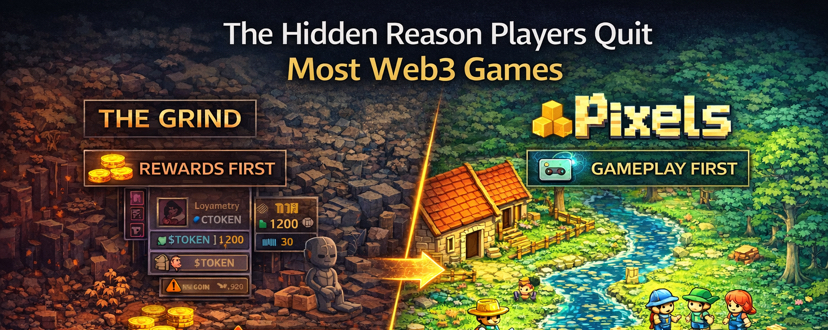
There’s a reason why many Web3 games struggle to keep players engaged, and it’s not always obvious at first.
Most discussions focus on rewards, tokenomics, or market conditions. But those are surface-level explanations. The real issue is deeper and more practical.
Time More specifically, how players feel about the time they spend inside the game.
In many Web3 projects, gameplay quickly turns into routine. Repetitive actions, forced grinding, and constant pressure to optimize every move. The experience starts to feel less like a game and more like a task.
At that point, players don’t leave because rewards are low.
They leave because the experience becomes exhausting.
Pixels approaches this problem differently.
Instead of maximizing how much a player does, it focuses on how the experience feels. The gameplay loop is simple, but it doesn’t feel like a chore. Farming, exploring, interacting with the environment… everything is designed to be easy to return to without mental fatigue.
That simplicity creates balance.
You don’t feel pressured to keep up.
You don’t feel punished for taking a break.
And that changes how long people stay.
Another important aspect is how the world itself behaves.
Pixels doesn’t feel static. The environment is shared, active, and built around interaction. Players exist within the same space, not isolated sessions. That creates a sense of continuity that goes beyond individual progress.
You’re not just completing actions.
You’re part of something ongoing.
That alone increases attachment.
Then there’s the technical side.
Running on Ronin reduces friction in a way that keeps the experience smooth. There are fewer interruptions, fewer delays, and less resistance between the player and the game itself.
This might seem like a small detail, but it directly affects engagement.
Because the easier it is to interact, the more likely players are to return.
But the most important shift Pixels introduces is subtle.
It doesn’t try to control player behavior through rewards.
It allows players to engage at their own pace.
That freedom is rare in Web3 gaming, where most systems are designed to push constant activity.
From a broader perspective, this reflects a different philosophy.
Instead of asking “how do we keep users active,”
it asks “how do we make the experience worth returning to.
That difference changes everything.
Pixels doesn’t rely on pressure.
It relies on comfort.
And in the long run, comfort is what builds consistency.
Because players don’t quit games they enjoy.
They quit games that feel like work.
