
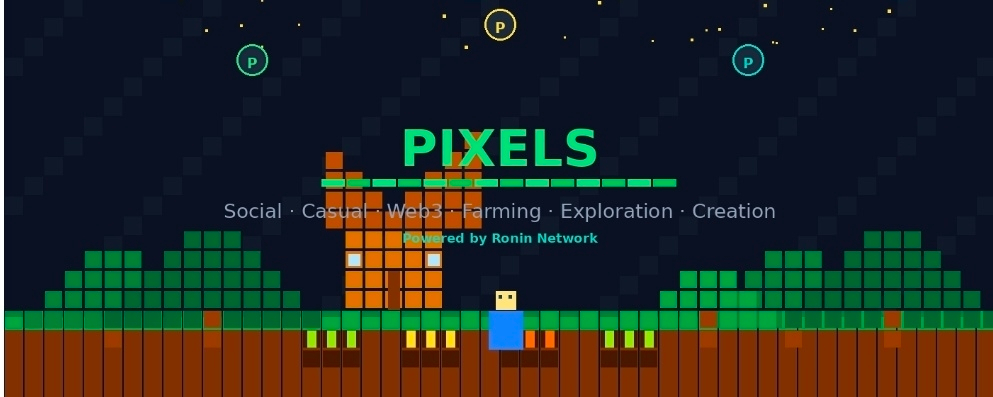
Powered by Ronin Network · Open World · Farm · Explore · Create
Executive Summary
Pixels is a social casual Web3 game built on the Ronin Network that has redefined what blockchain gaming can look like for mainstream audiences. Blending the approachable aesthetics of classic pixel-art farming games with the economic infrastructure of decentralized finance, Pixels offers players an open, persistent world where farming, exploration, crafting, and social interaction are rewarded with real digital ownership.
Since migrating to Ronin in 2023, Pixels has become one of the most played blockchain games in the world, at times ranking as the top dApp by daily active users across all chains. The game's success demonstrates that Web3 gaming can achieve genuine mainstream traction when the onboarding friction is minimized, gameplay is genuinely enjoyable, and the token economy is designed to reward engagement rather than speculation.
KEY STAT
At its peak, Pixels recorded over 1 million daily active wallets — making it one of the most actively used decentralized applications ever deployed.
1. What is Pixels?
Pixels is an open-world, browser-based game in which players inhabit a sprawling pixelated universe and engage in a rich variety of activities: tending to crops and animals on their farms, exploring dungeons and wilderness biomes, crafting items and structures, completing quests, and interacting with a vibrant player-driven economy. The game draws deep inspiration from classic titles such as Stardew Valley and Harvest Moon, but layers on a full Web3 economy where land, resources, crafted items, and in-game achievements translate into real digital assets.
Unlike many blockchain games that bolt financial mechanics onto thin gameplay, Pixels invests heavily in the quality and depth of the game loop itself. The result is a game that is fun to play whether or not the player engages with the token economy — but one that offers compelling economic upside for those who do.
Core Game Loop
Farm: Plant, tend, and harvest over 100 crop types with varying growth times, rarity, and yield
Explore: Traverse diverse biomes, discover hidden dungeons, and encounter rare resource nodes
Craft: Combine harvested resources into tools, buildings, decorations, and tradeable goods
Quest: Complete storyline missions, daily tasks, and seasonal events for rewards
Socialize: Build guilds, visit other players' farms, trade at the marketplace, and participate in community events
Earn: Accumulate PIXEL tokens and NFT assets through skilled play and economic participation
2. The Ronin Network Foundation
2.1 Why Ronin?
Pixels' migration to the Ronin Network in late 2023 was a pivotal strategic decision that unlocked the game's explosive growth. Ronin is an Ethereum-linked sidechain originally developed by Sky Mavis — the creators of Axie Infinity — specifically for gaming applications. Its design priorities align perfectly with Pixels' needs: near-zero transaction fees, sub-second finality, and a user experience that abstracts away blockchain complexity for non-crypto-native players.
On Ronin, transactions cost fractions of a cent and confirm in under two seconds. This means that in-game actions that generate on-chain events — planting crops, crafting items, trading goods — feel instant and cost nothing perceptible to the player. This stands in stark contrast to Ethereum mainnet or even many Layer 2 solutions, where gas fees and confirmation times would make casual gaming economically unviable.
2.2 Ronin Technical Profile
Parameter
Value
Consensus Mechanism
Delegated Proof of Stake (DPoS)
Block Time
~3 seconds
Transaction Finality
Instant (practical) / ~45s (full finality)
Transaction Cost
< $0.001 average
EVM Compatibility
Full (EVM-equivalent)
Bridge
Ronin Bridge — bidirectional ETH ↔ Ronin
Native Token
RON (staking, gas)
Validator Set
Permissioned + community validators
2.3 Gasless Transactions for Players
One of Ronin's most player-friendly features — and a key reason for Pixels' success — is its gasless transaction model for approved dApps. Through the Ronin Gasless feature, Pixels can sponsor transaction fees on behalf of its players, removing the requirement for players to hold RON just to interact with the game. New players can sign up, connect a wallet, and start playing without any prior crypto knowledge or token purchases, dramatically lowering the barrier to entry.
3. The PIXEL Token Economy
3.1 Token Overview
PIXEL is the native utility and governance token of the Pixels ecosystem. It serves as the primary medium of exchange within the game's economy and grants holders a voice in the game's development direction through on-chain governance. PIXEL is an ERC-20 compatible token deployed on the Ronin Network.
TOKEN UTILITY
PIXEL is used for: purchasing land and premium items, crafting high-tier recipes, accessing special game areas, governance voting, staking for rewards, and tipping other players in the social economy.
3.2 Tokenomics
Parameter
Detail
Total Supply
5,000,000,000 PIXEL (5 billion)
Ecosystem & Gameplay
30% — in-game rewards, quests, seasonal events
Team & Advisors
15% — 4-year vesting with 1-year cliff
Investors
15% — structured vesting schedules
Treasury
20% — protocol development and grants
Community & Airdrops
10% — early adopter rewards
Liquidity
10% — DEX liquidity and market making
3.3 Earning PIXEL In-Game
PIXEL tokens can be earned through multiple in-game mechanics, creating diverse pathways for players to participate in the economy regardless of their playstyle:
Quest Completion: Daily, weekly, and story quests distribute PIXEL rewards upon completion
Farming Excellence: Growing rare or high-demand crops and selling them at the marketplace earns PIXEL
Crafting and Trade: Producing crafted goods and trading them with other players generates income
Exploration Rewards: Discovering hidden locations, clearing dungeons, and collecting rare drops yields PIXEL and valuable NFTs
Land Ownership: Landowners earn a share of the economic activity occurring on their plots
Seasonal Events: Limited-time events with exclusive rewards drive engagement spikes and distribute PIXEL broadly
3.4 Token Sinks and Sustainability
A common failure mode in Web3 gaming is hyperinflation driven by unconstrained token emission. Pixels addresses this through a set of deliberate token sinks — mechanisms that remove PIXEL from circulation and maintain upward price pressure:
Land Purchases and Upgrades: Acquiring and expanding land requires PIXEL burns
Premium Crafting Recipes: Tier 3 and above crafting recipes consume PIXEL as a crafting fee
Seasonal Pass Purchases: Access to premium seasonal content requires PIXEL payment
Marketplace Fees: All player-to-player trades incur a small PIXEL fee that is burned
Governance Staking: PIXEL staked for governance is locked, reducing liquid supply
4. Land Ownership and NFT Assets
4.1 Land as a Core Asset
Land in Pixels is the foundational NFT asset of the ecosystem. Each plot of land is a unique ERC-721 token on the Ronin Network representing a section of the Pixels game world. Land owners have exclusive rights to develop their plots — constructing buildings, planting special crops, hosting businesses, and earning revenue from player visits and economic activity.
Land is scarce by design: the total supply of land plots is capped, and prime locations (near town centers, waterways, or special resource nodes) command significant premiums in the secondary market. This scarcity creates a genuine real estate economy within the game, where location strategy, development investment, and player traffic all influence land value.
4.2 Land Tiers and Features
Land Type
Features
Rarity
Terra
Basic land plot — farming, basic structures
Standard
Terra+
Enhanced yield, more building slots
Uncommon
Island
Isolated plot with unique biome resources
Rare
Megaplot
Large area, supports multiple buildings
Very Rare
Origin
Founding land with maximum features and legacy status
Legendary
4.3 In-Game NFT Items
Beyond land, the Pixels ecosystem contains a rich taxonomy of NFT assets that players can earn, craft, trade, and collect:
Tools: Farming tools, mining picks, fishing rods — each with distinct stats and durability
Seeds: Rare crop seeds with unique growth properties and market demand
Blueprints: Crafting recipes for buildings, decorations, and advanced tools
Cosmetics: Character skins, farm decorations, and avatar accessories
Pets: Companion animals that provide passive in-game bonuses
Guild Emblems: Organizational NFTs that represent membership and status in player guilds
5. Gameplay Systems Deep-Dive
5.1 Farming System
The farming system is the heart of Pixels and has been developed with a depth that belies the game's casual aesthetic. Players manage soil quality, irrigation, seasonal weather effects, and pest management alongside simple planting and harvesting. Over 100 distinct crop types are available, categorized by rarity tier (Common through Legendary), growth time (minutes to days), and market demand fluctuations driven by the real-time in-game economy.
Advanced farming mechanics include crop rotation bonuses (planting complementary crops in sequence yields higher outputs), composting systems (converting waste crops into soil-enhancing fertilizer), and greenhouse construction (enabling year-round growth of seasonal crops). These systems reward players who engage with the farming mechanics deeply, creating meaningful skill differentiation.
5.2 Exploration and Biomes
Beyond their home farms, players can explore a vast procedurally enriched world containing multiple distinct biomes: temperate forests, desert wastelands, arctic tundra, tropical rainforests, and underground cavern systems. Each biome hosts unique resource nodes, wildlife, and dungeon instances with exclusive loot tables.
Exploration is gated by player level and equipment tier, creating a natural progression arc that motivates continued engagement. Dungeons reset on weekly cycles, ensuring that regular players have ongoing reasons to explore beyond their farms. Rare exploration discoveries — hidden caves, ancient ruins, secret gardens — are shared in real-time on the in-game social feed, creating organic community excitement.
5.3 Social and Guild System
Pixels is explicitly designed as a social game. The guild system allows players to form organizations of up to 50 members, coordinate collective farming operations, share resource pools, and compete in guild-versus-guild seasonal tournaments. Guild land — collectively owned plots developed with contributions from all members — creates shared stakes in outcomes and deepens player relationships.
The game's social feed, marketplace, and in-game messaging system create a community layer that players return to daily even outside of active gameplay sessions. This social stickiness is a key driver of Pixels' exceptional retention metrics relative to other Web3 games.
6. Web3 Differentiators
6.1 True Asset Ownership
Unlike traditional gaming where in-app purchases and earned items are locked to a single platform and can be revoked at any time, Pixels assets are on-chain NFTs that players genuinely own. Land, tools, rare seeds, and cosmetics can be freely traded on the Ronin Marketplace or any compatible NFT platform. A player who invests time and skill into the game accumulates a portfolio of digital assets with real market value that persists independently of the game operator.
6.2 Player-Driven Economy
The Pixels economy is bottom-up, not top-down. Crop prices, crafting material values, and land rents are determined by supply and demand dynamics among players — not by game developer decree. This creates genuine market opportunities for economically minded players: identifying undervalued crops before seasonal demand spikes, arbitraging between in-game regions, or cornering the market on rare crafting materials.
6.3 Governance and Community Ownership
PIXEL token holders participate in the game's governance through snapshot voting on development proposals. This includes decisions on new content additions, economic parameter adjustments, token emission schedules, and partnership proposals. The development team has committed to progressive decentralization, with the goal of transitioning major game decisions entirely to community governance over a multi-year roadmap.
COMMUNITY FIRST
Pixels has held multiple community governance votes that directly shaped game features — from which crop types to add next, to the parameters of seasonal events and land auction mechanics. This level of player agency is unprecedented in mainstream gaming.
7. Ecosystem and Integrations
7.1 Ronin Ecosystem Synergies
As a flagship application on the Ronin Network, Pixels benefits from and contributes to a rich ecosystem of complementary applications. Ronin Wallet — with over 3 million users — provides instant, frictionless onboarding. The Ronin Marketplace offers a native venue for NFT trading with Pixels-specific discovery features. RON staking rewards can be directed toward Pixels-adjacent liquidity pools, creating cross-protocol yield opportunities for engaged community members.
7.2 Partner Integrations
Pixels has established integrations with several ecosystem partners that enrich the gameplay experience and expand the player base:
Axie Infinity: Cross-promotional events allowing Axie NFT holders to access exclusive Pixels content
Ronin Bridge: Seamless ETH and USDC transfers into the Ronin ecosystem for asset purchases
Mavis Hub: Integration with Sky Mavis's gaming hub for unified identity and achievement tracking
Third-party Marketplaces: PIXEL and Pixels NFTs are tradeable on OpenSea, Blur, and other major platforms via the Ronin Bridge
7.3 Mobile Expansion
Pixels launched as a browser-based game, but mobile expansion is a central pillar of the 2024-2025 roadmap. Native iOS and Android applications with full feature parity are in development, with a particular focus on optimizing the farming and social systems for touch interfaces. Mobile push notifications for crop harvest reminders and guild events are expected to significantly improve retention metrics among casual players.
8. Competitive Landscape
Game
Chain
Genre
Token
Peak Users
Web3
Pixels
Ronin
Farming / Social
PIXEL
1M+ DAU (peak)
✅ Full
Axie Infinity
Ronin
Battle / Breeding
AXS + SLP
2M+ DAU (peak)
✅ Full
The Sandbox
Ethereum/Polygon
Metaverse / Build
SAND
200K DAU
✅ Full
Farmer World
WAX
Farming
FWW / FWG
100K DAU
⚠️ Limited
Stardew Valley
None
Farming (Web2)
None
~3M daily
❌ None
9. Development Roadmap
Phase 1: Foundation (Completed)
Browser-based game launch, Ronin Network migration, PIXEL token generation event (TGE), land NFT minting, core farming and crafting systems, Ronin Marketplace integration, and initial guild system deployment.
Phase 2: World Expansion (In Progress)
New biome additions (Arctic and Volcanic regions), dungeon system expansion with 10+ new instance types, advanced crafting tier introduction, seasonal event framework, mobile app development, and governance portal launch.
Phase 3: Social Metaverse
Player-hosted events and in-game concerts, voice and video chat integration, guild alliance system, cross-game asset compatibility with Ronin ecosystem partners, advanced land development tools (multi-story buildings, underground expansion), and eSports-style competitive farming tournaments.
Phase 4: Full Decentralization
On-chain governance for all major game decisions, community-developed content via a modding SDK, decentralized marketplace with AMM-based pricing, and transition of server infrastructure to decentralized hosting solutions.
10. Risk Factors and Considerations
As with all Web3 gaming projects, prospective participants should be aware of the following risk categories:
Token Volatility: PIXEL token price is subject to crypto market volatility and can fluctuate significantly, affecting the fiat value of in-game earnings
Regulatory Risk: The regulatory classification of in-game tokens and NFTs varies by jurisdiction; players should consult local guidance
Game Longevity: Player retention is critical to economic viability; a decline in active users could negatively impact token and NFT values
Smart Contract Risk: Despite audits, on-chain contracts carry inherent technical risk; large holdings should be managed with appropriate security practices
Centralization: While decentralization is a stated goal, the current development team retains significant influence over game direction and economics
Conclusion
Pixels represents the clearest proof point to date that Web3 gaming can transcend the speculative stigma of its predecessors and deliver genuine, broad-based player engagement. By prioritizing gameplay quality, minimizing onboarding friction through Ronin's gasless infrastructure, and constructing a token economy that rewards skilled play rather than early entry alone, Pixels has built a game that millions of players choose to play — not just to earn, but because it is enjoyable.
The PIXEL token and NFT ecosystem provide a compelling economic layer for players who wish to derive financial value from their time investment, while the open-world game design ensures that non-economic players find equal enjoyment. This balance — rare in the Web3 gaming space — positions Pixels as a template for the next generation of blockchain games and a flagship application for the Ronin
Network ecosystem.
FINAL WORD
Pixels is not just a game. It is a demonstration that digital ownership, community governance, and genuine fun are not mutually exclusive — and that the future of gaming may well be built on open, player-owned worlds.