
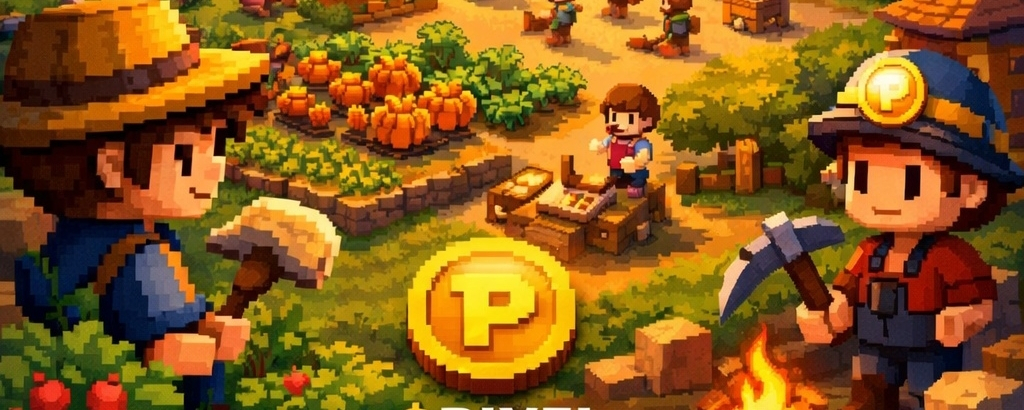
There’s a reason some Web3 projects feel exciting at first but don’t last. They rely too much on the surface, rewards, hype cycles, fast onboarding, quick exits. It works for attention, but not for retention. What makes @Pixels interesting is that it doesn’t try to win you over instantly. It builds in layers.
At the beginning, it almost feels too simple. You plant, you harvest, you move around. Nothing feels urgent. There’s no pressure to optimize everything immediately. And that’s intentional. Because instead of overwhelming you, Pixels lets you settle in first.
Then slowly, things start to unfold.
You begin to notice that small decisions matter. What you plant, when you log in, how you use your space. It’s not obvious at first, but over time, those small choices start shaping your entire experience. The game doesn’t tell you what’s best, it lets you figure it out.
That’s where the first layer reveals itself, player-driven flow.
You’re not forced into a path. You create your own rhythm. Some players go all in on efficiency, others just enjoy the routine. And both approaches work. That flexibility is what makes the system feel natural instead of rigid.
Then comes the second layer, the economy.
At a glance, $PIXEL looks like just another in-game token. But the longer you stay, the more you understand how it actually moves. It’s not sitting idle. It flows through actions, upgrades, trades, and decisions. It reflects activity.
You start to see patterns.
When you’re active and intentional, you’re part of that flow. When you’re not, things slow down. It’s not forced, it just happens. And because of that, the economy feels connected to gameplay, not separate from it.
That connection is important.
In many Web3 games, the economy feels like an add-on. Something you interact with outside the actual experience. In Pixels, it’s embedded. You don’t switch modes between “playing” and “earning.” It’s all one system.
Then there’s the third layer, progression.
Pixels doesn’t give you big jumps. It gives you small, steady improvements. You refine your setup. You adjust your routine. You get a little better each time you log in. It’s not dramatic, but it’s consistent.
And consistency builds attachment.
You start to recognize your own progress. Not because the game tells you, but because you feel it. Things become smoother. Decisions become easier. You spend less time guessing and more time doing.
That’s when it starts to click.
You’re no longer just playing, you’re operating within a system you understand.
Another layer that often goes unnoticed is how Pixels handles time. It doesn’t fight for all of it. It doesn’t demand constant attention. You can log in, do what you need to do, and leave. No stress, no penalty.
That alone changes behavior.
Instead of feeling like you have to keep up, you engage on your own terms. And when engagement is voluntary, it tends to last longer. You’re not burning out, you’re building a habit.
Over time, that habit becomes part of your routine.
You check in, you make a few moves, you adjust your setup. It becomes familiar. And familiarity creates comfort. That’s something most Web3 platforms overlook.
They chase excitement, but ignore comfort.
Pixels leans into comfort without becoming boring. Because underneath that calm surface, there’s always something to improve. Something to tweak. Something to understand better.
That’s what keeps it engaging.
There’s also a quiet social layer. You might not notice it immediately, but it’s there. Trading, shared markets, observing how others play. You’re part of a larger system, even if you’re playing solo.
And that matters.
Because systems feel more real when they’re shared. When your actions connect, even indirectly, to others. It adds weight to what you’re doing.
Looking at it from a bigger perspective, Pixels feels less like a game designed for quick wins and more like a space designed for long-term presence. It doesn’t try to impress you instantly. It earns your attention over time.
That’s a harder path, but a stronger one.
Of course, it’s not without challenges. As more players join, balance becomes harder. The economy becomes more complex. New dynamics emerge. But the foundation, layered design, player freedom, steady progression, gives it a better chance of adapting.
Because it’s not built on a single mechanic. It’s built on how those mechanics connect.
And that’s the real difference.
Pixels isn’t trying to be the most exciting thing on day one. It’s trying to be something you’re still using months later. Something that fits into your routine without forcing itself into your attention.
In a space driven by speed, that kind of patience stands out.
And sometimes, the projects that grow the slowest are the ones that last the longest.
