
BitTorrent built the internet's backbone before anyone called it infrastructure. Now its blockchain — BTTC — is attempting something far more audacious: to become the connective tissue of a decentralized world still too fragmented to function. Whether it succeeds may tell us everything about who actually wins the next era of crypto.

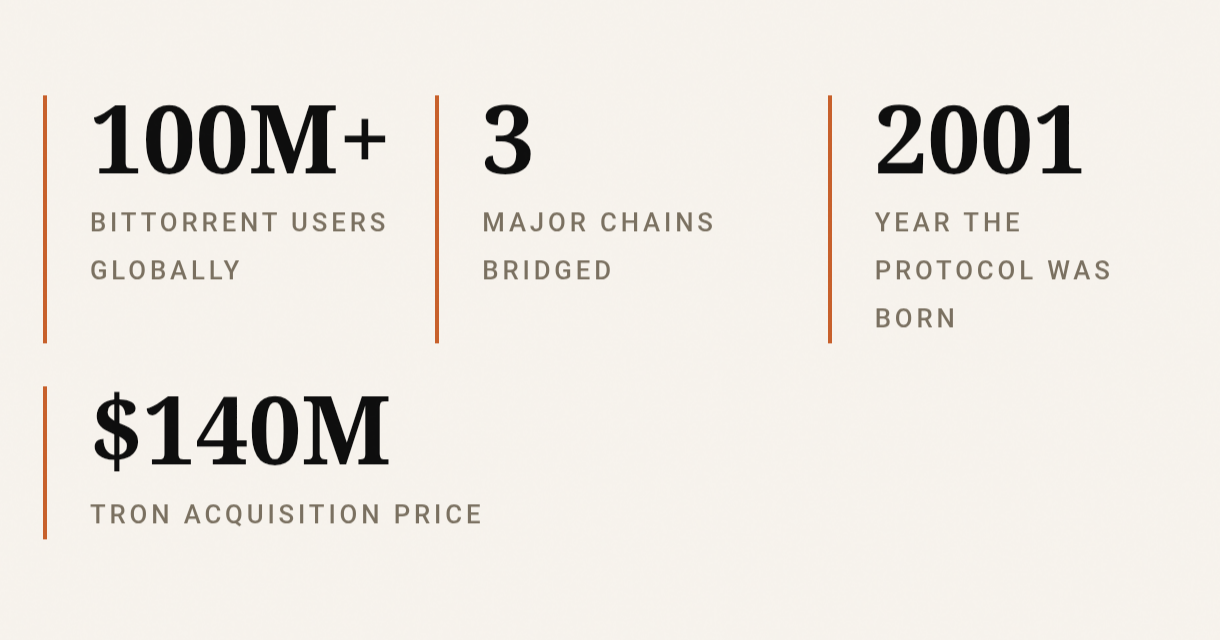
There is a photograph — not widely circulated, lost now in the sediment of early internet history — of a college student in San Francisco hunched over a PowerBook, uploading the first successful file transfer using a protocol he'd written over the course of one obsessive, sleepless summer. The file was small. The act was not. That student was Bram Cohen, and the protocol was BitTorrent, and what he unleashed in 2001 would eventually carry, at its peak, more than a third of all global internet traffic across its distributed spine.
Nobody, at the time, called it infrastructure. Infrastructure is what things become after the historians arrive. In the moment, it was just an idea: that the movement of data need not obey the logic of authority — of central servers, controlled pipes, permissioned access. Data could move like water. It could find its own path. It could be shared not from one point to many, but from many to many, simultaneously, redundantly, unstoppably.
Twenty-three years later, the descendants of that idea are working on something that would have seemed, even to Cohen, almost too large to be serious. BitTorrent Chain — BTTC — is attempting to do to the blockchain ecosystem what the original protocol did to file transfer: make the walls between separate worlds dissolve. And it is attempting this in a market so noisy, so feverish, so glutted with competing visions of the future, that quiet competence has become almost indistinguishable from irrelevance.
This is the story of what BTTC is building, why it matters more than its current reputation suggests, and why the next chapter of this particular saga may be the one worth watching most closely.
The Acquisition That Changed Everything — And Nobody Noticed
In July 2018, TRON Foundation acquired BitTorrent Inc. for $140 million. The press coverage, such as it was, focused on the dollar figure and the personalities involved. Justin Sun, TRON's founder and perhaps the crypto world's most practiced provocateur, made the announcements in the loud, declarative style that had become his signature. The headlines briefly materialized and then dissolved, as headlines do.
What received almost no serious analysis was the structural logic of the acquisition. Consider what TRON had actually purchased: not just a product, not just a user base, but the accumulated institutional knowledge of a protocol that had, for years, operated at a scale most blockchain projects still fantasize about. BitTorrent had solved — imperfectly, practically, durably — the problem of coordinating distributed resource-sharing among millions of anonymous participants who had no particular reason to trust one another.
That is, almost precisely, the problem that decentralized blockchain networks are trying to solve.
The marriage was theoretically elegant. In practice, it produced years of friction, misfires, overpromising, and the particular frustration of watching a genuinely interesting idea get buried under the noise of a bull market that rewarded spectacle over substance. But it also, eventually, produced BTTC: a layer-one compatible chain that launched in late 2021 with an architecture designed around one core conviction. That fragmentation is crypto's original wound. And that the cure is not a new chain. It is a bridge between existing ones.
What Fragmentation Actually Costs — In Human Terms
Before you can understand what $BTTC is trying to fix, you have to sit with how broken the thing it's fixing actually is — not in engineering terms, but in human ones.
Imagine you are a developer in Nairobi, Lagos, or Manila. You've built a micro-lending application using $ETH (Ethereum) smart contracts that has genuine traction in your community. Your users love it. Your code is clean. Your protocol is sound. Now one of those users wants to access a yield-generating product built on $BNB Chain. Another wants to move value through a TRON-based payment rail because the fees are lower for cross-border transfers to their family.
What happens next is not a technical problem. It is a human problem wearing a technical costume. Your user — often someone for whom every fraction of a dollar in fees is non-trivial — must navigate bridge protocols that are complex, frequently compromised, and designed by engineers who do not share their economic circumstances. They pay fees to enter each ecosystem. They pay fees to exit. They pay the invisible cost of time, confusion, and the creeping suspicion that a technology promising liberation has simply replaced one set of gatekeepers with another.
The promise of BTTC — cross-chain interoperability native to its design, not bolted on as an afterthought — is not, at its root, a technological argument. It is a moral one. It is a claim that the frictionless movement of value and information between distributed systems is not a luxury feature. It is the foundation without which none of the rest of this matters.
Context: The Interoperability Gap
Cross-chain bridge hacks have accounted for billions in losses across the crypto ecosystem. The demand for safe, efficient inter-chain movement has never been higher — and the infrastructure gap has never been more visible.
BTTC's architecture uses a Proof-of-Stake consensus mechanism with validators spread across TRON, Ethereum, and BNB Chain, creating layered security rather than a single point of failure. It is not a perfect solution. But in an ecosystem where most "bridges" are bolt-on solutions held together with optimism and cryptographic prayers, it represents a structural approach to a structural problem.
The Quiet Architecture of Something Enormous
Engineers who have worked near BTTC's core development describe a team that has cultivated a specific, slightly counter-cultural relationship with attention. When competing layer-one chains were announcing mainnet launches with the theatrical staging of Hollywood premieres, BTTC was refining its EVM compatibility. When the market was rewarding NFT platforms built on chains with near-zero real utility, BTTC was quietly extending its validator infrastructure.
The EVM compatibility point deserves a moment's attention, because it tends to get buried in lists of technical specifications where it loses its significance. EVM — Ethereum Virtual Machine — compatibility is the closest thing the blockchain ecosystem has to a universal language. A developer who writes in Solidity, Ethereum's native smart contract language, can deploy on any EVM-compatible chain without rewriting their work from scratch. In a world where developer talent is scarce, developer time is expensive, and developer attention is the most finite resource of all, EVM compatibility is not a feature. It is an invitation.
BTTC's invitation has been extended quietly. It has not been marketed with the aggression of a chain that believes it needs to win developers by volume. The ecosystem it is building is smaller than Ethereum's, thinner than BSC's, and younger than Solana's. But it is growing with a directional logic that rewards patient observation.
"The chains that survive the next decade will not be the ones that screamed loudest in year two. They will be the ones that understood, in year five, what they were actually for."
Five Horizons: Where BTTC Goes From Here
The future of any technology can be read at multiple scales simultaneously. Here are the five converging forces that will define what BTTC looks like in 2027 — and why each one deserves to be taken seriously.
Storage as Sovereignty
The original BitTorrent insight — that distributed storage and bandwidth are more resilient and efficient than centralized servers — maps onto blockchain incentive structures with startling elegance. Projects building on BTTC that reward node operators in BTT for storage and bandwidth contributions are not merely building products. They are encoding a philosophy into infrastructure. As regulatory pressure on centralized cloud services intensifies globally, this architecture becomes more valuable, not less.
The 100 Million Door
Over a hundred million people have used BitTorrent software at some point in their digital lives. That is not a community assembled by marketing spend — it is a community self-selected for comfort with decentralized, peer-to-peer thinking. The conversion funnel from BitTorrent user to Web3 participant via BTTC-integrated tools is shorter than any paid acquisition channel could manufacture. It is also largely untapped. That is unusual in a market where most opportunity has already been discovered and discounted.
1
Cross-Chain DeFi as Default
The DeFi protocols being designed today are not chain-native by conviction — they are chain-native by necessity. The infrastructure for seamless cross-chain execution has simply not existed at the quality and reliability needed for institutional-grade applications. As that infrastructure matures, the protocols positioned at the junctions between chains — not aligned to one ecosystem but moving fluidly between many — will capture disproportionate value. BTTC's structural position is exactly this junction.
Emerging Market Penetration
The next billion users entering Web3 will not arrive from San Francisco or Singapore. They will come from Lagos, Jakarta, Nairobi, São Paulo — cities where mobile-first computing is the norm, cross-border remittance is a daily economic necessity, and the cost of traditional financial infrastructure is not a minor inconvenience but a structural barrier to prosperity. BTTC's fee structure and cross-chain architecture are, without hyperbole, better suited to these users' actual needs than most of its competitors.
The Developer Ecosystem Flywheel
Technology ecosystems do not grow linearly. They grow in flywheels: developers build tools, tools attract users, users attract more developers, developers build better tools. BTTC's EVM compatibility, combined with its multi-chain positioning, means the flywheel, once it achieves sufficient momentum, can draw from the largest existing pool of blockchain developers on earth. The question is not whether this flywheel can spin. The question is what catalyzes the first rotation that makes the others inevitable. That catalyst — a flagship application with genuine user pull — is the most important unknown in BTTC's near-term story.
The Honest Reckoning
There is a version of this story that skips this section. That version is not worth your time.
BTTC has real problems. Its token performance has tested the faith of early believers through extended periods of price suppression that, however disconnected from fundamental development, are not irrelevant to the practical reality of funding development and retaining talent. Its community, while resilient, has experienced the specific kind of disillusionment that settles when a project's potential and its public momentum seem to exist on separate timelines.
The cross-chain space it operates in is not uncontested. Polkadot was built specifically around interoperability. Cosmos has been making the same argument, in its own language, for years. LayerZero, Wormhole, and a crowded field of bridge protocols are all competing for the same structural position. Capital flows in this space are significant, competitive intelligence is fierce, and the window for capturing dominant position narrows with each passing quarter.
And then there is the most uncomfortable challenge of all: narrative. In an ecosystem where narrative capital is as important as technical capital — sometimes more important — BTTC has struggled to control the story told about it. The association with the controversies that have surrounded TRON and its founder has created a form of reputational drag that affects developer recruitment, institutional consideration, and media coverage in ways that are difficult to quantify and even more difficult to reverse.
These are real. They are not dismissible with optimism. The only honest thing to say about them is that they exist alongside a structural opportunity that is also real, and that the outcome depends on choices still unmade, by people still working.
Price and value are not the same conversation. Every important technology in history has had its period when the two diverged violently — and the people who understood the difference were the ones who were still there when the gap closed.
What the History of Infrastructure Actually Teaches Us
In 1844, when Samuel Morse tapped out the first telegraph message — "What hath God wrought" — across forty miles of wire between Washington and Baltimore, the newspapers covered it as a curiosity. A novelty. Compelling in the way that parlor tricks are compelling. Within a decade, the telegraph had restructured global financial markets, made modern journalism possible, and begun the irreversible process of compressing time and space that we still live inside today.
The internet was called a fad by people who should have known better. TCP/IP — the actual protocol layer on which the modern internet runs — was a dry technical specification that lived in white papers for years before it transformed everything. Containerization — the shipping kind — changed global trade so completely that economists are still mapping the second and third-order effects. In every case, the thing that changed everything looked, from the outside, like an engineering problem being solved by patient, unglamorous people who were not especially interested in being celebrated for it.
Infrastructure is, by definition, what you stop noticing when it's working. The most successful version of BTTC is one where nobody thinks about it — where value and data simply move between chains the way water moves through pipes, invisibly, reliably, cheaply, and the machinery underneath is so functional it has become beneath notice.
That is not a modest ambition. It is, dressed in different clothing, one of the most significant ambitions in the current technological moment.
Standing at the Crossroads
Let's return, at the end, to Bram Cohen and that PowerBook and that summer. He was not thinking about infrastructure. He was thinking about a problem — how to move large files efficiently across an unreliable network — and the solution he found was so structurally sound that it outlasted the culture that produced it, the company that commercialized it, and the initial era of the technology it ran on. It became infrastructure by accident. Or rather, by design — the kind of design that doesn't announce itself.
BTTC carries something of that lineage. Not in brand, not in nostalgia, but in the structural logic of what it is attempting. The problem of fragmented blockchain ecosystems is real, growing, and consequential. The solution — a bridge that isn't a bridge but a native joint, an articulation point, a place where different architectures speak to each other without losing their own languages — is genuinely novel.
Whether BTTC becomes the thing that solves it, or merely the thing that was closest when the right team came along to finish the job, is a question that remains open. Open questions, in technology, are not weaknesses. They are the only honest place to locate the future.
The crossroads is real. The traffic is coming. Where you stand when it arrives is, still, a choice.



#KelpDAOFacesAttack #ranRejectsSecondRoundTalks #AltcoinRecoverySignals? #ARKInvestReducedPositionsinCircleandBullish #BTTC