
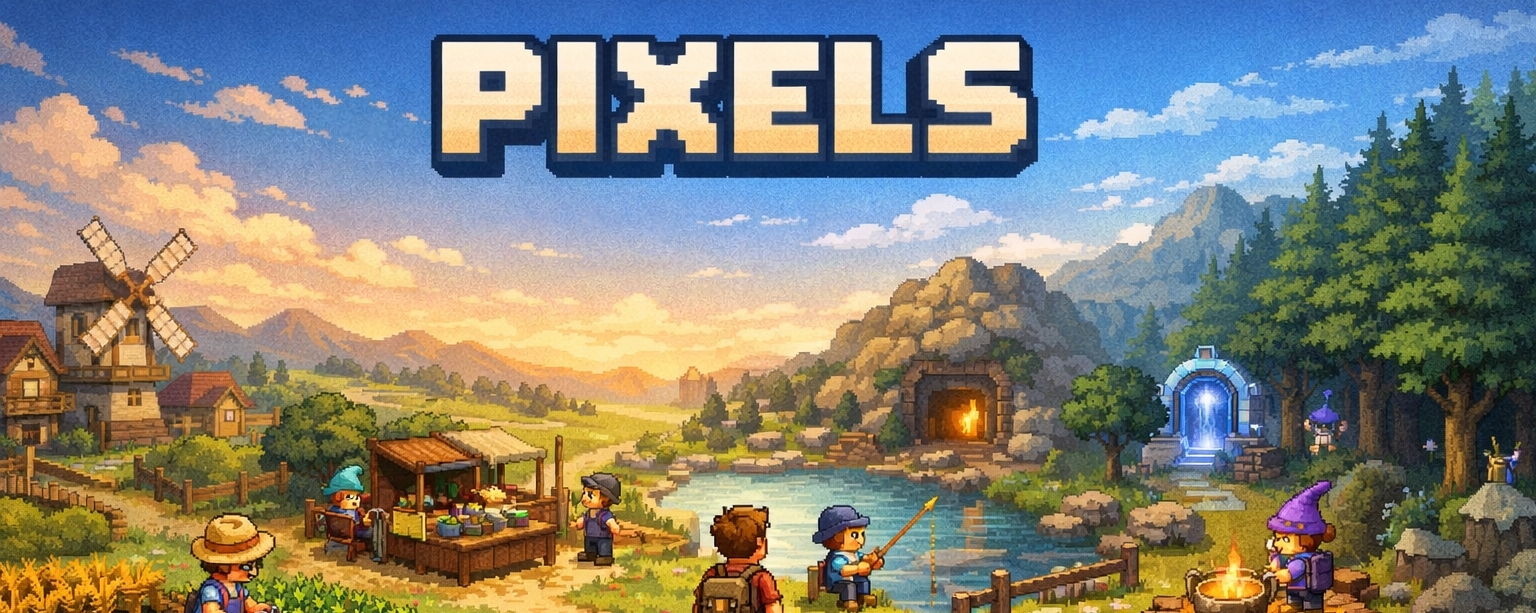

It doesn’t try to pull you in… and somehow, that’s exactly why you stay.
I’ll be honest, most Web3 games feel heavy the moment you open them. You can feel the system behind everything rewards, tokens, mechanics all pushing you toward a certain behavior. It’s clear what you’re supposed to do, what you’re supposed to earn, how you’re supposed to move.
And after a while… it starts to feel like work.
Pixels doesn’t hit you like that.

It feels light. You plant something, walk around, maybe trade a bit. Nothing is shouting for your attention. Nothing is trying too hard to prove its value. It almost feels like it’s holding back on purpose.
At first, that can feel underwhelming.
But the longer you sit with it, the more that restraint starts to make sense.
Because Pixels doesn’t force engagement.
It allows it.
Most systems are designed to guide you aggressively. They reward certain actions, push you toward optimization, and make sure you’re always aware of what matters. And while that works in the short term, it changes how people behave. Everything becomes intentional, calculated, transactional.
Pixels steps away from that.
It gives you simple mechanics, then leaves space around them. And in that space, something interesting starts to happen.
You begin to choose your own pace.
Some players focus on farming. Others spend time trading. Some just explore without any clear goal. There’s no strong pressure pulling everyone in the same direction. No feeling that you’re doing it “wrong” if you don’t optimize everything.
And because of that, behavior starts to feel more natural.
Not guided… but formed.
That’s a small difference on the surface, but it changes the entire experience.
Because when a system isn’t constantly telling you what to do, you start paying attention to what you actually want to do. You return because it feels comfortable, not because you feel like you have to.
And that’s rare.
Even the economy inside Pixels follows that same idea.
It exists, but it doesn’t dominate your attention. You’re not constantly thinking about tokens or rewards. You’re just interacting with the world, and value builds quietly around those interactions.
So instead of chasing outcomes, you just participate.
And participation starts to feel enough.
But that kind of design comes with its own tension.
Because when nothing is forced, nothing is guaranteed either.
Engagement becomes a choice, not a reaction. And that means the system depends on people continuing to show up — not because they’re incentivized to, but because they want to. That’s harder to build, and even harder to sustain.
Pixels seems to take that risk.
It doesn’t rely on constant pressure to keep you active. It relies on the environment being just engaging enough that you don’t feel like leaving.
And that’s a very different kind of strategy.
Underneath all of this, there’s also the infrastructure quietly making it possible.
Pixels runs on the Ronin Network, which keeps everything smooth and low-cost. And that matters more than it seems, because the moment interactions start to feel slow or expensive, the whole experience changes.
A system that feels forced often comes from friction.
Pixels avoids that by removing it.
You don’t think about transactions. You don’t feel delays. You just act, and things respond. And that’s what allows the experience to stay light.
But when you step back, something else starts to become clear.
Pixels isn’t trying to control behavior.
It’s trying to create an environment where behavior doesn’t need to be controlled.
And maybe that’s why it doesn’t feel forced.
Not because there’s no system underneath… but because the system knows when to step back.
And that leaves you with a thought that’s a bit uncomfortable once you sit with it.
If something can keep you engaged without pushing you…
if it can shape how you behave without making it obvious…
then are you really playing freely inside it…
or just moving naturally in a system that was designed so well, you never feel the need to question it?