
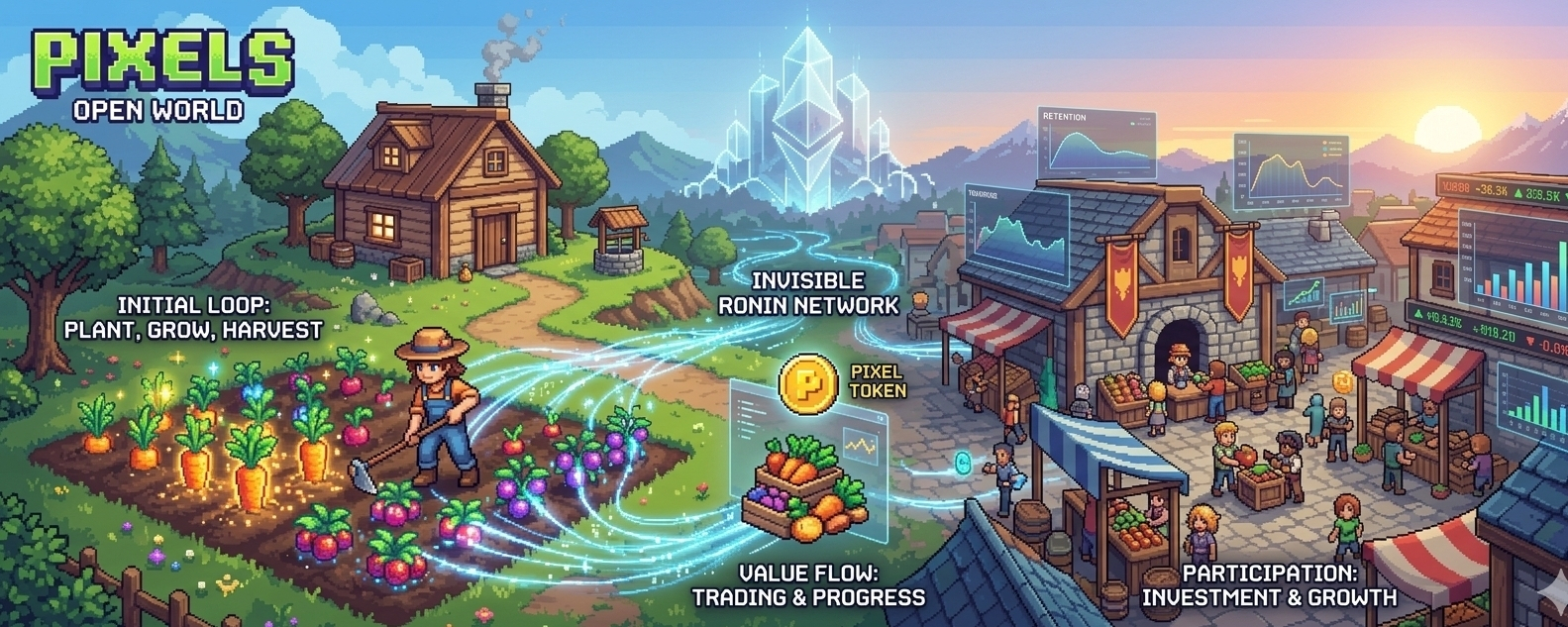

I will be honest — I almost scrolled past it. Another pixel-art farming game promising play-to-earn and blockchain magic. I’d tried a few before: plant seeds watch numbers go up cash out or burn out. But one lazy evening I clicked into Pixels on the Ronin Network and something unexpected happened. The autopilot switched off. One minute I was casually watering crops and chasing chickens around my tiny plot. The next I paused. Should I team up with the neighbor building a shared barn or keep my energy for my own expansion? Should I train this bouncy new pet to help with harvests or let it roam free for pure joy? That small deliberate choice felt strangely meaningful. In a world where algorithms decide what we see click and even feel Pixels hands the controller back to you.
The Illusion of Simplicity
Pixels doesn’t overwhelm you in the beginning. That’s intentional. It eases you into a loop that feels intuitive—plant harvest repeat. There’s no pressure to overthink no immediate demand for strategy.
And that’s exactly why most players underestimate it.
Because what feels like a casual loop is actually a system of decisions waiting to be understood. Every action you take carries weight even if it doesn’t feel that way at first.
• What you plant
• When you harvest
• How you spend your time
• What you choose to ignore
Individually these choices seem small. But together they shape your entire progression.
Pixels isn’t complex at the start—it becomes complex the moment you start paying attention.
The Shift from Playing to Understanding
There’s a moment every player eventually reaches.
It doesn’t come from leveling up or unlocking some thing new. It comes from a simple realization:
I have been doing things… but I don’t actually know why.
That’s when the shift begins.
You stop following patterns blindly and start questioning them. You begin to notice inefficiencies missed opportunities and habits that feel comfortable but aren’t effective.
This is where Pixels separates itself from traditional games.
It doesn’t force you to think it rewards you when you do.
Time Is Not the Advantage You Think It Is
In many games time is power. The more you play the more you progress.
Pixels challenges that idea in a subtle but powerful way.
Here, time alone is not enough. You can spend hours in the game and still feel like you’re not moving forward. Not because the system is unfair but because it’s responsive.
It responds to how you play not just how long you play.
Two players can invest the same amount of time and see completely different outcomes. The difference isn’t effort. It’s intention.
One is reacting. The other is deciding.
And over time, that difference compounds.
A Digital Reflection of Real World Thinking
What makes Pixels quietly powerful is how closely it mirrors real life decision making.
Without realizing it you start engaging with concepts that go far beyond the game:
• Managing limited resources
• Prioritizing actions
• Balancing short term gains with long term growth
• Understanding trade offs
You begin to feel the weight of opportunity cost choosing one action means giving up another. You start recognizing patterns in your own behavior like rushing decisions or sticking to habits that no longer serve you.
Pixels doesn’t teach these lessons directly.
It lets you experience them.
And that’s why they stick.
The Hidden Depth of Routine
At a surface level routine in Pixels feels repetitive. But for players who dig deeper routine becomes a tool.
Not a restriction but a system.
Instead of logging in and reacting to whatever is in front of them thoughtful players begin to structure their sessions. They decide in advance what matters most what can wait and what should be avoided entirely.
This creates clarity.
And clarity reduces wasted effort.
Over time their gameplay becomes smoother—not because the game got easier but because their decisions became sharper.
What once felt like randomness turns into rhythm.
The Community Effect
Another layer of Pixels’ quiet revolution lies in its social nature.
Players observe each other share strategies and discuss what works. This creates a dynamic environment where knowledge spreads quickly.
But there’s a catch.
Not all information is equally useful.
Some players copy strategies without understanding them hoping to replicate results. Others take the time to analyze adapt and refine what they learn.
That difference is subtle—but powerful.
Because in a system like Pixels understanding always outperforms imitation.
Why Most Players Stay Stuck
The truth is Pixels doesn’t hold players back.
Players hold themselves back.
They stay in auto pilot because it feels comfortable. They repeat actions because they’ve always worked well enough. They avoid questioning their approach because it requires effort.
But comfort comes at a cost.
Slow progress.
Missed opportunities.
Inconsistent results.
The game doesn’t punish these behaviors it simply reflects them.
And that’s what makes it so honest.
The Players Who Break Through
The players who move forward in Pixels aren’t necessarily the fastest or the most active.
They are the most aware.
They pay attention to outcomes.
They adjust when some thing isn’t working.
They think before they act.
Over time, they build something more valuable than resources or rewards.
They build understanding.
And once that understanding is in place progress stops feeling random.
It becomes intentional.
More Than a Game
At its core Pixels is not trying to be loud or over whelming. It doesn’t rely on constant excitement or flashy mechanics.
Its strength lies in subtlety.
It creates an environment where thinking matters where decisions have consequences and where awareness leads to growth.
That’s the quiet revolution happening in every pixel plot.
Not just a change in how you play but a shift in how you approach systems challenges and even your own habits.
Final Thought
What starts as a simple farming game slowly becomes some thing more meaningful.
A space where you learn to slow down observe and act with intention.
Because in Pixels the real difference isn’t how much you do.
It’s how well you understand what are you doing.
And once that clicks every thing changes.