
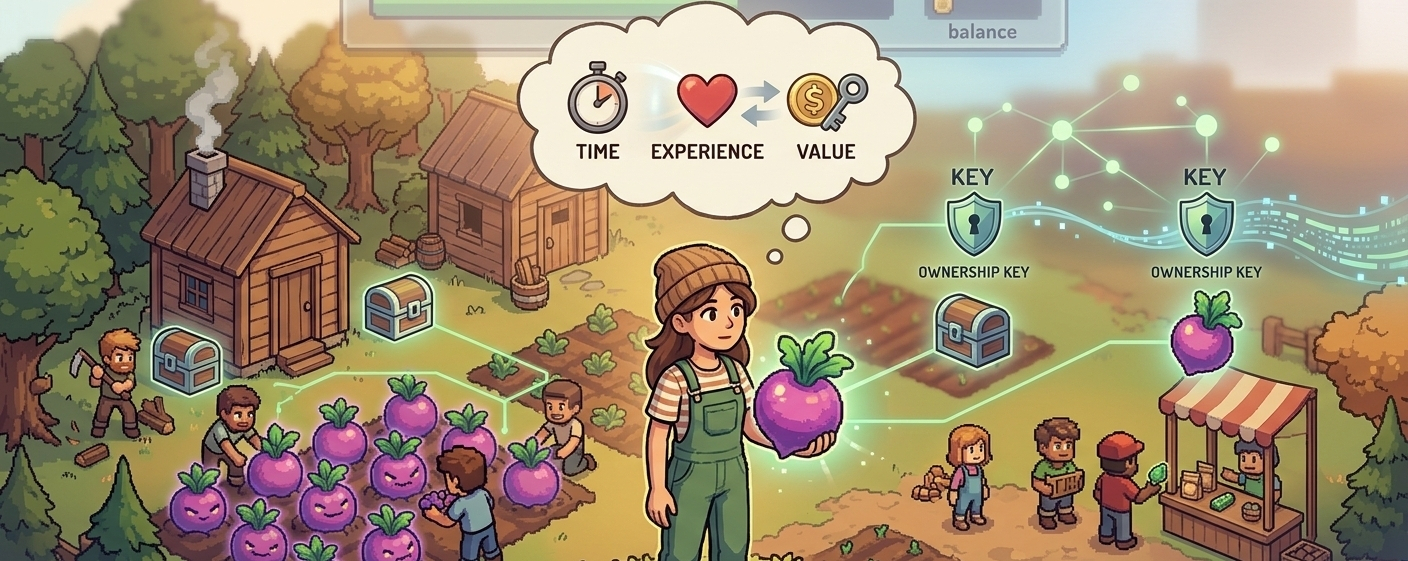
I didn’t really question it for a long time—why I kept putting so much time into games where nothing actually belonged to me.
It just felt normal. You play, you grind, you build things, and then one day you move on. The world resets, the servers stay, and everything you made stays locked inside someone else’s system. That was just how games worked.
But at some point, I started noticing how much of myself I was leaving behind in those places. Not just items or progress, but time. Effort. Even small routines that started to feel oddly meaningful. And still, I had no real claim over any of it.
Before blockchain games showed up, there were already small workarounds. Trading items, selling accounts, unofficial marketplaces that everyone knew existed but nobody fully trusted. Some games even built their own trading systems. But none of it really changed the core reality. The game could still take it all away, or simply shut the doors.
When Web3 gaming entered the picture, it sounded like that problem was finally being addressed. The idea was straightforward: if items exist on-chain, then they’re yours. Not just inside the game, but outside of it too.
At first, that idea made sense to me. But the more I looked at these games, the more I felt another layer forming over the top. A lot of them started turning into economic systems first, games second. You weren’t just playing—you were managing, optimizing, calculating. And honestly, it started to feel tiring more than fun.
Pixels feels different in a quieter way. When I first opened it, nothing really felt complicated. It’s a simple farming and life-sim style game. I plant things, collect resources, expand slowly, and talk to other players sometimes. That’s it at the surface level.
There’s no rush to understand everything at once. I didn’t feel pushed into systems I didn’t care about. I could just play. And that matters more than it sounds like it should.
Underneath that simplicity, there is still blockchain ownership involved. Some items can exist on-chain, and there’s an in-game economy that connects effort and progression. But it doesn’t sit in my face all the time. I can ignore it if I want to, which I actually appreciate.
Still, I can’t pretend it solves everything. Ownership here is real in a technical sense, but it’s also limited. If the game loses players or changes direction, the value and meaning of what I hold changes with it. So it’s not ownership in the absolute sense people sometimes imagine.
And then there’s progression. The more time I spend, the more I get ahead. That part feels familiar from almost every game I’ve ever played. But with blockchain systems mixed in, those gaps can feel a bit more fixed than before. Time and resources matter, and not everyone moves at the same pace.
The social side surprised me a little. I didn’t expect to interact as much as I do. There’s cooperation, trading, and small communities forming naturally. It makes the world feel alive in a simple way. But even there, I notice differences between players who treat it casually and those who treat it more seriously.
What I keep thinking about is whether this kind of system can actually last. I’ve seen enough games come and go to know that early activity doesn’t guarantee anything long-term. Pixels feels aware of that risk. It doesn’t push too hard, and it doesn’t overload you with incentives. It feels slower on purpose.
But I still don’t know if that’s enough.
Because at the end of the day, the question isn’t just about technology or ownership systems. It’s about why I play at all. What changes when the things I build in a game start to carry real weight outside of it?
And I keep coming back to one simple thought.
If I start owning more of what I build inside games, do I actually value the experience more—or does it quietly change the reason I enjoyed it in the first place?
