
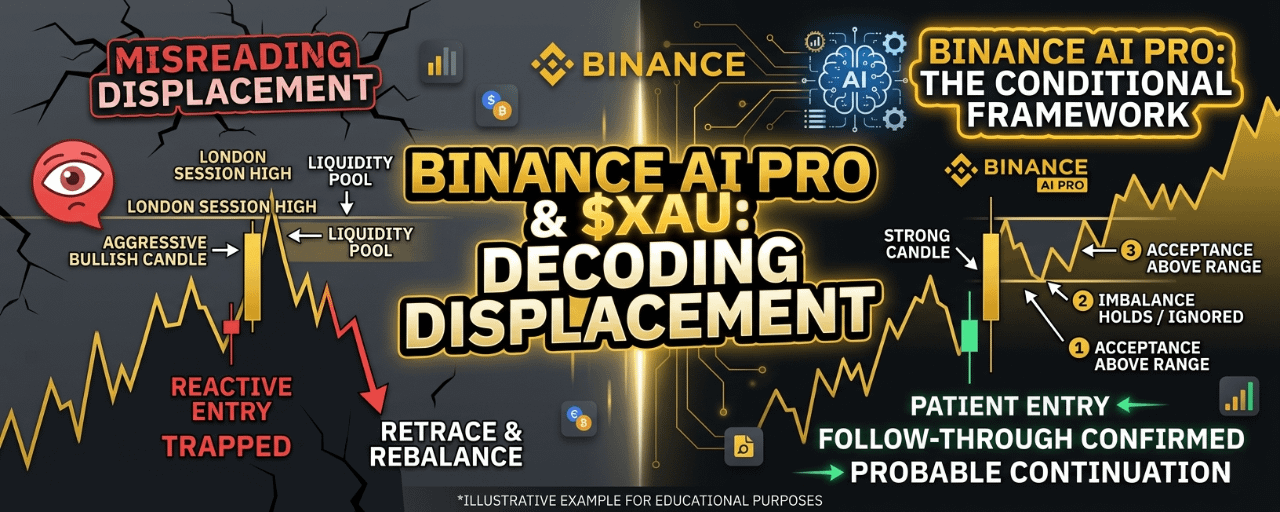
Binance AI Pro becomes meaningful when it is used to dissect one specific weakness most traders have on $XAU , misreading displacement. Strong candles are often interpreted as confirmation, but in gold, displacement without context is frequently just liquidity engineering.
A typical sequence I tracked recently was a high taken during a London session push, followed by an aggressive bullish candle closing above structure. Most entries came right after that close, assuming continuation. What actually followed was a shallow extension, then a full retrace back into the origin of the move. The initial displacement was not continuation, it was a liquidity event.
The key is not the candle itself, but what happens around it. When price displaces, three things need to be checked immediately. First, whether the move leaves behind a clear imbalance. Second, whether that imbalance gets partially filled or completely ignored. Third, whether subsequent candles show acceptance above the new range or failure to hold.
This is where Binance AI Pro adds value in a practical sense. Instead of reacting to the candle, it breaks the move into conditions. If displacement is followed by inefficient structure and no immediate continuation, probability shifts toward rebalancing. If the imbalance holds and price builds above it with compression, continuation becomes more likely. This conditional framing removes the tendency to treat every strong move as confirmation.
Another layer that becomes clearer is the relationship between displacement and liquidity pools. On $XAU , equal highs, session highs, and obvious breakout levels tend to attract positioning. Displacement into those zones is rarely the move itself. It is often the trigger before the real move begins in the opposite direction.
One example I noted was a sweep of equal highs followed by a sharp bullish expansion. On lower timeframes, this looked like a breakout. But when tracking follow through, there was no continuation, only absorption. Price stalled, then rotated downward, filling the entire imbalance left by the move. The initial expansion was not strength, it was distribution.
What changes with this approach is execution timing. Instead of entering on displacement, the focus shifts to what happens after. Does price accept above the move, or does it return to rebalance. That distinction is where most trades are won or lost.
Over time, this reduces one of the most common errors in trading gold, confusing movement with intent. Displacement shows activity, but only follow through confirms direction. Without that second layer, entries become reactive and exposed to reversals.
Trading always involves risk. AI generated suggestions are not financial advice. Past performance does not guarantee future results. Please check product availability in your region before participating.