
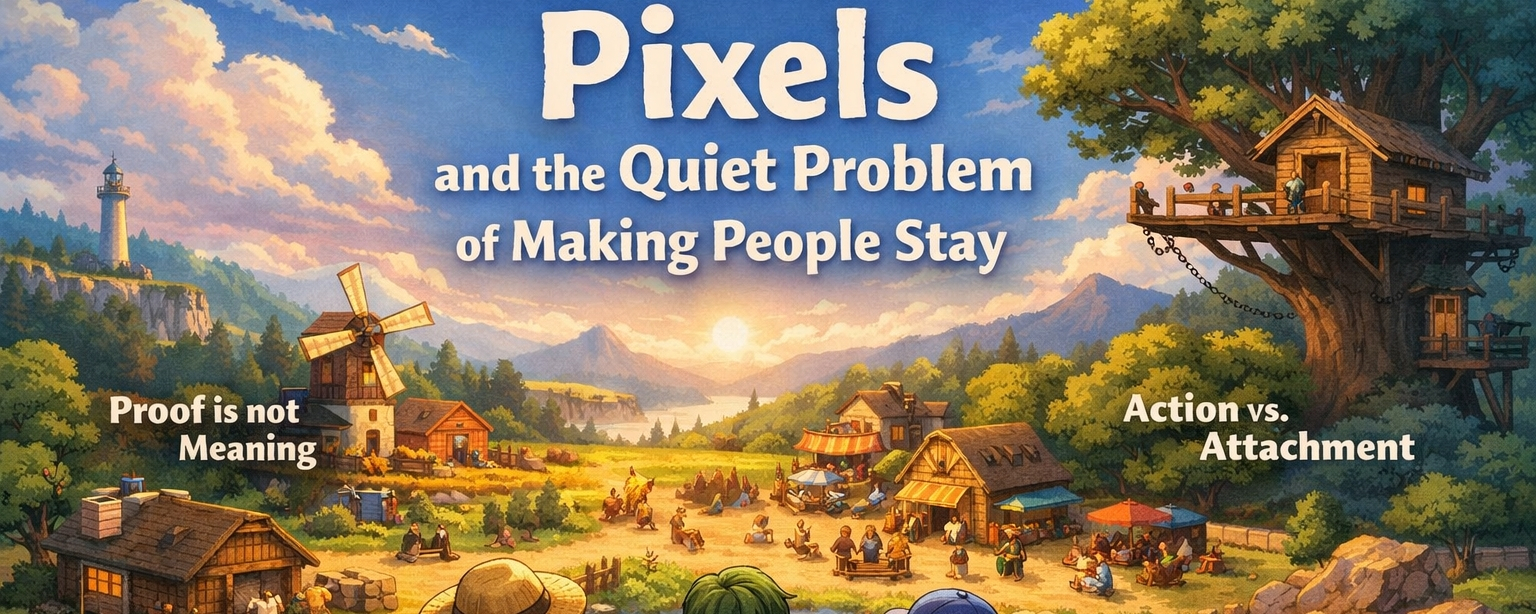
I did not think much of Pixels the first time I came across it. That is not me trying to be dismissive. It is just what happens when you have been around this market long enough. After a while, everything starts arriving with the same energy. A new project appears, people rush to call it important, the same words get recycled, and you are expected to react like this time is different. Most of the time, it is not. So you learn to look without giving too much of yourself too early.
That was my first reaction here. Pixels looked familiar. A social game, farming, exploration, a digital world built around simple interaction and routine presence. Nothing about that immediately made me stop. If anything, it felt like the kind of thing I should have understood in seconds and then forgotten just as quickly. Crypto has done this for years now, taking familiar ideas and wrapping them in a new layer of language, hoping the new language will make the old shape feel deeper than it is.
But Pixels stayed with me, and I kept wondering why.
Not because it looked bigger than everything else. Not because it sounded smarter. It actually felt smaller than the way this space usually tries to present itself, and maybe that is part of what made it harder to fully brush aside. It did not force itself into my attention. It just kept showing up in it. Quietly. And there is something about that kind of return that matters more to me now than hype ever does. In a market full of noise, I pay more attention to the things that linger than the things that shout.
The more I sat with it, the less I cared about describing what Pixels is and the more I started thinking about what kind of problem it seems to be touching. That problem feels older than Web3 and more difficult than most projects want to admit. It is the problem of how a digital space becomes somewhere people actually want to stay. Not visit for a moment. Not use because there is a reward attached. Stay. Return. Build habits around it. Let it slowly become part of their rhythm in a way that feels natural instead of forced.
That sounds simple when written down, but it may be one of the hardest things to build online.
The internet has always struggled with this. Every few years the language changes, but the problem does not. Community, platform, creator economy, digital ownership, social layer, online identity. Different terms, same underlying question. How do you create a place that people do not just pass through, but begin to care about. How do you build something that earns return without constantly bribing attention.
Crypto stepped into that old problem and, as usual, brought a new set of tools and a new set of distortions. Now everything can be tracked. Everything can be tokenized. Every action can be recorded, priced, measured, and turned into proof that participation happened. But that is where the deeper tension starts for me, because proof is not the same thing as meaning. A wallet can show that someone was there. It cannot tell you why being there mattered. A transaction can confirm movement. It cannot create attachment. A record can prove action. It cannot produce trust on its own.
That gap sits underneath more of this market than people like to admit.
We have become very good at showing evidence that activity exists. Less good at knowing whether that activity carries any weight beyond the fact that it can be seen. That is part of what kept pulling me back toward Pixels. It seems to sit close to that tension, whether intentionally or not. Close to the line between participation that is visible and participation that is actually felt. Close to the difference between a system that can count users and a place that can hold them.
And that difference matters. Maybe more than anything else now.
Because after enough years in crypto, fatigue stops coming from volatility or even failure. It comes from repetition. You start recognizing how often this space mistakes movement for meaning. A launch becomes traction. A user spike becomes loyalty. A token becomes a community. Ownership becomes belonging. We keep naming outcomes before they are real, and then we act surprised when the structure underneath them does not hold.
That is why I could not quite dismiss Pixels in the usual way. It did not strike me as some grand answer. I do not think like that anymore. But it did feel like something sitting near a more honest question than most projects do. Not how to create immediate intensity, but how to survive ordinary use. How to hold attention once the first layer of novelty thins out. How to become part of someone’s routine without feeling like pure extraction.
That is where the project starts to feel more interesting to me. Not in the dramatic way people often want crypto to feel, but in a quieter, more difficult way. A farming loop may sound light on the surface, but repetition is where the truth usually shows up. Repetition exposes what people actually value. Repetition removes some of the theater. It asks a harder thing. Will you come back when nobody is telling you this is important. Will you return when the moment is less loud. Will this place still make sense when the market is not handing you a fresh reason every day.
That is where so many systems fail. They can attract attention, but they cannot hold daily life. They can generate action, but not memory. They can create measurable participation, but not necessarily attachment. Everything starts to feel rented. People arrive because something is being offered. They leave when the offer weakens. And maybe that pattern is not just a flaw in crypto. Maybe it is one of the clearest reflections of the wider internet now. So much of online life is built around temporary alignment. Very little is built around patient meaning.
That is why Pixels kept bothering me, in a good way. It made me think again about how rare it is for a digital place to feel lived in rather than simply used. There is a real difference between those two things. A place people use can still be successful by most visible measures. But a place people live in, even lightly, even casually, carries another kind of weight. It becomes part of behavior before it becomes part of language. People stop explaining why they return. They just do.
I am not saying Pixels has fully become that. I do not know if it has. I do not know if any project can hold that balance cleanly for long, especially once money, ownership, and market expectations are layered into the experience. That is another tension that keeps coming back the more I think about it. Execution versus meaning. Action versus proof. Trust versus record. These are not clean oppositions, but they sit under everything. A project can execute well and still feel hollow. It can create strong visible signals and still fail to become real in the deeper sense. And sometimes what looks casual on the surface is actually standing closest to the hardest question of all: what makes people care enough to stay.
That question is older than crypto. It is probably older than the internet in its current form too. Every system wants engagement. Very few know how to turn repeated presence into something with texture. Not just use, but texture. That is the word I keep coming back to. The feeling that a place has built up enough small acts, enough routine, enough ordinary return, that it begins to mean something beyond its own mechanics.
Maybe that is what I was sensing with Pixels from the start, even before I had the words for it. Not that it was obviously special, but that it kept touching a problem most people still try to solve with metrics, monetization, or branding. And none of those things are meaningless, but none of them are enough. You can price behavior. You can reward it. You can track it in perfect detail. But you still cannot force it to matter.
That is where my attention stayed.
Not on the easy story. Not on the surface description. On the possibility that what looks simple may actually be circling something much heavier than it first appears. The difficulty of making an online space feel worth returning to. The difficulty of turning visible activity into real presence. The difficulty of building something that is not just efficient at capturing attention, but patient enough to earn it.
I still do not feel the need to overstate what Pixels is. In fact, I think overstating it would miss the point entirely. What stayed with me was not some sense that I had found the next big thing. It was something quieter than that. The feeling that beneath the familiar shape, there was a more serious question sitting there, and the project kept pulling my eye back because it seemed closer to that question than I first gave it credit for.
Maybe that is all this is for now. Just that shift. From dismissal to curiosity. From seeing it as another passing thing to noticing that it would not fully pass. And sometimes that is enough to make something worth writing down. Not certainty. Not conviction. Just the fact that it kept returning, and the more it returned, the less I thought the real story was about the game itself, and the more I thought it was about the kind of absence it was trying, however imperfectly, to fill.