There’s a quiet assumption baked into most blockchain systems: if you can prove something, you can coordinate around it. But the longer I sit with that idea, the more it feels incomplete especially when you introduce privacy. Proof alone doesn’t guarantee coordination. And in systems like PIXEL, where thousands of players, assets, and decisions collide in real time, coordination under partial visibility becomes the real problem.
Zero knowledge proofs were supposed to unlock privacy without sacrificing trust. And to some extent, they did. They let you prove that something is true without revealing why it’s true. But that’s only half the story. What they don’t solve at least not cleanly is how multiple private actions interact with each other simultaneously.
This is where the concurrency problem quietly breaks things.
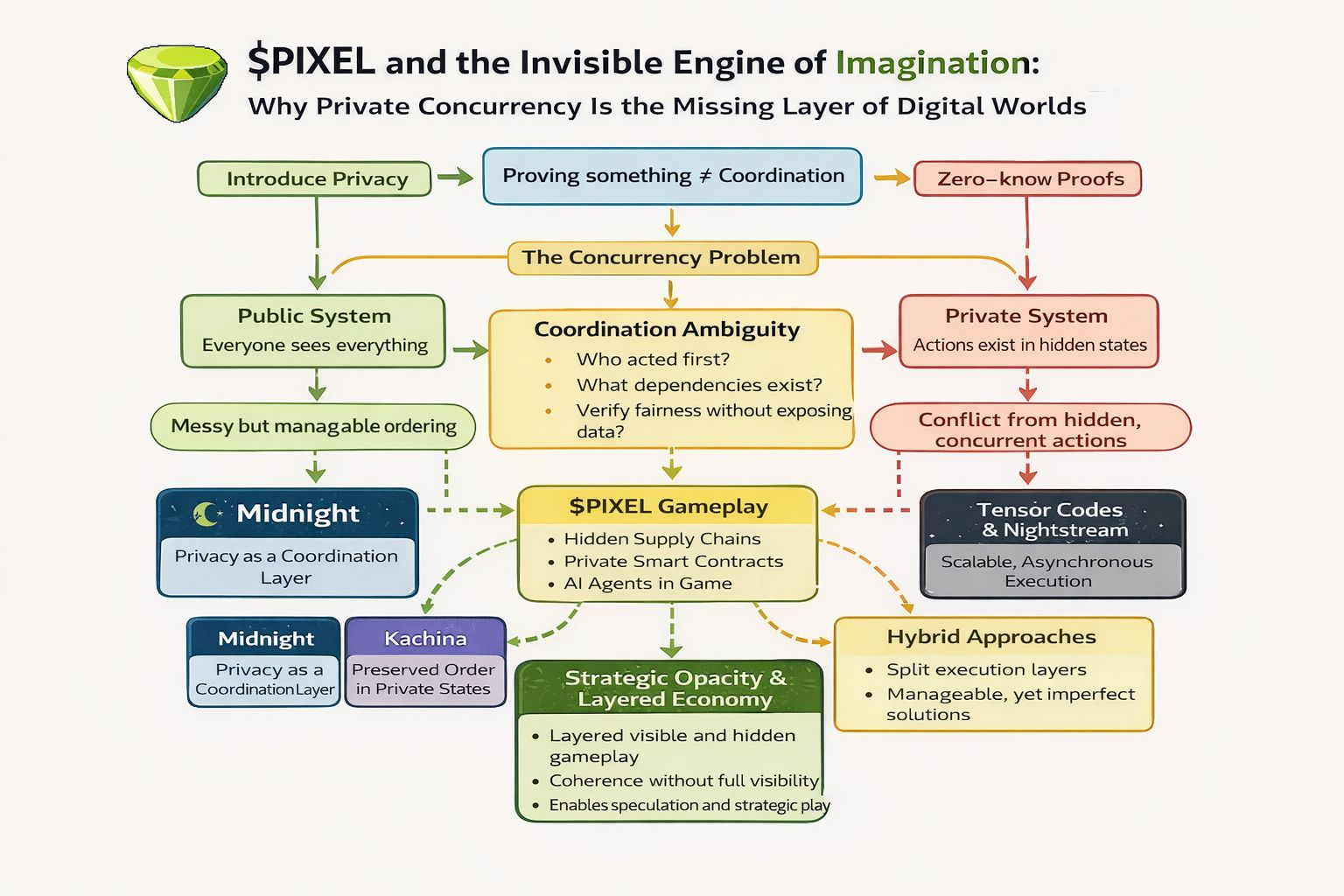
In a public system, concurrency is messy but manageable. Everyone sees everything, so ordering can be enforced. But in a private system, actions exist in hidden states. Two players can make decisions based on information that no one else sees. Now imagine those decisions conflict who resolves that conflict, and based on what visibility?
This isn’t just a technical edge case. It’s fundamental. And it becomes painfully obvious when you map it onto something like PIXEL.
Take a simple example: sealed bidding for rare land. If bids are private, players can’t front-run each other. That’s good. But if hundreds of players submit hidden bids simultaneously, the system needs to reconcile them without revealing intermediate states. The moment you try to process those bids in parallel, you run into coordination ambiguity. Who acted first? What dependencies existed? And how do you verify fairness without exposing the very data you’re trying to protect?
This is where emerging architectures start to feel less like upgrades and more like necessary evolutions.
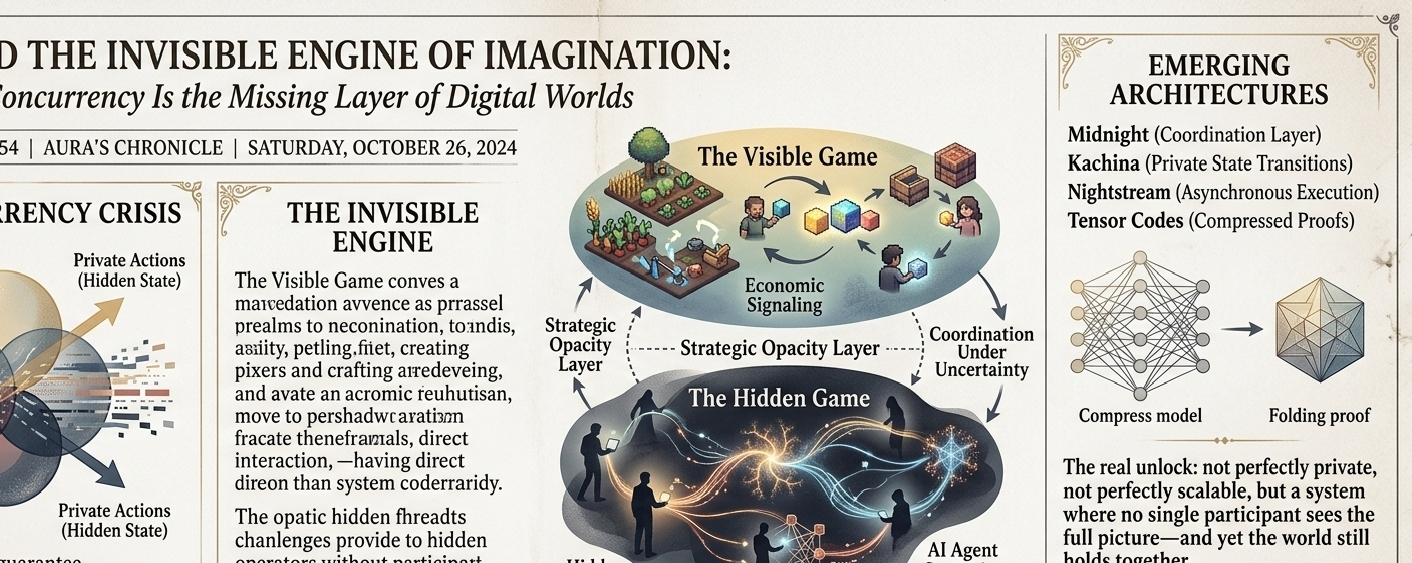
Midnight’s design philosophy leans into the idea that privacy isn’t a feature it’s a coordination layer. Systems like Kachina attempt to structure private state transitions in a way that preserves ordering without exposing content. Nightstream introduces asynchronous execution models that accept that not all actions need to be globally synchronized in real time. Tensor Codes and folding proofs push on scalability, compressing massive proof systems into something that can actually be processed at scale.
But none of these fully solve concurrency. They circle it. They reduce its surface area. They make it more manageable. But the core tension remains: private actions resist clean ordering.
And that tension matters more than it seems.
Because in a system like PIXEL, gameplay isn’t just interaction it’s coordination under uncertainty. Farming, crafting, trading these are all forms of economic signaling. Right now, most of that signaling is visible. But the moment you introduce private coordination, the game changes.
Imagine hidden supply chains where players coordinate resource production without revealing strategies. Or AI agents operating inside the game, making trades based on private models and unseen data. Or financial agreements loans, hedges, insurance executed through private smart contracts that don’t broadcast intent to the entire network.
Suddenly, the economy becomes layered. There’s the visible game, and then there’s the hidden one.
But without solving concurrency, that hidden layer stays fragile. Conflicts become harder to resolve. Latency increases. Systems either slow down or leak information to stay functional.
Hybrid consensus models try to bridge this gap splitting execution between public ordering layers and private computation layers. It’s a compromise. And maybe that’s the point. Full privacy and full concurrency might not coexist cleanly. At least not yet.
What’s interesting is that PIXEL doesn’t need perfect solutions to evolve. It just needs better approximations.
Because the real shift isn’t about hiding everything. It’s about enabling strategic opacity letting players act without revealing intent, while still maintaining a coherent world.
And that’s where privacy stops being about secrecy.
It becomes about imagination.
Because when not everything is visible, players don’t just react they speculate. They infer. They coordinate in ways that aren’t explicitly encoded.
And maybe that’s the real unlock.
Not a perfectly private system. Not a perfectly scalable one.
But a system where no single participant sees the full picture and yet the world still holds together.
That’s not just a technical milestone.
That’s a different kind of game entirely.