Pixels is easier to understand when it is seen less as a game and more as a small living economy with rules, property, labor, and social status. On the surface it looks like a casual farming world, but under that surface it is trying to solve a much larger problem, which is how people cooperate online when ownership is shared, rewards are visible, and value has to move through a system without constant central control. That is why Pixels matters. It is not only about farming or collecting tokens, it is about whether a digital world can keep people active, connected, and productive without turning into a short term reward trap.
At the center of the game is land, and land changes everything. Some players own land, some rent it, and some work on free plots through a sharecropping model. That means the game is not built around one simple role. It creates a layered social structure where ownership, access, and labor are separated. In real life, that structure feels familiar because it resembles how small economies work outside the crypto world. Some people hold assets, some rent them, and some provide work or coordination. Pixels takes that old economic pattern and places it inside a game world where the rules are visible and programmable. That makes it a useful case study in Web3, because it shows how digital property can shape daily behavior instead of just sitting in wallets as a static asset.
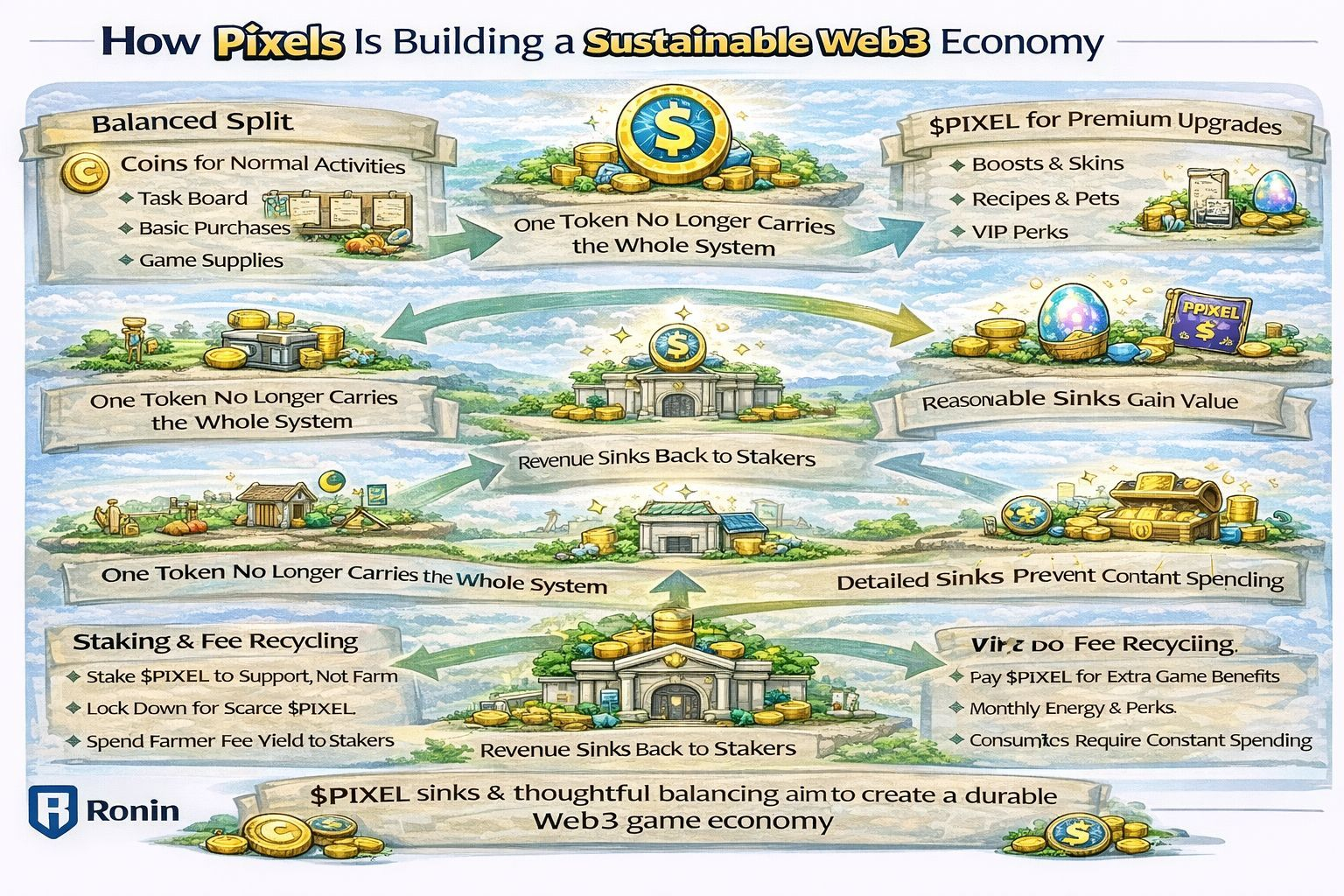
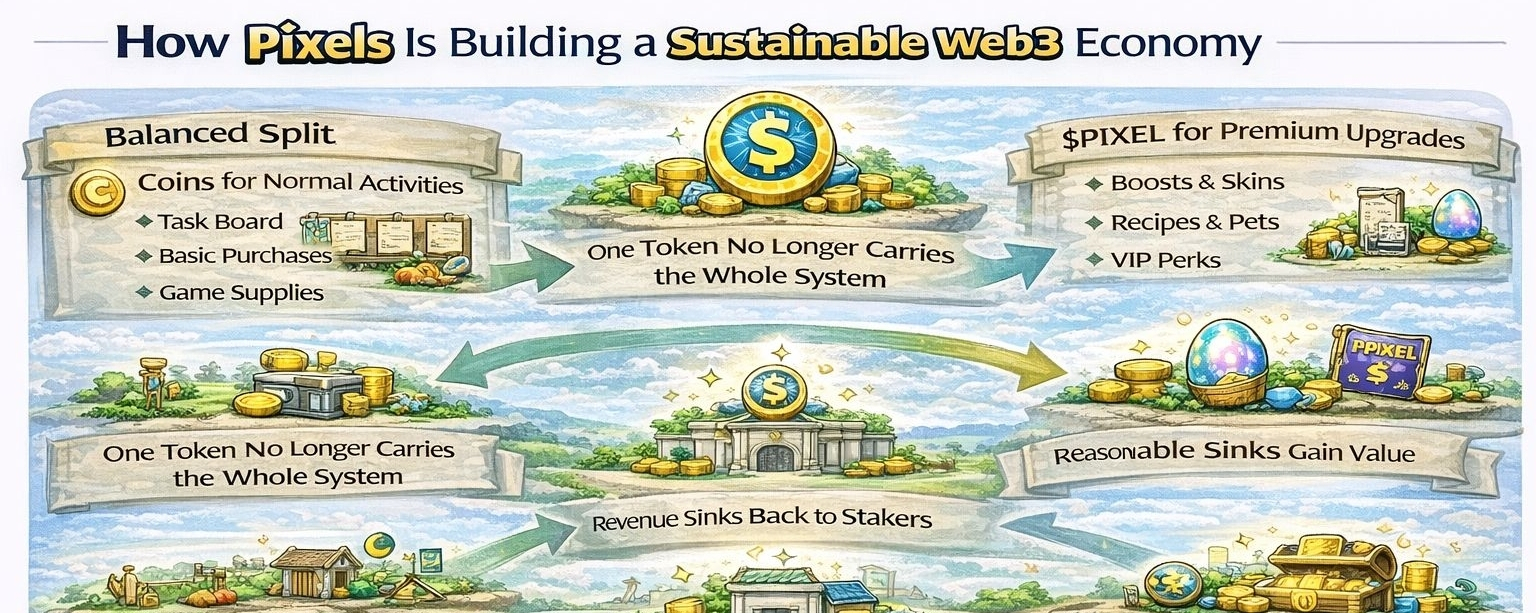
The token system is part of that same structure. In many crypto projects, the token is treated like the main story, but in Pixels it works more like the accounting layer beneath the story. It helps define what gets rewarded, what costs something, and what kind of activity the world wants to encourage. The project has already had to adjust its economy, which tells us something important. A game economy is not stable just because it has a token. It must manage inflation, preserve meaning, and keep rewards connected to real participation. Pixels shifted away from its older soft currency model because that system was becoming hard to control. That change is not a side note, it is one of the clearest signs that the team understands the difference between short term activity and long term economic health.
What makes Pixels interesting in the broader crypto system is that it does not rely on a single use case. It brings together farming, staking, reputation, guilds, pets, creator codes, and cross game links. Each of these pieces serves a different purpose. Farming creates routine activity. Staking creates locked commitment. Reputation creates trust and access control. Guilds create organized groups that can coordinate better than individual players. Creator codes create a flow of value toward social influence and community building. Pets and avatars create identity and personal attachment. Together these parts form a network of incentives rather than a single reward loop. That matters because durable systems do not depend on one behavior. They depend on many behaviors that reinforce one another.
Ronin gives this system a practical base. Without a chain that reduces friction, a game like Pixels would spend too much energy fighting blockchain complexity instead of building a world people enjoy. Ronin is important here because it lowers the technical cost of joining, trading, and moving assets. In simple terms, it makes the settlement layer easier to use. That matters more than many people realize, because a game economy only works when players can move value without feeling like every action is a financial chore. If the infrastructure is clumsy, the world feels heavy. If the infrastructure is smooth, people can focus on play, trade, and cooperation. In that sense, Ronin is not just a network under Pixels, it is part of the game’s social engine.
The deeper question is why any of this matters outside of crypto culture. It matters because online communities increasingly need systems that can reward real contribution without depending entirely on centralized platforms. Pixels is a test of whether a game can support a small economy where participants feel ownership, but also responsibility. That idea has real world relevance. Many modern digital communities struggle with free riding, spam, short attention spans, and weak trust. A system like Pixels tries to answer those problems with structure. Reputation decides who can do more. Staking decides who has skin in the game. Land and guilds decide who can organize production. The token decides how value is recorded and moved. This is the kind of design that can matter in any digital space where people need to coordinate over time.
The roadmap suggests that Pixels is trying to deepen this structure rather than simply expand it. Instead of endlessly minting new land or chasing surface growth, the project has moved toward broader economy changes, new social layers, more use cases for staking, and wider integration across games. That direction is sensible because mature systems usually grow by adding depth, not just size. A wider map is not always a stronger economy. A better economy is one where each part has a reason to exist and where players can understand how their actions shape the whole. Pixels seems to be moving in that direction by making its world more interconnected rather than just bigger.
The risks are just as important as the design. Every game economy with tokens faces the same basic danger, which is that reward can become the main reason to participate. When that happens, the game stops feeling like a world and starts feeling like a machine. Pixels has already had to correct parts of its economy because of inflation and reward pressure, and that shows the fragility of the model. Another risk is concentration. If land, reputation, and guild power keep accumulating in the hands of a small group, then the system can become less open over time. New players may still enter, but they may not feel they can truly rise. There is also the risk that social systems like guilds and reputation become too rigid, making the world efficient but less alive.
Even with those risks, Pixels remains important because it shows how Web3 can be used for something more subtle than speculation. It is not just a token project pretending to be a game. It is a living attempt to build digital settlement, digital trust, and digital labor into one environment. The real value of that idea is not in theory, it is in stress. A system like this only proves itself when players try to exploit it, leave it, return to it, trade inside it, organize around it, and adapt to changes in it. That is where the true measure of a Web3 economy appears. Pixels matters because it is trying to become a place where rules still work when attention shifts, where incentives still function when rewards change, and where a digital community can keep its shape under pressure. That is a much harder goal than making a popular game, and it is exactly why the project deserves serious attention.