
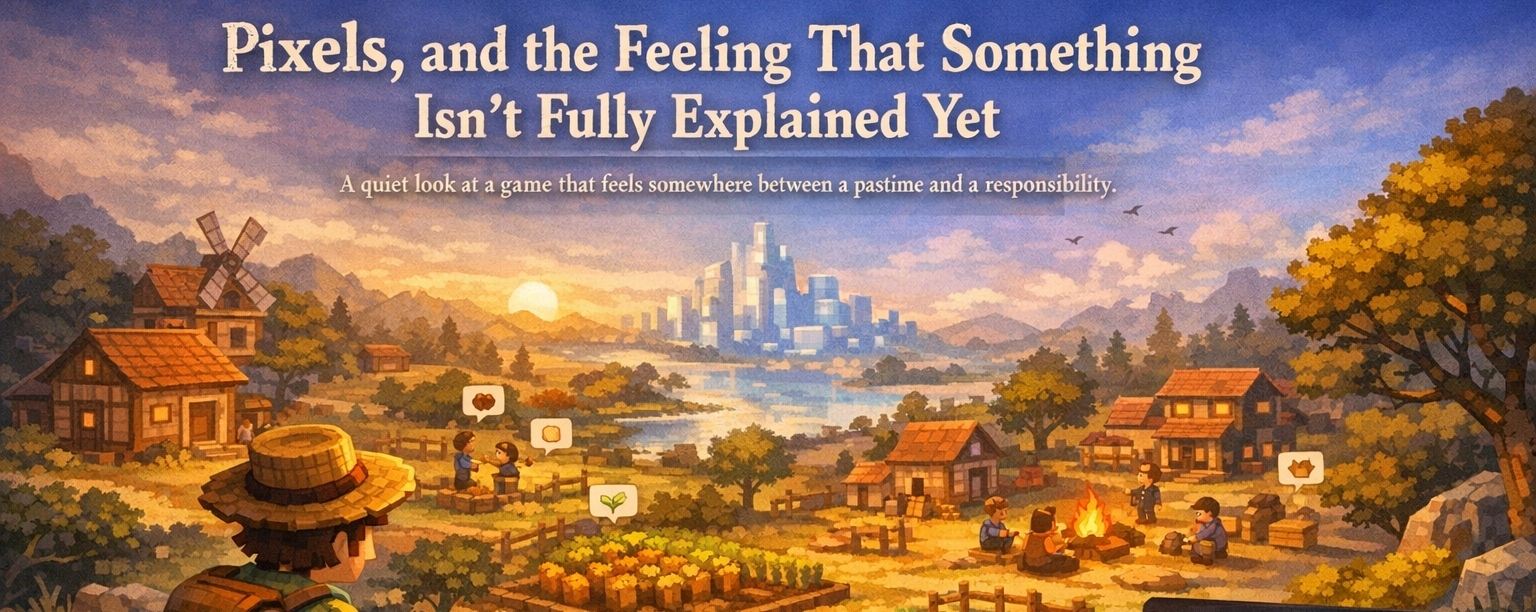
At the beginning, Pixels feels easy to understand. A farming game, a bit of exploration, a social layer, and somewhere underneath it all, Web3 quietly keeping track of ownership. It presents itself in a way that doesn’t ask too much from you. You plant something, you wait, you return. The loop is familiar enough that you don’t question it.
But after a while, small things start to feel slightly out of place.
It’s not anything obvious. The world is calm, almost intentionally simple. Yet there’s this underlying sense that your actions are being remembered differently than in a typical game. Not just stored, but recorded with a kind of permanence that changes how you look at even the smallest decision. Planting a crop or expanding a piece of land stops being just progress. It starts to feel like a commitment, even if the game never says that directly.
And that’s where the experience begins to shift.
Most games reset your attention constantly. New quests, new rewards, new urgency. Pixels does something quieter. It lets time pass. It allows repetition to settle in. At first, that feels relaxing. Then, slowly, it raises a question that isn’t immediately answered: if this world is persistent, what exactly makes it feel alive rather than just ongoing?
The presence of ownership complicates that question further.
In theory, owning something in a game should make it more meaningful. But in practice, it introduces a subtle tension. When something has value beyond the game, your behavior adjusts. You become slightly more careful, slightly more aware of outcomes. It’s not dramatic, but it’s noticeable. The freedom to experiment becomes balanced by the instinct to protect.
Pixels doesn’t resolve this tension. It just lets it exist.
The Ronin network, working quietly in the background, tries to remove friction. Transactions feel lighter, almost invisible at times. You don’t have to think about the technical side constantly, which helps the experience feel closer to a traditional game. But the awareness never fully disappears. You know there’s a system beneath the surface assigning value, tracking actions, shaping incentives.
And that awareness lingers.
What’s interesting is how the social aspect fits into all of this. You’re not alone in the world, but interactions often feel indirect. People are building, farming, progressing alongside you, yet everyone seems to be negotiating their own balance between playing and managing something that might matter outside the game. It creates a shared space, but not always a shared mindset.
That difference is subtle, but it changes the atmosphere.
Over time, Pixels starts to feel less like a game you “complete” and more like a place you revisit without fully understanding why. You log in, check on things, make small improvements. Nothing feels urgent, but it doesn’t feel meaningless either. It sits somewhere in between, in a space that hasn’t been clearly defined yet.
And maybe that’s the point, or maybe it’s the part still being figured out.
Because the deeper question never quite goes away. If a game gives you ownership, persistence, and a sense of continuity, is it still just a game? Or does it slowly become something else, something closer to a digital routine, or even a responsibility?
Pixels doesn’t answer that. It simply keeps running, letting you experience the question instead of resolving it.
And the longer you stay, the more you notice that the most important part of it isn’t what the game tells you.
It’s what it quietly leaves open.
