

Pixels is one of those projects that makes more sense when you stop reading it like a pitch and start reading it like a system. On the surface, it is a world of farming, exploration, skill growth, and social play. The official site frames it as a place where people can build games around digital collectibles, own what they earn, and play for free, while also pointing to Chapter 2, staking, and land on Ronin as part of the current setup. That tells me the project is not just trying to be a game, but a platform with a game at the center of it. �
pixels.xyz +1
What matters to me is the structure underneath that friendly surface. Pixels says its world is built around a persistent 2D environment where players gather resources, advance skills, build relationships, and move through quests and story content. It is also explicit that the game is meant to feel easy-going rather than heavy or intimidating. That sounds soft, but the design problem is hard: once a game becomes social and economic at the same time, you are no longer just balancing fun. You are balancing trust, timing, and the way people react when incentives stop lining up neatly with the experience. �
docs.pixels.xyz +1
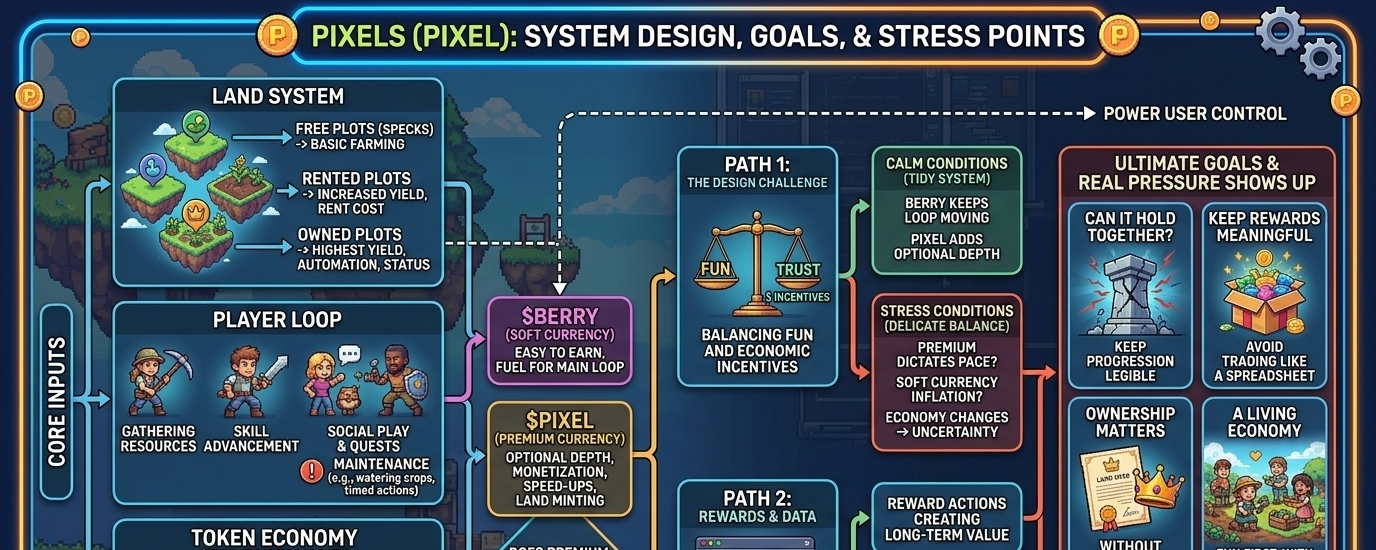
The part that stands out most is the two-token setup. Pixels describes $BERRY as the primary in-game currency, the soft currency that players use for core progression. It is supposed to be accessible and easy to earn, because it sits inside the main loop of play. $PIXEL, by contrast, is the premium currency. It is used for items, upgrades, cosmetics, land minting, speed-ups, temporary energy boosts, skins, pets, skill enhancers, crafting recipes, and even merchandise, but the docs are clear that players do not need it in order to progress. That distinction matters. A game economy gets unstable fast when the premium token becomes the only real path forward. Then the game stops feeling like a game and starts feeling like a fee schedule. �
docs.pixels.xyz +2
I think that split is Pixel’s strongest design decision, but also its most delicate one. In calm conditions, a two-token system can look tidy. $BERRY keeps the daily loop moving. $PIXEL adds optional depth and monetization without grinding the whole experience into a wall. But under stress, those same layers can pull against each other. If players believe the premium side is quietly dictating the pace of the game, trust starts to slip. If they believe the soft currency is too easy to farm, the game economy can inflate and lose meaning. If the economy changes too often, players stop planning and start waiting for the next patch. That is the real test: not whether the system works on a good day, but whether it still feels fair when people push on every weak point at once. �
docs.pixels.xyz +2
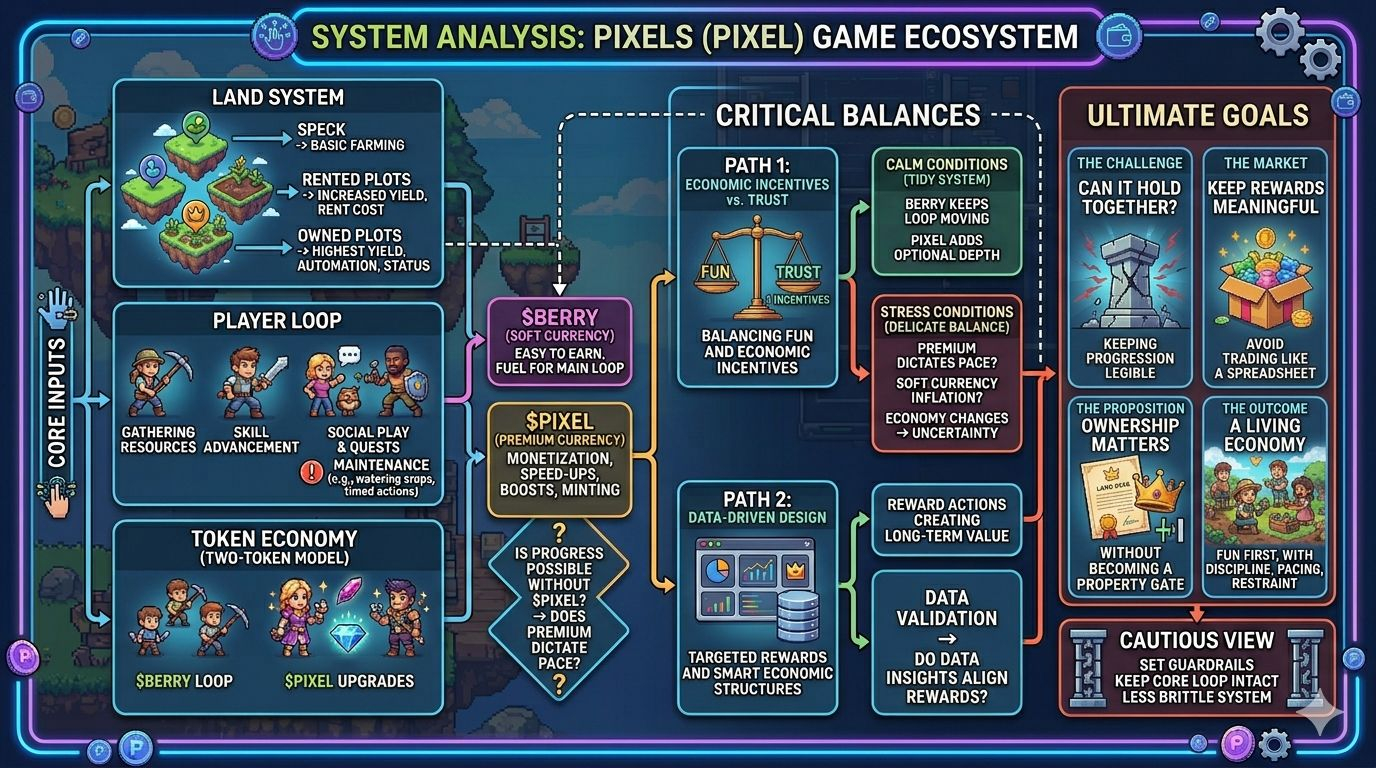 Land is another place where the trade-offs are very visible. Pixels describes plots as floating landmass in the universe, with free plots, rented plots, and owned plots. Free plots, also called Specks, are the most basic. Rented plots offer better yield and more freedom but come with a cost. Owned plots give the highest yield and the most functionality, with additional benefits tied to land ownership. The docs also say that not every feature requires land ownership, which is important because it prevents the whole game from collapsing into a property gate. At the same time, land ownership clearly matters for productivity, automation, and status. That is a familiar pattern in digital systems: the core experience stays open, but the power users get more control, more output, and more room to shape the world around them. �
docs.pixels.xyz
The farming loop is where the design becomes concrete instead of theoretical. To plant crops, players need seeds in inventory, then they plant on tilled plots. Crops have to be watered to keep progressing through their growth stages, and if they are left dry too long, they can die. Fertilizer is optional and can reduce growth time. In other words, the game is not built around one-and-done actions. It expects attention, timing, and repeated maintenance. That matters because maintenance-based systems create both engagement and fatigue. In a calm session, watering crops feels like routine care. Under pressure, when a player has a lot of plots or competing tasks, the same routine turns into friction. That is where good systems either earn loyalty or start to feel like chores. �
docs.pixels.xyz
The whitepaper says Pixels is trying to address the old play-to-earn problem through targeted rewards, smart economic structures, and better incentive alignment. It also says the team wants a data-driven infrastructure that rewards actions which create long-term value, not just short-term extraction. I take that seriously, but cautiously. Every project says it wants to reward “real” behavior. The hard part is that real behavior is messy. People optimize what is measurable. They repeat what gets rewarded. They drop anything that feels uncertain. So when Pixels says it is using data to target rewards, I hear an attempt to reduce waste, but also an admission that the system will be tested by players who are very good at finding the edge of any rule. �
whitepaper.pixels.xyz
That is why I do not think the interesting question is whether Pixels has a token, a farm, or a world map. The interesting question is whether it can hold together when the normal assumptions break. Can it keep progression legible when activity spikes? Can it keep rewards meaningful when players start treating every loop like a spreadsheet? Can it preserve the feeling that ownership matters without making the whole game feel like a balance sheet? Those are not marketing questions. They are operational questions. And they are the questions that decide whether a Web3 game feels alive after the novelty wears off. Pixels seems to understand that fun has to come first, but fun on its own is not enough. A living economy also needs discipline, pacing, and enough restraint to avoid turning every mechanic into a pressure point. �
whitepaper.pixels.xyz +2
What I end up with is a cautious view, not a romantic one. Pixels is trying to do something many Web3 games have struggled with: keep the core experience playable without making the token the center of gravity, use land and ownership without locking out everyone else, and build incentives that support the world instead of hollowing it out. That is a real design problem, not a slogan. It may work well in some conditions and fray in others. The project cannot control speculation, player greed, or the way a community behaves once rewards become visible. What it can do is set guardrails, keep the core loop intact, and make the system less brittle than the usual crypto game stack. That is not a guarantee. It is just a better starting point than pretending the stress will never come.
