
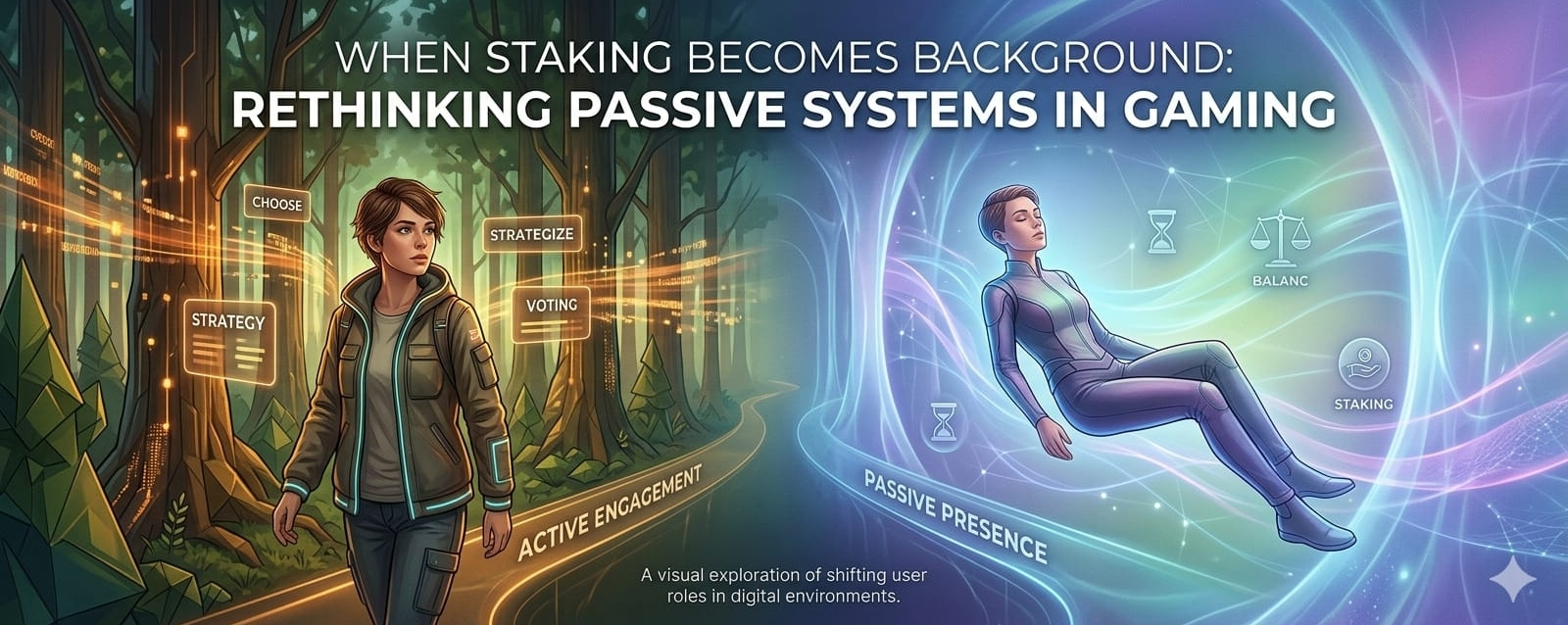
There’s a quiet shift happening in the way some games are designed, and you can feel it if you pay close enough attention. It’s not loud or disruptive. In fact, it’s the opposite—smooth, almost invisible. Systems like in-game staking don’t ask much from you. They just sit there, running in the background, doing their job while you go about everything else.
At first glance, it feels convenient. You hold your tokens, log in occasionally, and rewards arrive without effort. No constant decisions, no complicated steps. It’s frictionless by design. And that’s exactly what makes it interesting.
Because when effort disappears, something else changes too.
The moment a system stops asking for deliberate action, it often stops feeling like a choice. It becomes a habit. You don’t think about why you’re participating—you just are. Like opening an app out of routine or checking notifications without a clear reason. The behavior continues, but the awareness fades.
That’s where passive staking begins to feel less like engagement and more like presence.
You’re not actively involved, but you’re not absent either. The system only asks one quiet question: Are you still here? And as long as the answer is yes—through a login, a minimum balance, a small signal of activity—it keeps everything running. No pressure, no urgency. Just continuity.
There’s something subtle about that. It lowers the barrier so much that participation becomes almost automatic.
But then, layers start to appear.
Take mechanics like land-based boosts. On paper, they seem balanced—small percentage increases, capped limits, controlled advantages. Nothing extreme. But small advantages, when repeated over time, rarely stay small.
They accumulate.
A slight edge today becomes a noticeable gap later. Not because of sudden jumps, but because of steady, consistent reinforcement. And when players start recognizing that, their behavior shifts. What once felt like casual participation begins to lean toward optimization.
Land stops being cosmetic or symbolic. It becomes strategic.
And that’s where the system quietly evolves—from something you use into something you start to play around.
Even the timing of rewards plays a role in shaping this behavior. When rewards are distributed monthly, there’s distance. You stake, then step away. The system breathes. So do you. There’s room to forget, to disengage, to return without feeling like you’ve missed something immediate.
But shorten that cycle to daily rewards, and the rhythm changes.
Now there’s a pulse. A recurring signal. Something small, but consistent, that draws your attention back. Not forcefully, just persistently. It doesn’t demand engagement—it invites it, again and again.
And over time, that invitation can turn into expectation.
You check more often. You think in shorter intervals. You react instead of reflect. The system hasn’t become more aggressive—but it has become more present in your day-to-day thinking.
Another layer sits beneath all of this: trust.
When a system operates on your behalf, you’re no longer involved in every step. You’re relying on it to function correctly in the background. Most of the time, that trust goes unnoticed because everything works as expected.
But the moment something feels off—a delay, a mismatch, a moment of confusion—that invisible trust becomes very visible, very quickly.
And that’s where pressure begins to build.
Not extreme pressure, but the kind that comes from scale. From more users optimizing, more expectations forming, more interactions happening simultaneously. Systems don’t just operate in isolation—they evolve alongside the behavior of the people using them.
And behavior always evolves.
That’s what makes these systems so fascinating. They’re not just mechanics or features. They’re environments that shape decisions, influence habits, and gradually redefine what participation feels like.
None of this necessarily points to a problem.
But it does point to something worth noticing.
Because the most impactful changes are rarely the obvious ones. They don’t arrive with announcements or disruptions. They build quietly—through repetition, convenience, and small incentives that seem too simple to question.
And maybe the real question isn’t whether these systems work well.
It’s this:
At what point does a system stop being something we actively engage with…
and become something we simply move within, without even realizing it?