Most players chose their Union in under a minute.
No strategy, no real thought just a quick decision based on name, vibe, or where friends went.
That one moment feels small, but it quietly decides how much PIXEL you walk away with at the end of the season.
The game doesn’t warn you about it it lets the outcome explain it later.
Chapter 3 looks simple at first.
Three Unions compete to build their Hearth, and the moment one reaches 100%, the season ends.
Rewards are split instantly with 70% going to the winner and 30% to second place.
Third place barely gets anything.
This system doesn’t reward effort alone.
It rewards where your Union stands when everything stops.
As more players join the total reward pool increases.
On the surface, that sounds like a win for everyone involved.
But the structure never changes.
70 stays 70.
30 stays 30.
The opportunity grows, but the competition inside it becomes tighter.
Each Union runs on its own Yieldstone type, creating three separate resource systems inside the same race.
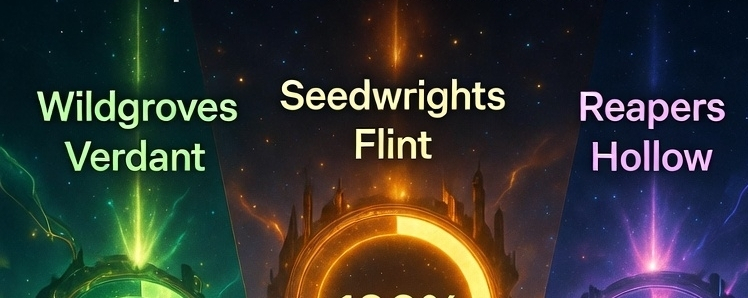
Wildgroves use Verdant, Seedwrights use Flint, and Reapers rely on Hollow.
You can earn these through daily tasks, or produce them if you have the right setup.
And that’s where the real gap starts to show.
Players with NFT land can run multiple Yieldstone Presses at the same time, generating output that simple grinding cannot match.
At that point, it’s no longer just about effort it is about capacity.
There’s also a mechanic most players overlook completely.
Every day, you receive not only your own Union’s stones, but also stones from rival Unions.
Most players ignore them. That’s where they lose value.
Those stones are designed for sabotage.
Depositing them into enemy Hearths reduces their progress and slows their path to 100%.
And the target is always the same. the leading Union.
If you are not slowing them down, you’re indirectly helping them win.
The system becomes more demanding through Offerings, which appear when a Hearth is under pressure.
These are time limited challenges that either accelerate progress or defend against incoming sabotage.
If a Union responds in time, it gains momentum.
If it doesn’t, it falls behind.
The game doesn’t force coordination.
It simply rewards the Unions that manage to act together.
Switching Unions exists, but it’s not a free solution.
After the first switch, it costs 50 PIXEL and locks you out for 48 hours.
In a live season, that delay is enough to miss key moments that define outcomes.
You lose contribution time.
You lose positioning.
And joining a winning Union late doesn’t guarantee rewards, because rewards are tied to contribution not just presence.
This is where most players misunderstand the system.
Being in the winning Union is not enough.
Grinding alone is not enough either. you need both.
Position and participation working together.
Without that, you stay active but earn very little. None of this is hidden.
The reward structure is public, the mechanics are documented, and the costs are clearly defined.
Every player has access to the same information from the start.
The difference is who actually uses it before making a decision.
By the end of the season, the results don’t feel random anymore.
They follow positioning, timing, and coordination.
And for most players, the most important decision wasn’t made at the end.
It was made in the first minute.