
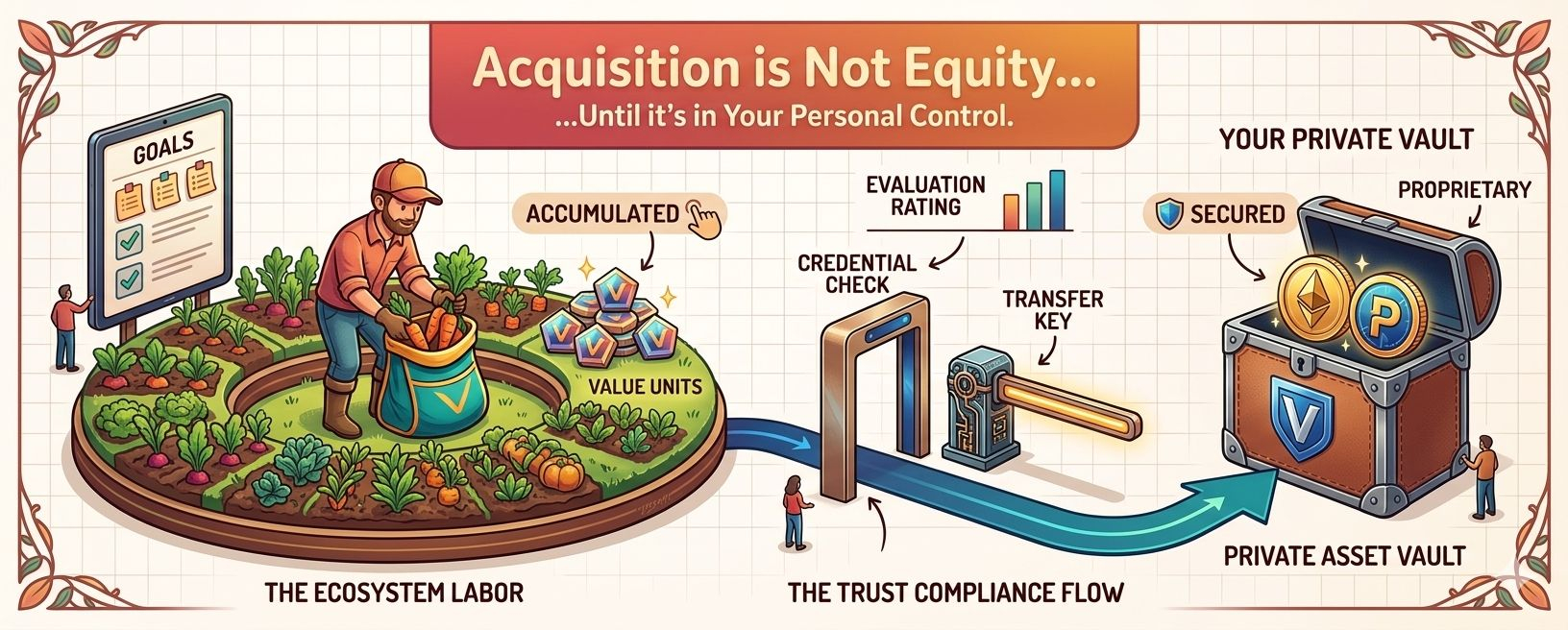
You Don’t Really Own It in Pixels… Until You Leave With It
At first, I didn’t think much about it — or maybe I did, but didn’t follow the thought all the way through. Because inside Pixels, earning feels straightforward. You complete a task, rewards show up, and it feels finished… like the value is already yours.
But over time, something starts to feel off.
Earning and leaving don’t feel like part of the same process — even though they revolve around the same token. There’s a gap between the two, and the longer you sit with it, the more noticeable it becomes.
Inside the game loop, everything flows effortlessly. It’s fast, responsive, almost frictionless. You act, you earn, value circulates. The system feels complete on its own.
But the moment you think about taking that value out — moving it beyond the game — the experience changes. It no longer feels smooth. It feels… conditional.
There’s always something in between.
Call it Trust Score, reputation, or internal validation — whatever it is, it doesn’t feel like just another feature. It feels like a checkpoint. And not everyone passes through it the same way.
Two players can do similar actions, complete similar tasks, and still experience completely different outcomes when it comes to exiting. One moves value out quickly. Another waits. Another gets slowed down without a clear reason.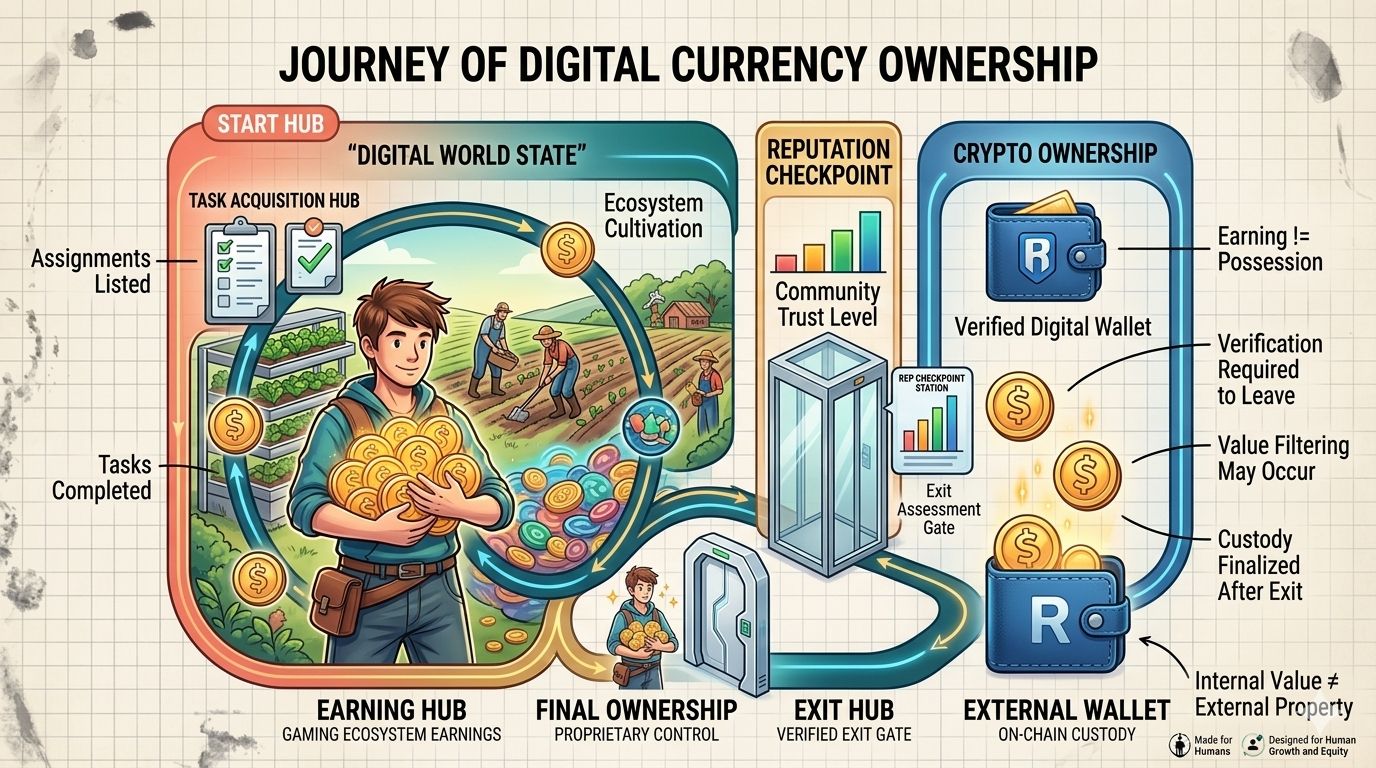
It doesn’t feel random. It feels observed.
The same effort… but a different exit.
And that shifts the question entirely: did you actually earn it — or did you just get access to it within the system?
Because if you can’t freely take it out, then maybe earning wasn’t the final step. Maybe it was just the middle of the process.
Over time, it starts to feel like the system isn’t only deciding what gets rewarded — it’s deciding what gets released. And those are clearly not the same decision.
You can sense that difference if you stay long enough. The system is comfortable letting value exist internally. But the moment that value tries to leave, the rules tighten.
And in a way, that makes sense.
Once value exits, it’s gone. It’s no longer part of the loop. It can’t be recycled, reused, or absorbed back into the system. It becomes final.
That’s why not everything that’s earned is meant to leave.
Even the in-game currency reflects this. It keeps circulating, absorbing activity, containing excess flow — not as a failure point, but as part of the design. A controlled layer where most value remains.
Which leads to a deeper realization: ownership might not happen when you earn.
It might only happen when you successfully exit.
Everything before that feels… provisional. Like you’re holding something that still belongs to the system until it decides otherwise.
And the system doesn’t block you outright. It doesn’t say “no.” Instead, it slows you down. It evaluates. It delays. Quietly.
Not denied — just not fully released.
That’s where this stops feeling like simple anti-bot protection and starts looking like economic control. Because bots are the easy explanation. The harder question is what happens to real players who don’t align with the system’s expectations.
Do they wait longer?
Do they stay inside the loop?
Does their value keep circulating until they “fit” better?
Over time, it starts to feel like exit isn’t purely technical — it’s behavioral.
It’s not just about what you do to earn, but how the system interprets your actions over time. Almost like you’re being evaluated — not explicitly, but through patterns.
And that leads to an uncomfortable idea:
Earning isn’t enough — you have to qualify.
Qualify for exit.
Because letting value leave has a cost. And the system seems aware of that. If too much exits too quickly, the balance breaks. We’ve seen that happen in other systems before.
So instead of controlling only rewards, the system also controls release.
Some value exits smoothly.
Some lingers.
Some never quite makes it out.
And you don’t always know why — you just feel it through friction, timing, and delay.
Once you notice this, it starts influencing how you play. Subtly. You adjust without realizing it. You think about reputation, consistency, behavior — not because you’re told to, but because somewhere you understand that exit isn’t guaranteed.
And that changes everything.
The loop is no longer just about earning — it’s about qualifying for ownership.
In most systems, once you earn something, it’s yours. Here, ownership feels delayed. Like it sits in a pending state until the system is ready to let it go.
Which leads to a bigger realization:
The real control point isn’t where you earn.
It’s where you exit.
That narrow space between in-game activity and on-chain settlement — where value isn’t just transferred, but approved.
Where the system decides:
This can leave.
This stays.
And once you see it that way, it’s hard to unsee.
The game loop is one layer.
Progression is another.
But exit… that’s where everything becomes real.
So now the question changes again — and this time it sticks:
It’s not about how much you can earn.
It’s about how much you can actually take with you.