

I didn’t think much about it at first. It just felt like another routine.
Log in, plant crops, wait, harvest, repeat. Sometimes I’d optimize a bit, sometimes I’d just go through the motions without thinking. It was relaxing in a way, but also predictable. The kind of loop you can step away from without feeling like you’re missing anything important.
And yet, I kept coming back.
Not because the actions were exciting, but because they accumulated into something over time. Still, that “something” felt vague. I was spending hours, making progress, but it wasn’t clear what that time actually translated into beyond the game itself.
At that moment, I realized most systems don’t really account for player time in a meaningful way. They track progress, rewards, levels—but time itself gets flattened. Whether you play efficiently or casually, intensely or passively, the system rarely distinguishes the quality or structure of that time.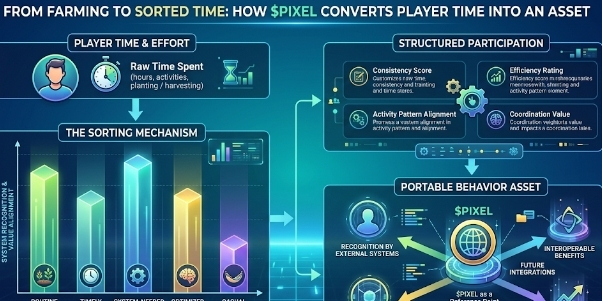
It just records outcomes.
That’s where something like @PIXEL started to feel slightly different, even if I didn’t immediately trust the direction.
Initially, I thought it was just a familiar farming loop with an added token layer. Another system where time equals rewards, and rewards eventually lose context. I’ve seen that pattern before, and it usually doesn’t hold up.
But the more I paid attention, the more it seemed like $PIXEL wasn’t just measuring what you earned—it was indirectly shaping how your time is organized and recognized.
Not in an obvious way, but through structure.
Certain activities yield different outcomes, not just in quantity but in how they fit into the broader system. Some actions seem to carry more weight, others less, depending on timing, demand, or coordination with what the system needs.
So time isn’t just spent—it’s sorted.
That distinction is subtle, but it changes how I think about the loop.
Instead of all player time being interchangeable, it starts to feel categorized. Productive in one context, less relevant in another. Not because the system explicitly ranks it, but because the outputs align differently with what’s happening overall.
$PIXEL, in that sense, acts like a reference point. It doesn’t just reward activity—it reflects how that activity fits into a larger pattern. What you earn becomes tied not only to effort, but to where that effort sits within the system.
What I find interesting is that this doesn’t feel forced.
You can still play casually. You can still ignore optimization. But over time, patterns emerge. Some players naturally align their actions with what the system seems to favor. Others drift. And those differences begin to show up in outcomes.
Still, I had doubts.
If players aren’t consciously aware of this “sorting,” does it actually matter? If it’s not visible, is it meaningful, or just an internal mechanism that doesn’t translate into real impact?
Initially, it felt like an overcomplication of a simple loop.
But upon reflection, the value might not be in visibility, but in consistency.
If player time can be interpreted, even loosely, then it becomes something other systems could eventually reference. Not just how much time was spent, but how it was spent. What kind of actions, under what conditions, producing what results.
That starts to look less like gameplay data and more like a form of structured participation.
And if that structure is anchored through something like Pixel then it becomes portable. Not easily, not immediately, but potentially. A way for different environments to recognize not just ownership or assets, but behavior.
You could imagine systems responding differently based on that. Not because they share databases, but because they reference the same underlying signals.
But I don’t think this is guaranteed to work, at least not yet.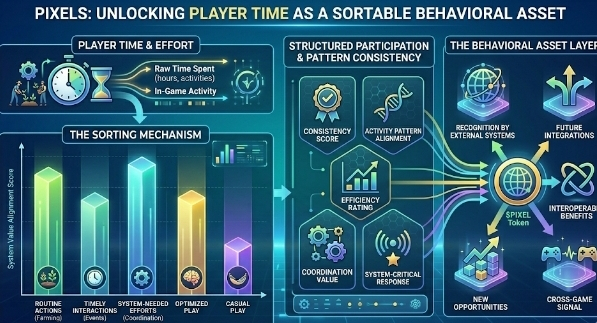
There’s a lot of friction in turning player behavior into something broadly useful. Most systems are still isolated. And even if the data exists, interpreting it consistently across environments is another challenge entirely.
There’s also the question of whether players want their time to be “sorted” at all, or if they prefer it to remain loosely defined and personal.
Right now, I’m still observing.
I hold a small amount of pixel , mostly to stay close to how this system evolves. I’m not fully convinced that player time becomes a meaningful external asset, but I can see the early shape of it forming.
For me, the real signal is simple.
If over time, players begin to adjust how they spend their time—not because they’re told to, but because the system consistently rewards certain patterns—and if those patterns start to matter beyond the immediate game, then something deeper is happening.
Not just farming.
But a system quietly turning time into something structured, something recognizable, and maybe eventually, something other systems begin to rely on.