
At first, PiXeL does not look especially mysterious.It looks like the kind of game loop most people understand almost immediately.You log in, move through familiar tasks, manage resources, make small decisions, and repeat actions that start feeling natural after only a short time.On the surface, it carries the rhythm of routine.There is work, there is reward, there is visible progression.Nothing about that seems unusual. In fact, that familiarity is probably the reason the deeper part stays hidden for a while. The loop is ordinary enough that you do not immediately stop to ask what the system is really noticing while you are inside it.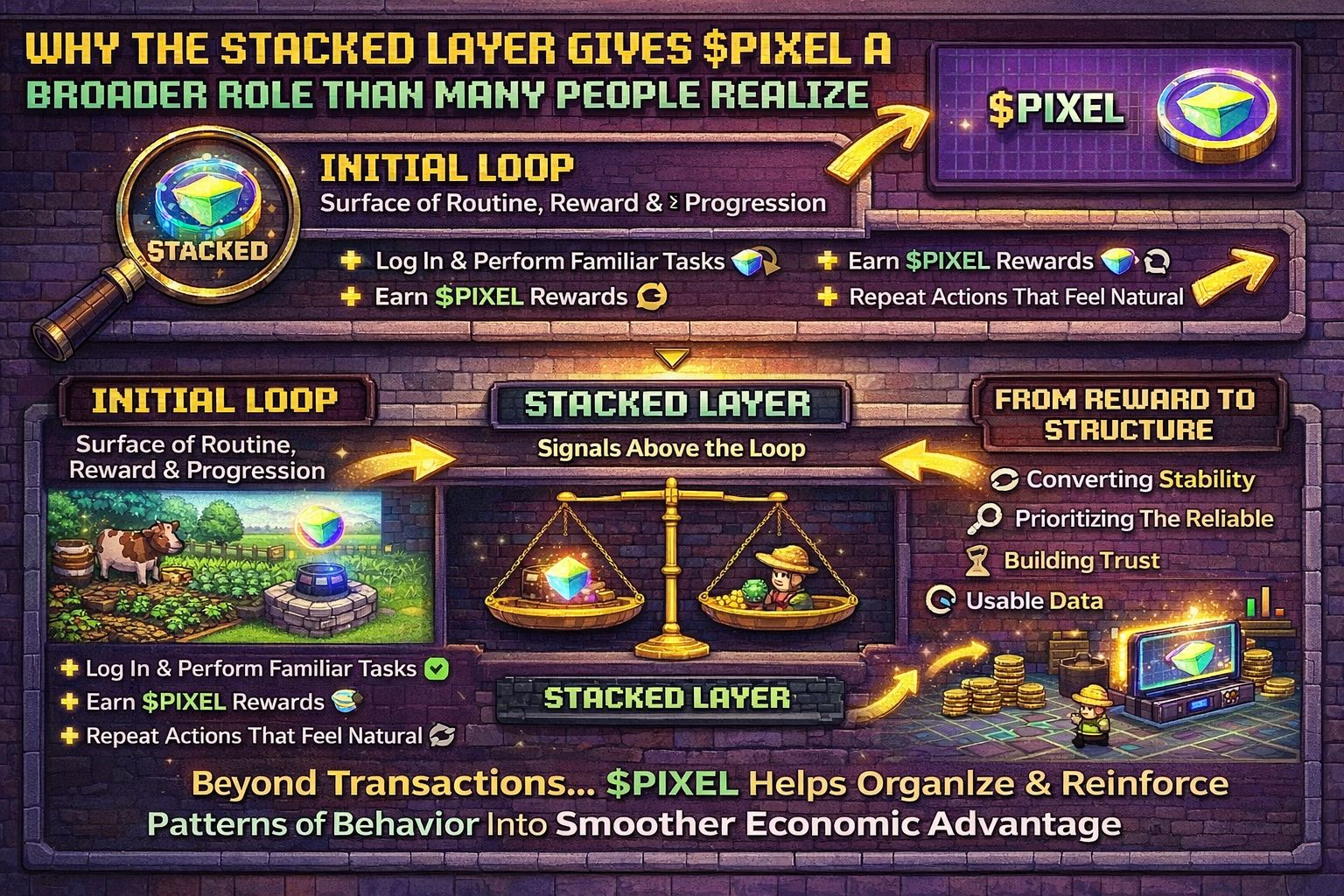
What made me pause was not some dramatic imbalance or obvious flaw........ It was something quieter than that. After spending more time with Pixels, I started noticing that two players could seem similarly active without the game treating their time in the same way............. I do not just mean differences in strategy, knowledge, or luck. I mean a subtler difference in how activity appears to settle into the system. Some forms of participation seem easier for the game to absorb. Certain routines start producing smoother outcomes, less friction, more continuity. Other patterns remain technically active but somehow feel less aligned, less reinforced, less cumulative. The result is not brokenness. It is a kind of quiet sorting.
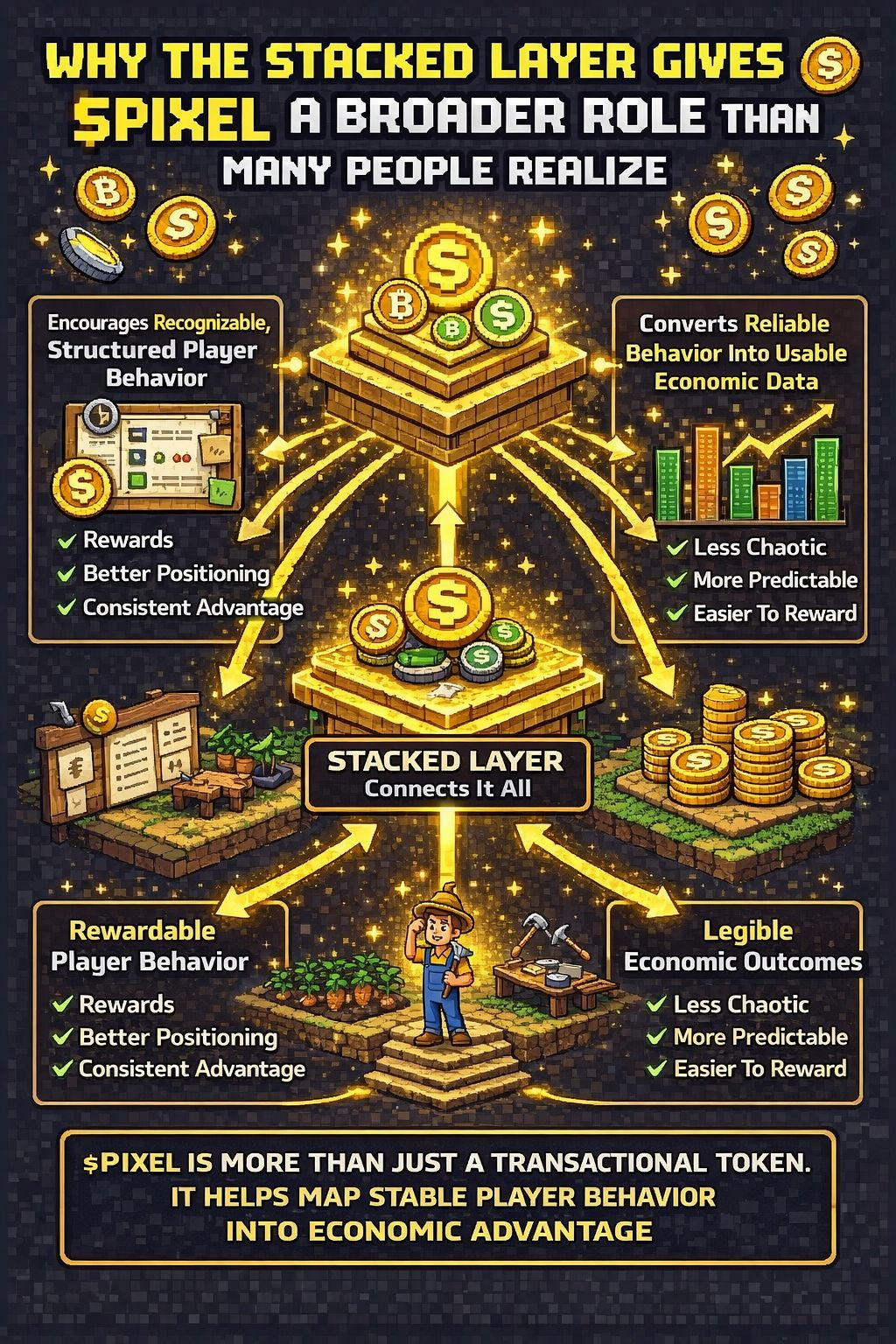
That changed how I began thinking about PiXEL. It started making less sense to me as a simple reward token and more sense as part of a wider layer that helps organize behavior. The interesting question stopped being how much activity gets rewarded and became something more structural: what kind of activity becomes legible enough to be treated as valuable over time.That is where the Stacked layer starts to matter more than many people realize. Once I began looking at Pixels through that lens, Stacked stopped feeling like a side feature attached to the economy. It started feeling more like an interpretive layer sitting above player behavior, helping the system decide which forms of engagement deserve reinforcement, continuity, and economic weight.
I think that distinction matters because not all time inside a game is equal in practice, even when it looks equal in hours. One hour spent chaotically, with no rhythm, no continuity, and no relation to broader system needs, does not produce the same downstream effect as one hour spent in a pattern the system can read, anticipate, and reuse. That is the part I keep returning to. Pixels may not just be rewarding effort. It may be evaluating the form effort takes once it passes through repeated loops. Time stops being a neutral input and starts becoming a shaped signal. Structure begins to matter. Reliability begins to matter. Repetition, when it becomes consistent enough, starts looking less like habit and more like usable data.
The easiest analogy I can think of is not from crypto at all. It is closer to the way large online marketplaces quietly rank sellers. On paper, every seller is simply listing products. But over time, the platform starts treating some sellers differently, not only because they sold more, but because their behavior became dependable. They ship on time. They respond predictably. Their patterns are easier for the platform to trust, surface, and build around. Eventually, the platform is not just hosting them. It is leaning on them.Their reliability becomes part of the system’s operating logic. I get a similar feeling when I think about what the Stacked layer may be doing inside Pixels. It may be taking repeated player behavior and translating it into something the ecosystem can sort, prioritize, and quietly build around more efficiently.
That possibility gives $PIXEL a broader role than many people first assume. A token usually gets discussed in transactional terms. People ask whether it is spent, earned, burned, locked, or circulated. Those questions matter, but they may not reach the deepest function here. If the system is using $PIXEL inside a wider architecture that connects incentives to recurring patterns of behavior, then its utility is not only transactional. It becomes behavioral. It helps convert certain forms of stable participation into smoother progression, better positioning, or more consistent economic advantage inside the ecosystem. In that case, the token is not simply paying for activity after the fact. It is participating in the way activity gets classified and reinforced in the first place.
That would also explain why progression can start to feel smoother once a player settles into a pattern the game can read clearly. At that point, it no longer feels like the system is reacting to isolated actions. It feels like it is responding to a profile of behavior. Not a public profile in the social sense, but a structural one. A rhythm. A pattern of return. A reliable way of participating. The player is still playing, but their time is no longer arriving as random fragments. It arrives in a form the system can process more efficiently. And once that happens, the game may begin rewarding not just what the player does, but how recognizable their behavior becomes across time.
This is where the idea becomes more interesting, but also more uncomfortable. A system that gets better at recognizing stable patterns can produce efficiency, but it can also narrow the field of acceptable behavior............. When some routines become easier to evaluate and therefore easier to reward, experimentation can start losing ground. Play styles may slowly converge, not because anyone is forced into conformity, but because the system quietly smooths one path more than another. The danger is not overt control. It is soft selection. Players drift toward what works, and what works may increasingly mean what the system can measure with the least ambiguity.
That creates a real tension between efficiency and freedom. A game economy cannot remain coherent if everything is equally rewarded regardless of structure. Some filtering is inevitable. But the more deeply a system organizes around predictable behavior, the more it risks turning creativity into noise. Invisible evaluation systems are powerful precisely because they do not need to announce themselves. They operate through outcomes. One routine compounds. Another remains flat. One player feels carried by momentum. Another feels oddly static despite comparable effort. Over time, that can reshape the culture of play without ever looking like a rule.
It also makes token value harder to read. If pixel is doing more than mediating purchases or payouts, then its value cannot be understood only through direct transactional utility. Part of its role may lie in how it helps map behavior onto economic outcomes.That is harder to price because it is less visible. A token with behavioral utility does not just move through an economy. It helps organize the terms under which some participants become more economically legible than others. That is a subtler form of power, and also a more difficult one to evaluate from the outside.
I do not say any of this as criticism in the simple sense. Every functioning system has to decide what it notices, what it retains, and what it reinforces. My interest is more in what Pixels may be optimizing beneath the visible loop. The obvious output is farming, crafting, trading, and progression. The less obvious output may be a cleaner map of behavior itself. A way of learning which players generate patterns that can be trusted, predicted, and economically integrated. Seen that way, the Stacked layer is not just adding rewards on top of gameplay. It may be helping turn gameplay into a more structured coordination surface.
That is why I think the role of Pixel may be broader than it first appears. It may not only compensate participation. It may help convert stable behavior into usable position inside the ecosystem. And that possibility changes how the whole loop looks to me. What first appears to be a simple cycle of play and reward may actually be producing something quieter and more valuable to the system: not just tokens, but behavior that has become organized enough to be recognized, sorted, and reused.