
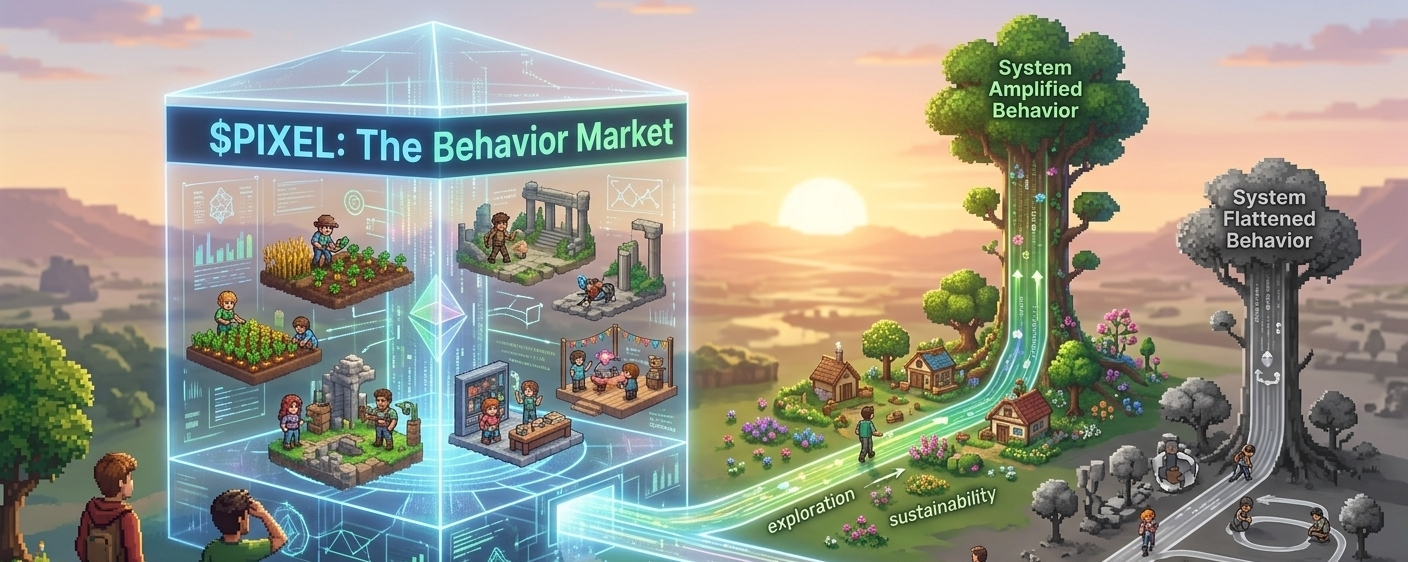

The first time I watched someone play Pixels, I remember feeling a little thrown off by how relaxed it all looked.
Nothing felt urgent. Nothing was screaming for attention. There weren’t any obvious pressure points, no constant push to spend, no sense that the game was trying to force you into a certain pace. At first, it almost felt like the system didn’t really care how you played.
But the longer I watched, the less true that felt.
Because even though everything looked calm on the surface, some players clearly ended up in better positions than others. Not just because they moved faster or grinded harder, but because they seemed to be doing the kind of things the system kept opening up for.
That’s the part I think a lot of people miss.
We still talk about game tokens in a very old way. Usually it comes down to speed: pay to move faster, earn to keep playing, leave when the rewards stop making sense. That framework is familiar, but it also tends to fall apart in familiar ways.
What feels more interesting is when a system stops caring so much about speed and starts quietly favoring certain behaviors over others.
That’s what Pixels has started to feel like to me.
Most game economies don’t really care what you’re doing. They care that you’re doing something repeatable. Farm more, get more. Grind longer, earn more. The system doesn’t really ask whether that behavior is good for the game, good for the economy, or even worth encouraging. It just measures output.
And honestly, I think that mindset has done more damage than inflation itself.
Because when every action gets rewarded more or less the same way, players stop thinking about what actually matters. They stop experimenting. They stop engaging with the world in a meaningful way. They just find the easiest loop and run it until it stops working.
In Pixels, I don’t think every loop is being treated the same anymore.
Some activities start to feel heavier over time, like they’re still there but not really leading anywhere. Others feel like they keep opening doors. The longer you stay in them, the better your position seems to get. That difference is subtle, but once you notice it, it changes the way the whole economy feels.
It stops being about doing more.
It starts being about doing the kind of thing the system seems willing to keep rewarding.
I’ve been trying to find the cleanest way to describe that, but it sits in an awkward middle space. It’s part incentive design, part behavior sorting. And PIXEL feels like it sits right in the middle of that process.
Not just as a reward token. Not just as a utility layer. More like the thing through which the game reinforces certain patterns and lets others fade out.
That sounds abstract until you compare it to something outside gaming.
Think about platforms like TikTok or YouTube. Not everything grows evenly there either. The platform doesn’t reward effort in a pure sense. It rewards what fits its own logic of amplification. Most creators never get a full explanation for why one thing takes off and another doesn’t, but they adjust anyway. Over time, the platform shapes behavior without ever needing to say it directly.
Pixels is starting to feel a little like that.
Just slower. Quieter. Less obvious.
Instead of a visible algorithm pushing things around, the game seems to do it through economic signals. Rewards shift. Access shifts. Some forms of play start compounding into better outcomes, while others stay stuck in place. You can still do whatever you want, technically, but that doesn’t mean every path is equally alive.
That’s where PIXEL starts becoming more than just a utility token.
It starts to feel like a way the game prices attention not social attention, but system attention. Which behaviors does the game keep responding to? Which ones does it gradually stop caring about? That matters more than people think, even if it’s harder to point to directly.
For a long time, I assumed demand for a token like this would mostly come from the obvious stuff: more players, more spending, more transactions.
That still matters, sure.
But structurally, I think something else matters more: whether players believe the way they’re playing will still make sense later.
If they believe that, they keep building inside the system. If they don’t, they start playing more defensively. Or worse, they start extracting.
And that’s where this gets risky.
Because if Pixels starts reinforcing the wrong behaviors, the failure probably won’t show up right away. Players won’t necessarily complain. They’ll adapt first. They’ll figure out what the system wants, reduce it to the shortest possible loop, and repeat it until the whole thing becomes hollow.
That’s how a lot of play-to-earn systems died.
Not because nobody understood them, but because people understood them too well.
There’s also a transparency issue here that I still can’t fully sort out in my own head.
The more selective a system becomes, the less predictable it feels. Sometimes that’s good. It makes shallow exploitation harder. But it can also create this quiet frustration where players can tell there’s a better way to position themselves, but they can’t quite see what it is.
And once that happens, behavior itself becomes speculative.
Not just the token. Not just the market. The way you play the game.
Maybe that’s the real shift.
Maybe PIXEL isn’t just sitting on top of gameplay anymore. Maybe it’s becoming part of the mechanism that decides which kinds of gameplay get to scale at all. Some loops keep expanding. Others flatten out. And once that gap starts compounding, the economy stops feeling like a simple reward system and starts feeling more like a filter.
I don’t know if that was intentional.
Maybe it was designed this way. Maybe it just emerged over time.
But once you see it, it’s hard to look at the game the same way again.
And it leaves me with one question I can’t really shake:
If the system is always deciding which behaviors deserve to grow, then when does playing stop feeling like exploration and start feeling like trying to stay in sync with something you can sense, but never fully see?
