
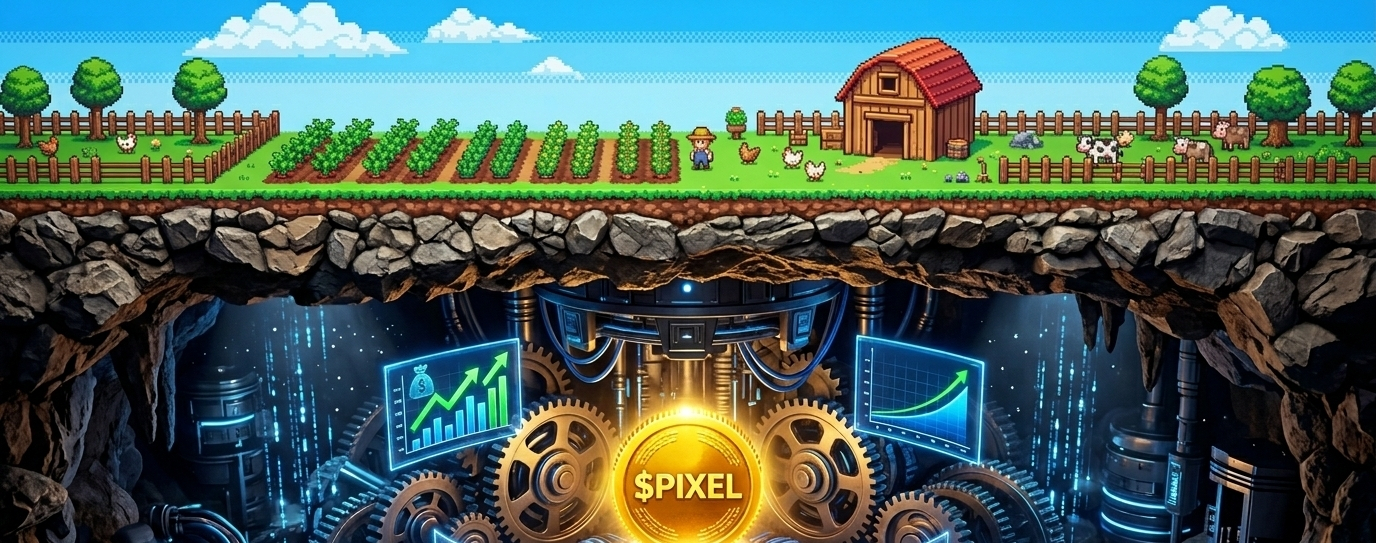
Hook: Most people still think Pixels is a game about watering crops. That view is about two years out of date. The real story isn't happening in the fields—it's happening in the infrastructure layer quietly being assembled underneath. And that layer changes everything about how we should value $PIXEL.
For a long time, the narrative around Pixel's was straightforward: a cozy farming sim with a token attached. That was never wrong, but it was always incomplete. The team wasn't just building a game. They were stress-testing a thesis: can you attach real value to a virtual world without the entire economy collapsing under bots, farmers, and extractive behavior?
The answer, after years of live experimentation and hundreds of millions of processed rewards, is Stacked.
The Problem Stacked Solves
Most Web3 games fail for the same reason. They launch a token, attach a quest board, and watch the economy drain. Play-to-earn, in its raw form, optimizes for extraction. Players arrive for yield. They leave when yield dries up. The game was never the point.
The Pixel's team lived through this. They watched bots game the system. They saw reward budgets leak to users who never intended to stay. Stacked is the product of those scars—a rewarded LiveOps engine with an AI game economist on top designed to answer one question: Who should get rewarded, for what, when, and with what kind of reward?
The AI Differentiator
The real edge inside Stacked is the intelligence layer. Studios gain access to an AI game economist that analyzes cohorts, spots churn patterns, and suggests experiments worth running. Why are whales dropping between Day 3 and Day 7? Which mechanics correlate with long-term retention? Ask the system. Get answers. Run campaigns. Measure lift. Insight to action, no waiting.
What This Means for $PIXEL
In a single-game economy, a token's fate is tied to one title's popularity. Stacked rewires that risk. It positions Pixels as B2B infrastructure for Web3 gaming.
Pixel sits inside this engine as the cross-game loyalty currency. As more studios plug into Stacked—joining Pixels, Pixel Dungeons, Sleepagotchi, and Chubkins—demand surface expands. More games mean more sinks, more utility, more reasons for the token to move.
Long-term, Pixel becomes more staking-centric—a governance and loyalty asset aligning participants with ecosystem growth. This isn't dilution. It's maturation.
The Moat Is Real
Here's the line that separates Stacked from whitepaper projects: Built in production, not in a deck.
The fraud prevention, anti-bot logic, behavioral data at scale—these are battle-tested. Stacked has processed hundreds of millions of rewards and helped drive $25M+ in revenue. Most teams can ship a quest board. Few can build a reward system that survives real adversarial usage. Stacked already has. That scar tissue is the moat.
The Quiet Engine
The market chases spectacle. Stacked is quiet infrastructure—the engine humming under the hood while players tend crops or explore dungeons. But quiet engines run longest.
Pixel is no longer just a game. It's evolving into a shared rewards layer across a growing ecosystem. Pixel isn't searching for utility. It's busy powering it.
The farm was the proof of concept. Stacked is the product. That's a different kind of bet entirely.