
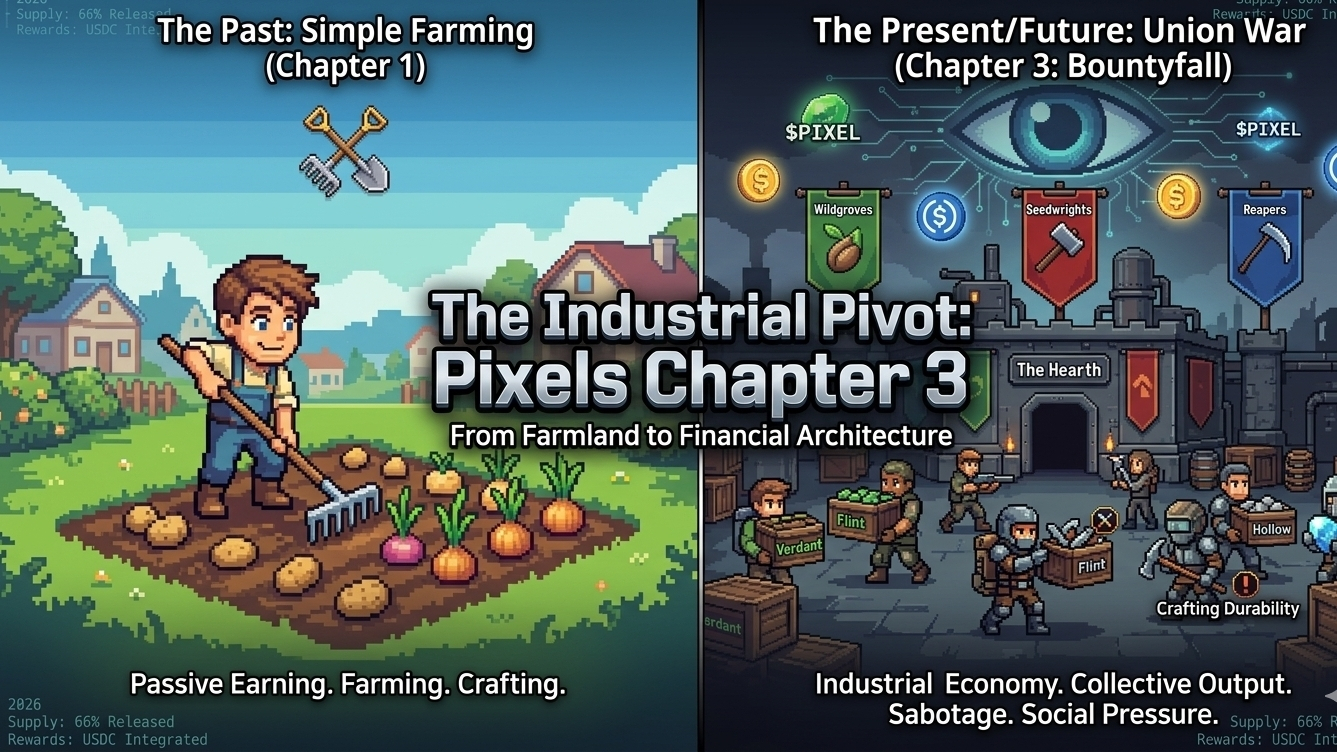
Pixels Chapter 3: Bountyfall is finally here and this isn't just a game update. It's a union war, an economy experiment, and the most interesting test case in Web3 gaming in 2026. Seedwrights run on discipline, Wildgroves let nature find its own path, and Reapers? They straight up tell you life and death are the same harvest. So the real question is: where do you stand?
The Real Shift From Farming to Faction War
I'll be honest when Pixels first showed up on the radar, the instinct was to file it under "next P2E flop." Cute pixel graphics, some token rewards, then a slow death. We've heard that story before.
But Chapter 3: Bountyfall has pushed the game in a completely different direction. The real turning point isn't any single new feature it's the way everything connects to everything else. Passive farming has been replaced by a structured digital economy where every player's decision affects someone else.
It's not just a game. It's a multi-layer system.
Yieldstones, Sabotage, and the War for Terra Villa
Chapter 3's core mechanic looks simple on the surface — but underneath, it's carefully engineered.
There are three Unions:
Wildgroves (Verdant Yieldstones),
Seedwrights (Flint Yieldstones),
and
Reapers (Hollow Yieldstones).
Each Union has its own Hearth in Terra Villa, and the mission is to push your Hearth to 100% health before anyone else does.
Here's where the economy gets interesting. Players deposit Yieldstones into their own Union's Hearth to boost its health — but they can also drop the wrong Yieldstone into an enemy Hearth to damage rival progress. To defend against this sabotage, players can purchase Defense Offerings from the Chamber Shop.
This means the game is not just cooperative it's actively competitive. Build your team, try to break the other team, and keep the economy running at the same time. Yieldstones are non-tradable and can only be earned through gameplay, either by completing taskboard tasks or by crafting on NFT lands. That's a smart design call — you can't buy your way around the system from the outside.
Crafting Durability, Inventory Caps, and Speck Upgrades all three existing economic sinks are now more tightly woven into the Yieldstone system. Spend resources to work, earn rewards, feed them back into the system. The economy breathes but the breathing is controlled.
Stacked When AI Becomes the Reward System's Security Guard
One problem that used to kill every P2E game was bots and fake accounts. Rewards meant for real players ended up in automated farms instead.
Stacked is the answer to that problem an AI-powered rewards platform built to separate real players from bots. In the March 2026 AMA, Pixels CEO Luke Barwikowski confirmed that bots collecting rewards was a genuine ongoing issue, and that Stacked is specifically designed to target the most loyal and genuine users.
On the backend, Stacked uses a data SDK that tracks player activity and combines it with anonymized historical data from the Pixels ecosystem enabling bot detection, player segmentation, and precise reward attribution.
Right now, roughly 20% of rewards are distributed through Stacked, 50% through the taskboard, and the rest through activities like Neon Zone and Merchant Ships but the team's plan is to eventually move everything into the Stacked system.
This shift matters. An AI deciding who gets rewarded, when, and how much sounds fairer in theory. But I'll be honest opacity carries its own risk. When players can't understand why their reward rate changed, trust starts to crack.
Union War = Social Pressure + Economic Incentive
Faction systems in games aren't new but Pixels has tied them to an economic layer that makes things genuinely interesting.
When a Union reaches 100% Hearth Health and wins the season, the first-place Union takes 70% of the prize pool, second place gets 30%, and third place receives only starter Yieldstones for the next season.
That structure means your earnings don't just depend on your own effor they depend on the collective decisions of thousands of other players. That's social pressure wrapped in financial stakes. Even a casual player starts contributing more simply because their Union is watching. It's a smart, non-monetary retention tool.
PIXEL, USDC, and the Supply Reality
By April 2026, 66% of total $PIXEL supply is already in circulation. That's a serious challenge for emission management and Pixels knows it.
That's partly why the team has shifted toward USDC rewards alongside the native PIXEL token. Stablecoin yield reduces the reflexive sell pressure that token-only reward systems tend to create.
PIXEL staking has also become productive in a new way — stakers now directly influence which games receive resources and incentives from the Pixels ecosystem, as part of a decentralized publishing model rolling out in phases.
Honest Take — Will This Actually Hold?
Bountyfall's design is impressive. The sinks, the Union wars, Stacked's AI filter, USDC rewards everything is pointing in the same direction. This isn't a P2E model that survives only on new player entry.
But one question hasn't been honestly answered yet: can a tightly engineered economy ever actually feel natural?
The most successful games in history Stardew Valley, Minecraft never felt designed. They felt discovered. Pixels Chapter 3 has built a genuinely impressive machine. But the real test isn't whether the economy holds it's whether players one day forget they're inside one.
Now you tell me which Union are you fighting for? Wildgroves, Seedwrights, or Reapers? Drop it in the comments. ⚔️
#pixel #Pixels #web3gaming #PlayToEarn @Pixels $PIXEL
