

A Game That Moves At Your Pace
When people talk about Web3 games, they usually focus on systems, tokens, and earning. It often sounds like the goal is to prove that a new kind of economy works. But when you actually sit inside most of these games, something feels missing. The world feels tight, almost mechanical. Every action seems to point toward a reward, and after a while, it becomes predictable. You stop feeling like a person inside a world and start feeling like a function inside a system.
Pixels feels different in a quiet way. It does not try too hard to show you what it is doing. On the surface, it looks simple. You farm, you gather, you craft, you move around, you interact with other players. These are familiar actions, nothing complicated or new. But the way they connect over time changes how the experience feels. The game does not rush you. It does not constantly push you toward a single path. It lets you settle into your own rhythm.
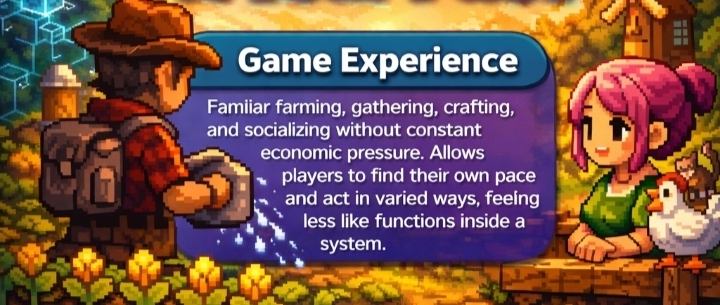
That rhythm is where something more human starts to appear. People do not behave in perfectly optimized ways. Sometimes they play seriously, sometimes casually. Sometimes they focus on efficiency, sometimes they just wander. Pixels leaves space for all of that. You can spend time improving your setup, or you can move slowly and explore. You can focus on earning, or you can simply build a routine that feels comfortable. The system does not punish you for choosing your own pace, and that small freedom changes everything.
In many Web3 games, value is always in front of you. Every action is measured, every step is tied to a clear output. Over time, this shapes behavior. Players stop experimenting and start calculating. They follow the most efficient path because the system makes it obvious. The world loses its depth because everything becomes a means to an end. Pixels steps slightly away from that. It still has an economy, it still has rewards, but it does not constantly demand that you think about them. Instead, value builds slowly through what you choose to do and how consistently you show up.
The way the game works is simple enough to understand, but layered enough to grow over time. You perform actions that produce resources. Those resources can be used, traded, or saved for later. Some activities take time, some depend on where you are, some depend on what you have access to. As you continue, you naturally start to lean into certain roles. You might become someone who focuses on farming, or someone who trades, or someone who explores. The system does not force these roles on you, they just emerge from your behavior. That makes the world feel less like a set of instructions and more like a place where patterns form on their own.
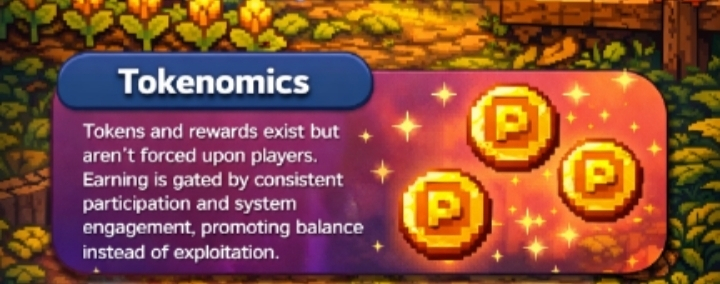
The token side of Pixels follows this same idea. There is a token, there are rewards, but earning is not completely open from the start. You need to engage with the system, understand it, and stay consistent. This creates a kind of filter. It slows things down, which can feel frustrating at first, but it also protects the system from being drained too quickly. In a broader sense, this is about balance. A token economy needs to distribute value, but it also needs to keep people engaged over time. If everything is too easy, it collapses. If everything is too hard, people leave. Pixels tries to sit somewhere in between.
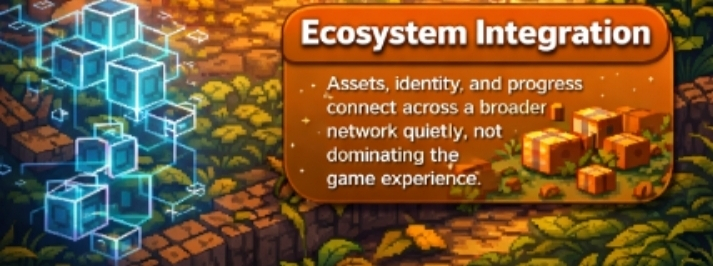
Around the game, there is also a larger structure. Assets can exist beyond a single session, progress can carry meaning, and the system connects to a wider network. But what stands out is how quietly this is handled. You are not constantly reminded of ownership or technical details. They are there when you need them, but they do not dominate the experience. This separation keeps the world from feeling too transactional. It allows the player to focus on what they are doing, rather than what everything is worth at every moment.
Looking ahead, the real challenge for a system like this is not growth, but balance. Adding more content is always possible, but keeping the same feeling is harder. If too many incentives are added, players will narrow their behavior again. If too few are added, the system can lose energy. The direction forward depends on maintaining that space where players can still move naturally without being pushed into a single way of playing.
There are risks, and they are not dramatic, they build slowly. If certain activities become too rewarding, everyone will move toward them, and the diversity of behavior will disappear. If rewards become too weak, people may lose interest. There is also the constant pressure from outside, where many players arrive expecting quick returns. Managing that expectation without breaking the system is not simple. It requires constant adjustment and careful observation of how people actually behave, not just how they are expected to behave.
What makes Pixels stand out is not that it avoids these problems completely, but that it approaches them with a different mindset. It does not treat players like perfect economic actors. It allows for inconsistency, for routine, for small personal choices that do not always make sense on paper. It accepts that value is not always immediate, and that time plays a role in how things develop.
When things become unstable, which happens often in the broader crypto space, systems are tested. If a game relies only on rewards, players leave when those rewards shrink. But if a game has something more, a sense of place, a sense of routine, a sense that time spent there has meaning beyond just output, it holds together longer. Pixels leans in that direction. It builds a system where behavior matters as much as rewards, and where the player can exist without constantly proving something.
That is why it feels more human. Not because it removes structure, but because it softens it. It creates a space where people can act in their own way, even inside a system that still runs on rules. And in a world where most Web3 games still feel like experiments trying to justify themselves, that quiet shift toward something more natural may be what actually lasts.